Invicta Water discusses its pioneering technology to eliminate PFAS contamination across various water sources in the Carolinas, breaking them down at the molecular level without producing hazardous waste.
For decades, communities across the United States have struggled with a silent problem flowing through their taps, their rivers, and their soils. PFAS – per- and polyfluoroalkyl substances – earned the nickname ‘forever chemicals’ because they don’t break down naturally and are now found in the blood of nearly every American. Linked to cancer, immune dysfunction, and developmental harm, PFAS contamination has become one of the most pressing public health and environmental issues of our time.
While many technologies can capture PFAS, almost none can destroy them within the same process train. And those technologies that can only capture PFAS, simply shift the problem elsewhere – into landfill waste, incinerators, or concentrated brine streams. But one North Carolina company has found a path not just to remove PFAS, but to eliminate them entirely.
Invicta Water, headquartered in Burlington, NC, is rapidly gaining national attention for a technology platform that breaks PFAS apart at the molecular level. Their system, based on years of research in materials science and photocatalysis, is already operating in multiple real-world projects across the Carolinas – ranging from small community well systems to large-scale industrial wastewater facilities.
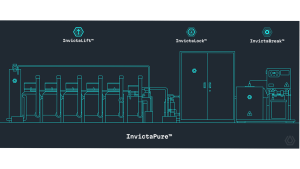
The company describes its approach with three simple words: Lift, Lock, Break.
A different way to think about PFAS treatment
Where commonly applied PFAS removal technologies require filters, carbon, resins, or high-pressure membranes, Invicta Water’s system works by first pulling PFAS out of water (‘Lift’), then concentrating it into a highly enriched phase (‘Lock’), and finally using a patented photocatalytic process to break PFAS down into harmless components (‘Break’).
Unlike thermal or incineration methods for destruction, the process operates at ambient temperature and atmospheric pressure, making it significantly more energy-efficient and adaptable to a wide range of flow rates.
“What makes this approach notable,” say multiple municipal partners, “is that it doesn’t produce a secondary waste stream.” Instead of generating PFAS-laden carbon or RO concentrate with nowhere to go, Invicta’s system aims to leave nothing behind.
This philosophy – true destruction rather than displacement – is driving interest from utilities, regulators, and industrial operators who face rising regulatory pressure and growing community expectations.
From small town wells to million-gallon systems
Invicta Water’s value is no longer theoretical. It’s being proven across an expanding portfolio of field projects.
In South Carolina, the company has five drinking water projects treating between 10,000 and 15,000 gallons per day each. These small systems illustrate the modularity of the Lift–Lock–Break platform, showing that even small rural communities can deploy destruction technology without major infrastructure changes.
In North Carolina, the Town of Cary is hosting one of Invicta’s most widely watched pilots – a 100,000-gallon-per-day drinking water treatment system. Cary, which draws water from Jordan Lake, has been proactive in addressing PFAS after statewide testing revealed elevated concentrations in several Triangle-area water sources. Early reports from the site indicate the system is performing well, with non-detect results verified by third-party laboratories.

Wastewater treatment presents a tougher challenge, but Invicta is tackling that, too. In Burlington, NC, the company operates a 200,000-gallon-per-day wastewater system. Wastewater carries a broader mix of chemicals, temperature fluctuations, and organic load – factors that historically make PFAS treatment less predictable. Demonstrating consistent destruction in this environment is a major technical milestone.
But the largest and perhaps most consequential deployment to date is at a private industrial facility in South Carolina. There, Invicta Water has installed a system capable of treating over 1,000,000 gallons per day of PFAS-laden industrial wastewater. For industry sectors such as textiles, coatings, chemicals, aerospace, and semiconductor manufacturing – where PFAS use is widespread – this scale of treatment is vital.
“This is where the technology moves from a pilot to a platform,” industry analysts note. “Treating a million gallons a day shows that a destruction-based PFAS solution can compete in real-world operations.”
Taking on the hardest PFAS problems: AFFF, RO Concentrate, and legacy sites
Beyond drinking and wastewater, the company is also working on some of the most difficult PFAS challenges.
A state- and federally funded Invicta Water project is focused on destroying Aqueous Film Forming Foam (AFFF) – the firefighting foam historically used at military bases and airports. AFFF contains some of the most recalcitrant PFAS compounds ever manufactured. Demonstrating destruction in these concentrated solutions is considered a technical benchmark in the industry.
In another North Carolina project, Invicta is addressing contaminated retention ponds at a former textile mill that has sat idle for more than 25 years. The ponds contain decades-old industrial discharge – complex, persistent, and representative of contamination found at legacy sites across the Southeast.
The company is also working with North Carolina partners on landfill leachate, one of the most challenging PFAS matrices due to its high organic content and variability. Traditional PFAS treatment methods often fail in leachate because they rapidly foul or degrade.
Finally, Invicta has completed multiple demonstrations treating reverse osmosis (RO) concentrate, a waste stream with some of the highest PFAS levels found in municipal systems. Successfully destroying PFAS in RO concentrate is critical for utilities that rely on RO but have limited options for managing the resulting brine.
Together, these projects create a compelling case: Invicta Water’s technology can treat any PFAS concentration – from parts-per-quadrillion drinking water to the extreme levels found in AFFF.
Scaling toward full commercialisation
Every one of Invicta’s projects – whether for a small water district, a major municipality, or a private industrial customer – uses the same core Lift–Lock–Break technology. Only the footprint and flow capacity change.
This consistency is a major advantage for utilities and regulators evaluating long-term PFAS strategies. It means that a town with a 10,000-gallon-per-day system can rely on the same chemistry and engineering principles proven in a million-gallon-per-day industrial system. It also means the company can scale rapidly without redesigning the underlying process.
Industry observers point out that Invicta Water is now entering the pivotal phase where innovative environmental technologies transition from promising pilots to widespread adoption. With multiple drinking water, wastewater, industrial, and special waste projects now operating, the company has moved well beyond the R&D stage and is firmly on the path toward full commercialisation.
A future without ‘forever chemicals’
As federal regulations tighten and public awareness grows, communities are searching for PFAS solutions that don’t simply move the problem but solve it. Invicta Water’s Lift–Lock–Break platform offers something rare in the environmental technology space: a method that completely destroys PFAS at scale, without secondary waste, and without the energy demands of thermal remediation.
Every deployment brings them closer to a future where ‘forever chemicals’ aren’t forever at all, and in a marketplace long dominated by stopgap measures, Invicta Water’s message is straightforward: PFAS can be lifted, locked, and broken – permanently.
Forever ends here.