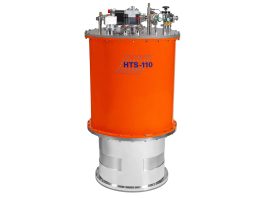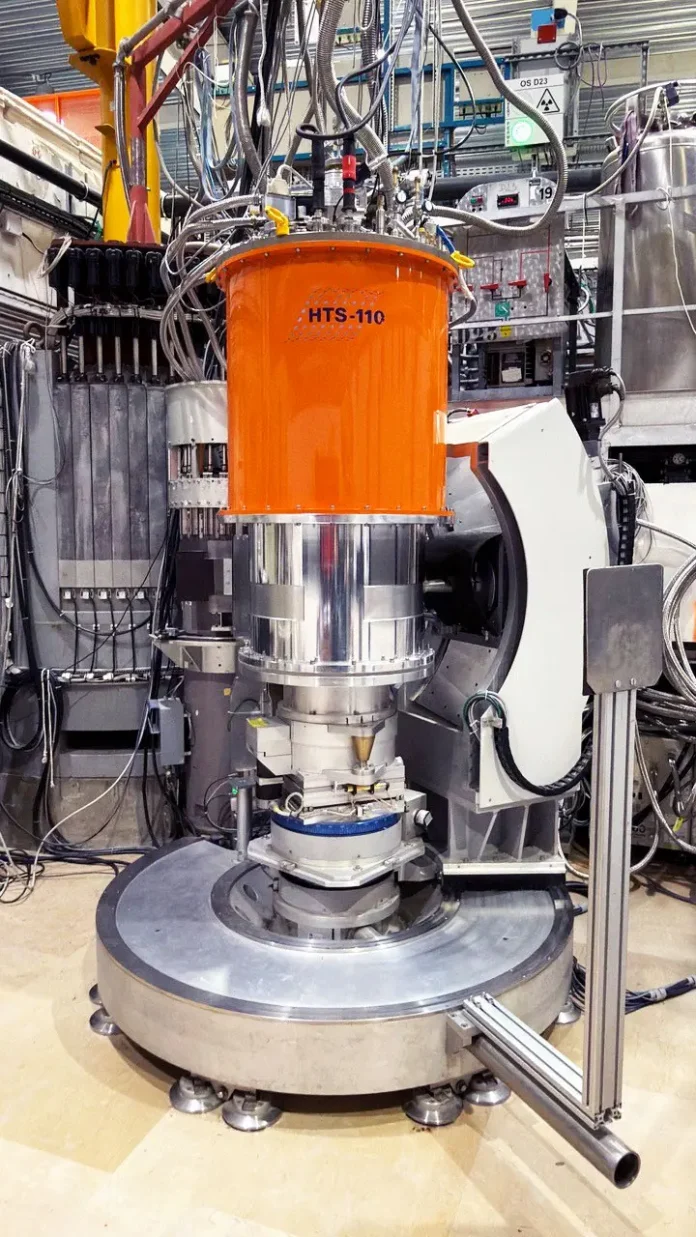
HTS-110 has been selected by the European Spallation Source (ESS) to design and manufacture a high-field, 14 tesla magnet for neutron spectroscopy.
The 14 tesla magnet will be deployed on the CSPEC (Cold Chopper Spectrometer) and T-REX (Bispectral Chopper Spectrometer) instruments at the ESS in Lund, Sweden.
It represents a significant leap forward in magnetic sample environments, offering researchers a symmetric vertical field of up to 14 tesla combined with a Variable Temperature Insert (VTI).
The combination will support normal operation from 1.5 K to 325 K and allow the insertion and cooling of a dilution refrigerator and/or a He³ ultra-low temperature (ULT) insert.
The contract follows HTS-110’s recent delivery of a world-first 12 tesla all-HTS magnet to the CEA for neutron science, at the Institut Laue-Langevin (ILL), further cementing the company’s position as the premier provider of high-field magnetic environments for advanced research facilities.
Technical collaborations on tesla magnets
The system represents a deep technical partnership between HTS-110 and the ILL, mirroring the successful collaboration model established during the recent delivery of the 12 tesla system to CEA.
As with its previous project, HTS-110 is responsible for manufacturing the complete magnet system, while the ILL team will design the VTI. This continuity allows the ESS to benefit from a proven interface between magnet and sample environment, leveraging HTS-110’s manufacturing capabilities alongside ILL’s 50 years of expertise in cryogenic systems.
Overcoming challenges of traditional LTS magnets
The main challenge for conventional low-temperature superconducting (LTS) magnets in neutron-scattering applications is the risk of quenching.
Neutron scattering instruments and sample environments typically incorporate mechanical structures made of aluminium and other metals. In such environments, a magnet quench can induce transient eddy currents in surrounding metallic structures, resulting in significant electromagnetic forces that may cause damage to the magnet system and beamline components.
HTS-110’s solution leverages the inherent thermal stability of high-temperature superconductors.
Unlike low-temperature superconductors (LTSs), HTS coils are robust to rapid discharging, thereby eliminating the risk of generating unbalanced forces that could damage the magnet system.
Optimised for neutron science
The 14 tesla magnet has been purpose-built to maximise data quality and detector efficiency:
- Maximised detector coverage: The split-pair geometry features a horizontal opening of -36° to +144° and a vertical opening of ±7°, ensuring maximum visibility for the CSPEC and TREX detector banks.
- Low background interference: To minimise neutron scattering, the coils are supported by wedges rather than continuous rings.
- Operational efficiency: The system features a recondensing helium tank feeding the dual-heat-exchanger VTI, ensuring one-week autonomy in liquid helium, fast sample cooling/heating and a ramp time to full field of less than one hour.
Dr Taotao Huang, Principal Magnet Designer at HTS-110, commented: “The magnet will be designed using second-generation high-temperature superconducting (HTS) wire, offering the potential to achieve significantly higher magnetic fields.
“Compared to conventional LTS conductors, 2G HTS wire provides superior current-carrying capacity in high magnetic fields, enhanced thermal stability, and a much lower risk of quench, making it ideal for demanding neutron scattering environments.”