Mirela Atanasiu, Head of Operations and Communication at the Clean Hydrogen Partnership, discusses Hydrogen Valleys and how they are accelerating Europe’s clean hydrogen economy.
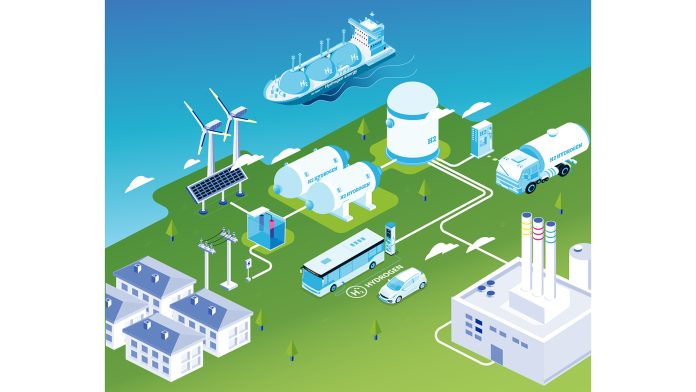
Europe’s clean hydrogen transition has reached a decisive turning point, with the focus shifting to deployment at scale. The most visible embodiment of this shift is the rise of Hydrogen Valleys — regional ecosystems where hydrogen is produced, stored, distributed and used across multiple sectors. Europe’s energy revolution is now happening in regions, cities, and industrial clusters, building the clean hydrogen economy from the ground up to drive decarbonisation and regional growth.
From concept to reality
Born out of the Clean Hydrogen Partnership and its predecessor’s earlier work with the regions, Hydrogen Valleys integrate the entire hydrogen value chain – from renewable production to industrial use and mobility – within one geography.
Hydrogen Valleys are where European strengths converge: research excellence, regional cohesion, and industrial innovation. They demonstrate that decarbonisation can drive competitiveness, jobs, and energy security all at once. That’s why the REPowerEU Plan elevated Hydrogen Valleys to a central place in Europe’s hydrogen strategy, allocating €200m to double their number by 2025.
Europe already leads globally: about 60 Hydrogen Valleys are in development or operation across the continent, representing €150bn in investment. Out of these, more than 20 valleys have benefitted from the support of the Clean Hydrogen Partnership, mobilising over €1.3bn in investment.
From Groningen to Galicia, from Crete to the North Sea ports, regional ecosystems are emerging where hydrogen is produced, stored, distributed, and used locally.
Hydrogen Valleys supported by the Clean Hydrogen Partnership vary in scale and geography, from major industrial hubs to transport-focused projects in islands. Large-scale projects, such as NAHV (northern Italy, Slovenia, and Croatia) and BalticSeaH2 (southern Finland and Estonia), aim at producing over 4,000 tonnes of hydrogen per year. Smaller-scale valleys like Green Hysland in Mallorca and H2tALENT in Portugal demonstrate the viability of hydrogen in insular and dispersed contexts, highlighting the flexibility of the model and its application across diverse end-uses, from industry to transport.
The valleys also build public trust and visibility for the technology. Citizens can see hydrogen vehicles on their streets, industry can expand and connect dedicated infrastructure for production and transport, forming cross-sector collaborations. Investors can evaluate real assets, and policymakers can observe strategy becoming reality.
Facilitate, stimulate, accelerate
Regions and cities hold the keys to hydrogen deployment: they plan transport fleets, manage industrial zones, and oversee permitting. Yet, many lack the expertise or financing capacity to turn plans into bankable projects.
To bridge this gap, the Clean Hydrogen Partnership created the Project Development Assistance (PDA) initiative. Building on its successful pilot for regions, the new Hydrogen Valleys Facility provides tailor-made technical, financial, and legal advice to help promoters reach final investment decision (FID).
Two support tracks are offered:
- PDA Light (6 weeks) for early-stage concepts refining pre-feasibility.
- PDA Plus (12 weeks) for advanced projects nearing FID.
In 2025, 15 valleys from 11 countries were selected for assistance – proof of Europe’s growing appetite for hands-on project-development support.
Knowledge sharing for acceleration
Alongside the facility, the Hydrogen Valleys Knowledge Centre provides a repository of best practices, case studies, and templates, covering governance, permitting, financing, and stakeholder engagement. Its mission is to make replication faster and cheaper, helping new valleys build on proven experience. It also fosters peer-to-peer learning, connecting policymakers, researchers, and industry leaders.
About the Clean Hydrogen Partnership
The Clean Hydrogen Partnership is the EU’s public-private partnership supporting research and innovation to accelerate the development and deployment of clean hydrogen technologies in Europe.
About the H2V Facility
Funded by the Clean Hydrogen Partnership, the H2V Facility aims to accelerate Hydrogen Valleys toward FID and support the European Commission’s target of having 50 valleys operational or under construction in the EU by 2030.
Over the next five years, the H2V Facility will provide dedicated non-financial support through three pillars: 1) Project Development Assistance (PDA), 2) the H2V Knowledge Centre, and 3) the H2V Platform.
- Project Development Assistance supports Hydrogen Valleys from idea to concept (PDA light) and from concept to feasibility and eventually FID (PDA plus).
- The H2V Knowledge Centre will serve as a self-service and interaction platform for the broader hydrogen community, offering content, knowledge products, and exchange formats on best practices at different project maturity levels.
- The H2V Platform that features Hydrogen Valleys will be enhanced with new technical and content features to address the evolving needs of Hydrogen Valleys.
Please note, this article will also appear in the 24th edition of our quarterly publication.