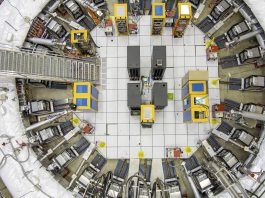
In a major leap for particle physics, researchers at CERN’s LHCb experiment have achieved a landmark measurement of the Z boson mass – one of the most fundamental parameters in the Standard Model.
Using data from proton collisions at the Large Hadron Collider (LHC), this is the first time the Z boson’s mass has been measured with such precision by an LHC experiment.
The result not only confirms decades-old predictions with stunning accuracy but also showcases LHCb’s growing capability to deliver high-precision results in a challenging experimental environment.
This breakthrough underscores the LHC’s diverse experiments and signals a new era of precision tests that could reveal flaws in our current understanding of the Universe.
Unlocking the secrets of the Z boson
The Z boson is one of the heaviest known elementary particles, weighing in at approximately 91 billion electronvolts (GeV).
Discovered in the 1980s alongside its counterpart, the W boson, its existence helped validate the Standard Model of particle physics – a triumph that earned the 1984 Nobel Prize.
As a mediator of the weak nuclear force, the Z boson plays a critical role in subatomic processes, and precise measurements of its mass are vital for probing the Standard Model and exploring potential new physics.
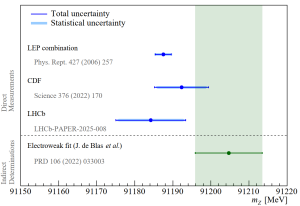
The LHCb experiment recorded 174,000 Z boson decays into muon pairs – heavier versions of the electron – to achieve a mass measurement of 91,184.2 MeV with an impressively low uncertainty of 9.5 MeV.
This level of precision, within 0.01%, matches theoretical predictions and aligns with past results from previous experiments like LEP in Europe and CDF in the United States.
LHCb’s unique approach pays off
While the LHC’s larger ATLAS and CMS detectors surround the collision point, LHCb takes a different approach.
Specialising in the study of matter-antimatter differences via beauty quarks (b quarks), LHCb is designed as a forward spectrometer – optimised to capture particles flung in one direction along the beamline.
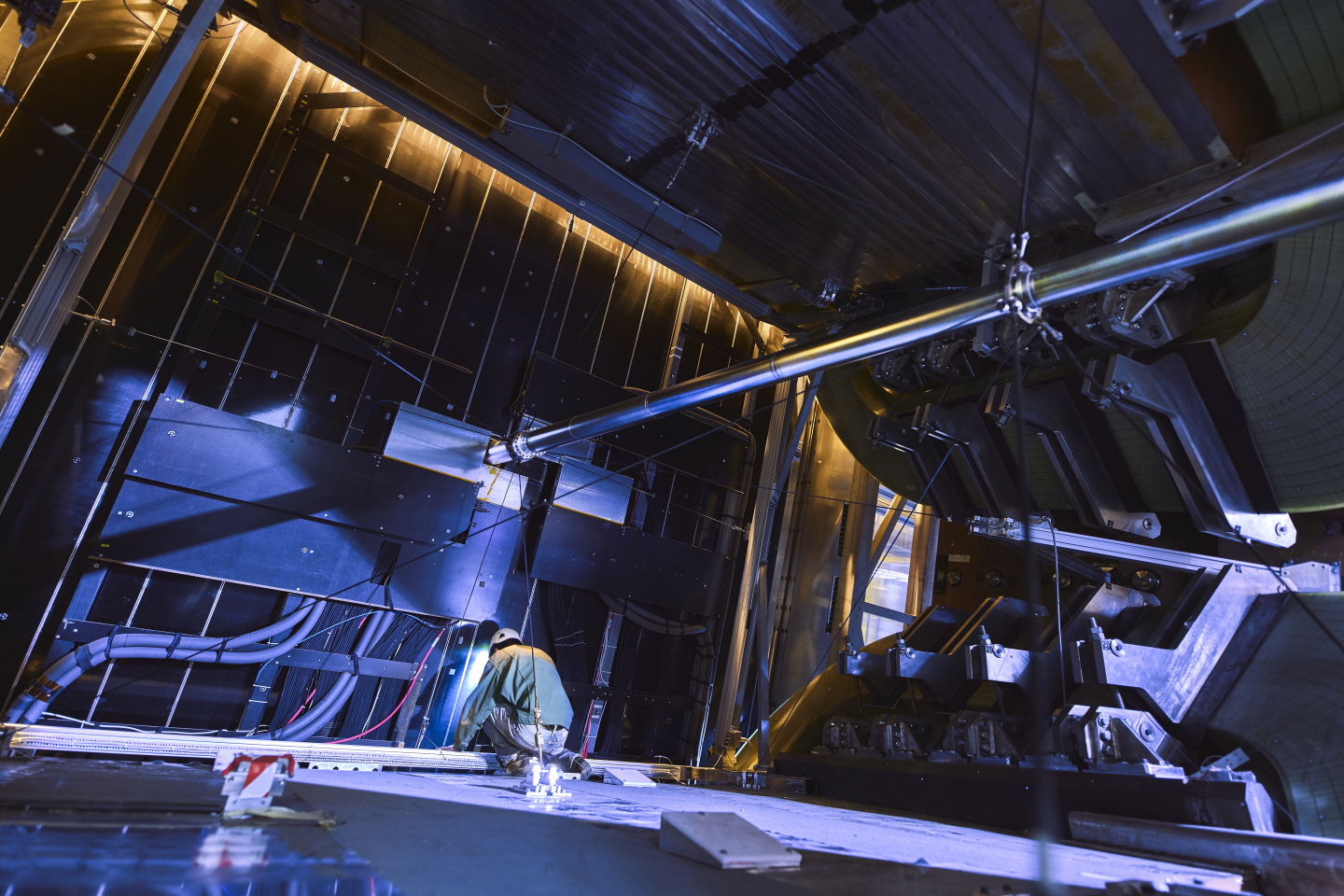
Its sophisticated tracking system and planar detectors are arranged over 20 metres, located 100 metres underground near Ferney-Voltaire, France.
This tailored design has now proven its versatility, allowing researchers to extract meaningful precision measurements even in the complex environment of proton–proton collisions – an environment traditionally more challenging for such studies than electron–positron collisions.
Future implications and broader impact
The success of this Z boson mass measurement from LHCb paves the way for even more precise analyses at the upcoming High-Luminosity LHC.
It also sets a strong precedent for complementary measurements from ATLAS and CMS, whose independent experimental setups will allow the combined results to achieve even lower uncertainties.
LHCb spokesperson Vincenzo Vagnoni explained: “The High-Luminosity LHC has the potential to challenge the precision of the Z boson mass measurement from LEP – something that seemed inconceivable at the beginning of the LHC programme.
“This will pave the way for proposed future colliders, such as the FCC-ee, to achieve an even bigger leap in precision.”
As CERN’s quest for deeper understanding continues, this result marks a powerful demonstration of how innovative detector design and rigorous analysis can push the boundaries of known physics and perhaps even hint at new phenomena waiting to be discovered.