Growing EU demand for rare earth magnets threatens energy transition due to geopolitical dependence and a currently uncompetitive European industry.
Europe’s transition to sustainable energy and mobility is a cornerstone of major policy initiatives such as the Green Deal, Fit for 55, and REPowerEU. Central to this transition are permanent magnets — critical components in electric vehicles, wind turbines, industrial motors, and countless modern technologies. Today, the most powerful of these magnets are based on rare earth elements (REEs), particularly neodymium–iron–boron (NdFeB) alloys. Their exceptional performance comes from a unique interplay between their electronic structure and crystal lattice, which forces atomic magnetic moments to align along a preferred crystallographic direction. This phenomenon, known as magnetocrystalline anisotropy, provides both high magnetisation (thanks to iron) and strong coercivity (thanks to neodymium).
The importance of REE-free magnets
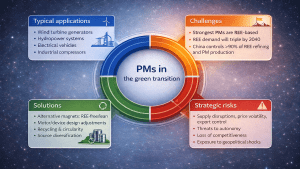
However, this technological advantage comes with growing challenges. By 2040, global demand for REEs — especially for permanent magnets used in electric vehicles and wind turbines — is expected to more than triple. The extraction, refining, and manufacturing of REE-based magnets are heavily concentrated in a few geographical regions and are deeply affected by geopolitical tensions. This creates significant economic vulnerability for Europe, whose REE industry cannot currently compete with China without substantial public support. These concerns, along with environmental considerations, highlight the need for alternative magnet technologies. Fig. 1 illustrates the crucial role of permanent magnets in the green transition and the obstacles associated with their current supply chains.
One viable route is to combine REE-free magnets with clever engineering of components and devices. Even if such magnets cannot yet match the absolute performance of NdFeB systems, their use in redesigned motors or generators can greatly improve sustainability, reduce market dependence, and strengthen European industrial resilience.
Among the most promising REE-free candidates are magnets based on aluminium, nickel, cobalt, and iron –collectively known as AlNiCo magnets. Unlike REE magnets, AlNiCo materials have relatively low magnetocrystalline anisotropy because the electronic structure and crystal symmetry of their elements are less synergistically aligned. To compensate, their magnetic performance relies heavily on shape anisotropy: the alignment of magnetic nanorods along specific crystallographic directions. Within each columnar grain, these nanorods form magnetic domains separated by domain walls, allowing the material to exhibit directional magnetic behaviour.
A major advantage of AlNiCo magnets is their excellent performance at high temperatures. Where NdFeB magnets begin to lose coercivity when heated, AlNiCo magnets maintain their coercive strength, making them attractive for elevated temperature applications.
A promising solution: The MagNEO approach
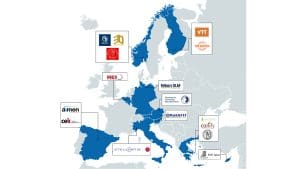
The MagNEO project brings together a diverse consortium of 16 partners from ten European countries, spanning research institutions, advanced manufacturing companies, technology providers, universities, and experts in skills development and communication.
Its overarching aim is to develop and implement advanced additive manufacturing (AM) strategies to enable REE-free AlNiCo magnets to replace, or complement, traditional REE-based permanent magnets. This work integrates experimental research, computational modelling, and data-driven optimisation.
The project also focuses strongly on sustainability. MagNEO will develop new recycling strategies and validate the performance of next-generation magnets in several key application areas:
- Automotive and high-speed devices, such as anti-lock braking systems, headlights, and heat pump motors.
- Low-speed direct-drive generators for wind turbines.
- Electric propulsion systems for maritime vessels.
The project concept is illustrated in Fig. 2.
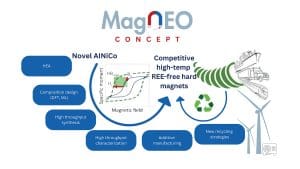
At the heart of MagNEO’s approach are agile and flexible design methodologies that combine experiments, modelling, and optimisation tools. The project advances both materials and manufacturing. It includes optimisation of feedstock production through gas atomisation and extensive exploration of additive manufacturing techniques. AM offers several sustainability advantages: it reduces raw material usage compared with traditional permanent magnet production, enables near-net shape fabrication of complex components, and allows leftover material from the printing process to be reprocessed and reused.
Beyond materials and manufacturing, MagNEO includes component-level design and feasibility studies with industrial end users. Circularity is another central pillar of the project. Its recycling strategy includes:
- Direct recycling of long-used powders, AM scrap, and end-of-life magnets by remelting and atomising them into new alloy powders.
- Direct recycling of crushed end-of-life magnets to produce bonded magnets.
- Indirect recycling using green-chemistry techniques to selectively recover critical metals such as cobalt, nickel, and copper.
These practices have significant potential to reduce the demand for virgin materials and close the loop in magnet production.
Overcoming challenges
To achieve its goals, MagNEO currently addresses several complex scientific and technical challenges:
- Ensuring the structural integrity of additively manufactured alloy components.
- Developing the correct grain texture at the microstructural level, aligned along the preferred magnetisation direction to ensure strong directional magnetic behaviour.
- Forming well-aligned FeCo-rich crystallites at the nanoscale, with precise shape and spacing to enhance shape anisotropy.
Addressing these challenges requires precise control over material structure at multiple scales — from the architecture of phases at the nanometre level to large-scale grain orientation — both during additive manufacturing and in subsequent thermomagnetic processing steps.
Enhancing the magnetic properties of gap permanent magnets, which bridge the performance gap between low-cost ferrites and high-performance rare-earth magnets, such as those of the AlNiCo-type, is a technically demanding exercise requiring extended development timelines. Progress must be tightly integrated with the design of motors, generators, and other devices that will use these magnets. Adaptation on both the materials and engineering sides is essential to unlock their full potential.
Finally, recycling is critical to Europe’s long-term position in magnet manufacturing. Developing robust circular processes will strengthen material security, support industrial competitiveness, and reduce environmental impact.
Through its multidisciplinary approach, spanning innovative materials, advanced manufacturing, device integration, and circular design, the MagNEO project aims to help Europe build a more sustainable and resilient future for magnetic technologies.
Disclaimer

Funded by the European Union. Views and opinions expressed are, however, those of the author(s) only and do not necessarily reflect those of the European Union or the European Health and Digital Executive Agency (HADEA). Neither the European Union nor the granting authority can be held responsible for them.
Please Note: This is a Commercial Profile

This work is licensed under Creative Commons Attribution-NonCommercial-NoDerivatives 4.0 International.
Please note, this article will also appear in the 25th edition of our quarterly publication.