Advances in flue gas sampling enable PFAS detection and comparative evaluation of analytical methods.
For decades, waste incineration has been considered a robust way to handle problematic materials – including those containing per- and polyfluoroalkyl substances (PFAS). High-temperature combustion was expected to destroy these so-called ‘forever chemicals.’ But a persistent question has remained: Are PFAS truly broken down, or do some survive and escape through the stack?
Until recently, the answer was simply unknown. Measuring PFAS in flue gas was long seen as technically impossible – the temperatures, the chemistry, and the diversity of PFAS made it a blind spot in environmental monitoring. But that picture is now changing. Across Europe and the US, researchers are testing new sampling and analytical methods, and the first comparable datasets are emerging.
The challenge behind the smoke
PFAS are not one substance but thousands, some ionic, others volatile, many unstable at high temperatures. No single method can capture them all. The flue-gas matrix itself makes things worse: it is hot, reactive, and full of particles and moisture. Any PFAS that survive combustion may transform, adsorb, or slip through before anyone can catch them.
For years, most studies looked only at ashes and scrubber water. What left the stack in gaseous form remained a mystery. That changed when new sampling protocols, originally developed by the U.S. Environmental Protection Agency (EPA), were adapted for full-scale incineration trials.
Two methods, one stack
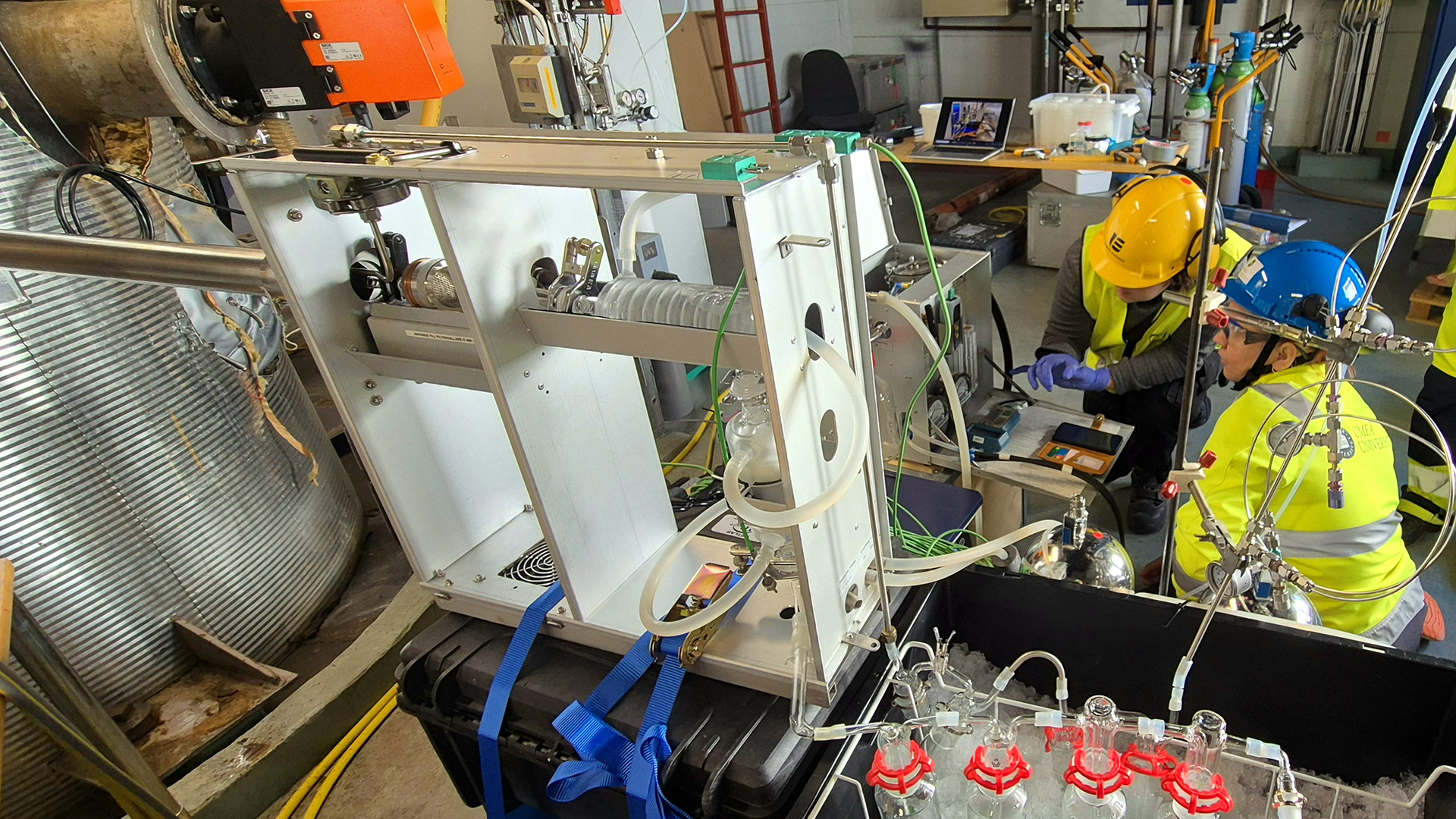
In 2024, IVL Swedish Environmental Research Institute carried out one of the first side-by-side comparisons of two semi-volatile PFAS sampling methods: a modified EN 1948-1 setup, a European standard for the sampling of dioxins and furans in stationary source emissions, and the EPA’s OTM-45 method, a standardised approach for measuring targeted PFAS compounds in stack emissions.
Both were run on the same flue-gas stack at the same time, a deliberate choice to eliminate differences caused by operating conditions. The goal was not to prove which method was ‘better,’ but to understand how each behaved under identical circumstances.
The samples were analysed by GC-MS/MS Gas Chromatography-Tandem Mass Spectrometry, targeting semi-volatile PFAS and selected precursors. The comparison provided valuable insight into capture efficiency, blank stability, and breakthrough behaviour, data that had previously been missing.
A window into the volatile fraction
At the same time, IVL established the OTM-50 method for volatile PFAS. While OTM-50 is still new globally, the Gothenburg laboratory was among the first to set up the full analytical chain for all 30 target compounds included in the method.
These substances, more volatile than typical PFAS measured in water or solids, require specialised sampling equipment and careful temperature control to prevent losses. Each stage, from sample recovery to quantification, had to be validated to ensure the results were traceable and comparable.
What the results show
The findings highlight both progress and complexity:
- Semi-volatile PFAS can be captured and analysed reproducibly using established trains, but the choice of method affects what is retained and at what efficiency.
- Volatile PFAS can be quantified for a defined set of compounds, though the availability of calibration standards remains a limitation.
- Parallel sampling matters. Running methods simultaneously under the same conditions revealed differences that would otherwise be mistaken for plant-specific variation.
- Uncertainties remain. Sampling artefacts, sorbent interactions, and trace-level quantification challenges make full comparability across studies a work in progress.
From first measurements to better understanding
These new measurements do not claim that incineration fails, or that it succeeds entirely. What they show is that PFAS measurement in flue gas is now possible, and that method choice has a strong influence on what is detected.
Johan Strandberg, Project Manager at IVL, said: “The real achievement is comparability. We’ve shown that you can run different methods in parallel and start to understand their strengths and weaknesses. That’s a crucial step if we want monitoring data that regulators and operators can trust.”
Towards harmonised practice
Next comes harmonisation. As countries begin to adopt or adapt these methods, the challenge will be to ensure that measurements are reproducible, transparent, and meaningful. Inter-laboratory comparisons, reference materials, and consistent reporting criteria are all needed before emission factors or regulatory limits can be defined.
Strandberg added: “For the first time, we can look at PFAS in the gas phase with methods that are comparable and validated in real incineration conditions. That gives us the foundation we need to make informed decisions – both technically and politically.”
Looking ahead
The ability to measure PFAS in flue gas marks an important shift. Incineration may still prove to be an effective destruction route under the right conditions, but only if we can verify what leaves the stack. Each reliable measurement adds a new piece to the puzzle, helping regulators, operators, and researchers move from speculation to evidence.
The story of PFAS in flue gas is not finished. But for the first time, it can be measured, and that is where real understanding begins.
PFAS in the stack: From blind spot to breakthrough
“The real achievement is comparability. We’ve shown that different methods can be run in parallel and evaluated systematically.” – Johan Strandberg, IVL.
Why it matters
• For decades, PFAS emissions from incineration stacks were a blind spot.
- High-temperature combustion was assumed to destroy PFAS, but it has never been proven.
- New sampling and analysis methods are turning assumptions into data.
First-of-its-kind comparison
• In 2024, IVL ran EN 1948-1 (EU) and OTM-45 (US EPA) side by side on the same stack.
- Parallel testing showed how method choice changes what is detected.
- Volatile PFAS were captured using OTM-50, targeting 30 compounds.
Key insights
• Semi-volatile PFAS can be captured reliably.
- Volatile PFAS are measurable, but calibration standards remain limited.
- Parallel sampling is essential to separate method effects from plant effects.
- Uncertainties remain, but the monitoring gap is closing fast.
What’s next?
• Inter-laboratory comparisons, harmonised reporting, and shared protocols.
- A critical step toward trusted PFAS emission data – and future regulation.