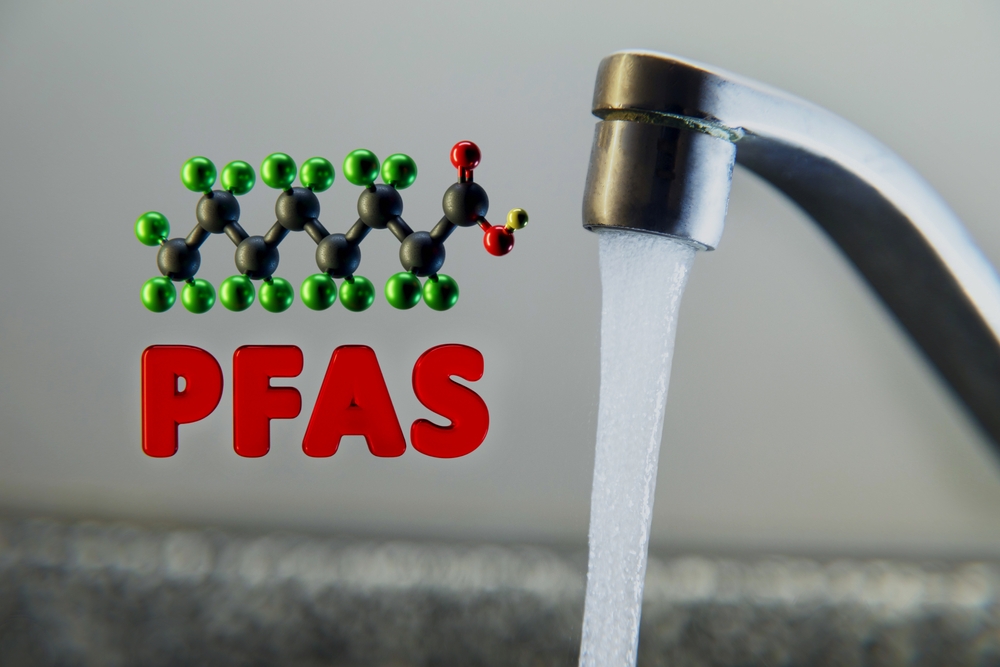
A growing health concern is bubbling up across the United Kingdom as new evidence reveals that millions of residents may be drinking water contaminated with toxic ‘forever chemicals.’
Following a BBC investigation, water technology company Bluewater has issued a stark warning, urging both public awareness and government intervention to address the escalating problem of PFAS in tap water.
Bengt Rittri, founder and CEO of Bluewater, explained: “The BBC-spotlighted findings confirm that even in countries with advanced water systems from Europe to North America, safety can no longer be taken for granted.”
PFAS explained
PFAS (per- and polyfluoroalkyl substances) are a group of more than 10,000 manufactured chemicals first developed in the 1940s.
They are prized for their resistance to heat, oil, and water, making them common in products such as non-stick cookware, waterproof clothing, food packaging, and firefighting foams.
The problem is that PFAS do not break down easily in nature – hence their nickname, forever chemicals.
Once released into the environment, they accumulate in soil, waterways, wildlife, and even human blood. Over time, this buildup can pose serious health risks.
Scientific research has linked PFAS exposure to a range of medical conditions, including:
- Certain types of cancer (notably kidney and testicular)
- High cholesterol and thyroid disease
- Liver damage and immune dysfunction
- Reduced fertility and developmental delays in children
Because of their persistence and toxicity, experts warn that even low-level, long-term exposure can have cumulative and harmful effects.
Alarming findings on PFAS in the UK’s drinking water
Recent findings show that over six million people in Britain are receiving water from supplies contaminated with PFAS, at levels considered potentially hazardous.
Despite the UK’s reputation for advanced water systems, testing by both the BBC and environmental researchers has revealed that these persistent chemicals are slipping through standard treatment processes and entering household taps.
A 2024 Bluewater study detected worrying concentrations of PFAS and PFOA in London’s tap water, echoing prior warnings from the Royal Society of Chemistry that the UK lags behind other developed nations in regulating these substances.
Many European countries and US states have already set strict limits for PFAS in drinking water, while the UK is still debating safe thresholds.
Are UK water systems equipped to cope?
Traditional water treatment infrastructure was never designed to remove PFAS.
While modern filtration can eliminate many bacteria and metals, these microscopic compounds often pass through unfiltered.
Enforcement notices reviewed by the BBC’s investigation found PFAS concentrations in some UK water networks high enough to pose potential health dangers – a situation that could worsen without stricter oversight.
Environmental campaigners argue that the UK Government must establish binding safety limits and require water companies to monitor PFAS more closely.
Public health advocates also emphasise the need for greater transparency so that consumers can make informed decisions about their drinking water.
Towards a cleaner, safer future
In response to the findings, Bluewater is promoting advanced purification technologies designed to eliminate PFAS, microplastics, and other emerging contaminants directly at the tap.
The company advocates sustainable solutions that avoid reliance on bottled water, which can leach microplastics and worsen the global waste crisis.
As the science becomes clearer and public awareness grows, the issue of PFAS in tap water is evolving from a scientific concern to a national policy priority.
Ensuring clean, safe, and sustainable water isn’t just an environmental responsibility – it’s a fundamental human right that demands urgent and innovative action.