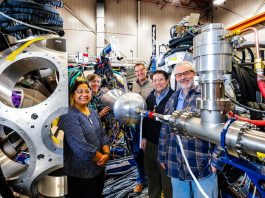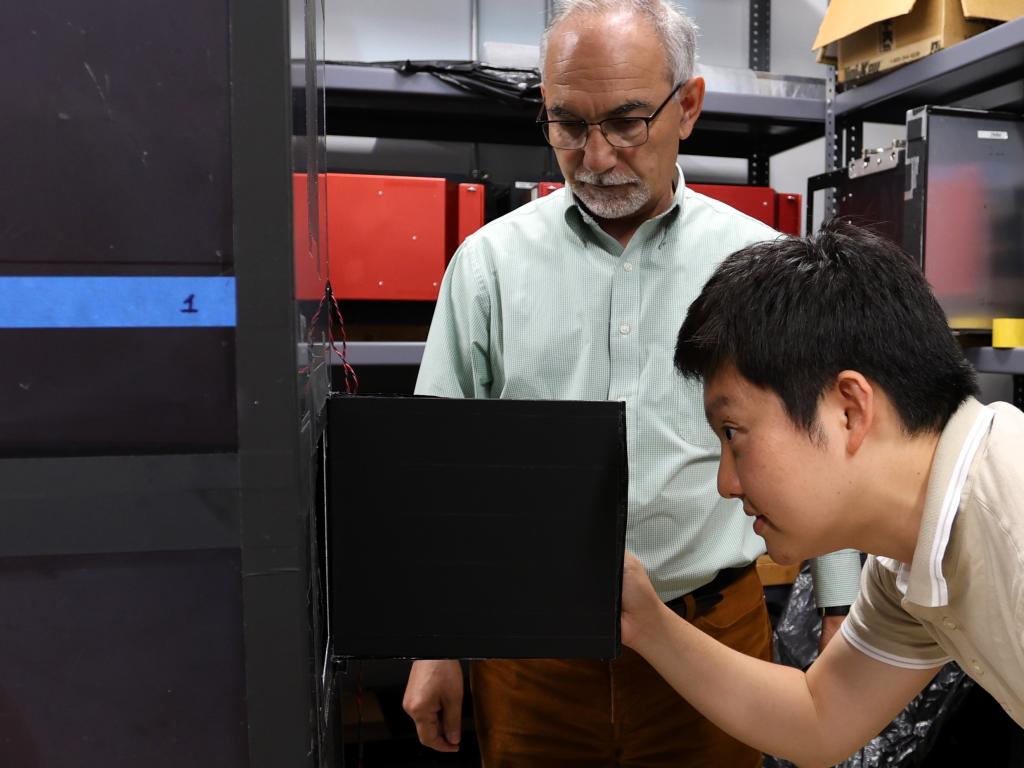
In a milestone that blends physics, engineering, and innovation, researchers at the Department of Energy’s Oak Ridge National Laboratory (ORNL) have developed a mobile muon detector.
This cutting-edge system is designed to probe dense materials, improve nuclear fuel monitoring, and tackle one of the toughest challenges in quantum computing.
Muons, subatomic particles similar to electrons but heavier, pass through matter at nearly the speed of light. Their ability to penetrate dense materials makes them invaluable for imaging applications.
However, their fleeting lifespan – just a few microseconds compared to neutrons’ ten minutes – has historically limited their practical use. ORNL’s new muon detector overcomes these challenges, creating new opportunities for science and technology.
Tackling nuclear security challenges
The muon detector is poised to revolutionise how scientists monitor and safeguard nuclear materials.
By analysing how muons scatter and lose energy when passing through matter, the system provides detailed images of objects such as shielded nuclear fuel canisters.
Unlike earlier detectors that relied on single measurements, this device simultaneously measures both muon energy and scattering angles, delivering significantly clearer and more accurate imaging.
This advancement has direct implications for nuclear safety. From tracking spent nuclear fuel to supporting the development of next-generation reactors, the detector enhances accountability in nuclear materials management.
Its applications extend to waste disposal strategies, helping the US and global community strengthen safeguards against potential risks.
Supporting the future of quantum computing
Beyond nuclear science, the detector could help solve one of the most pressing hurdles in quantum computing: qubit stability.
Qubits, the fundamental building blocks of quantum computers, are highly sensitive and prone to errors caused by cosmic radiation.
By studying how muons and other cosmic particles interact with qubits, researchers can refine error correction methods and design more resilient quantum hardware.
Without such advances, scaling quantum computers beyond controlled lab environments would remain out of reach.
The muon detector, therefore, plays a dual role – ensuring nuclear safety while advancing next-generation computing.
Born from cross-disciplinary collaboration
The project highlights the power of collaboration across scientific fields. The idea for the muon detector originated during doctoral research into computational simulations for muon tomography.
Yet it took root at ORNL when its initial creator, JungHyun Bae, found inspiration in an existing neutron detector on display at the American Museum of Science and Energy in Tennessee.
That neutron detector, originally built by ORNL’s Neutron Sciences Directorate and honoured with a prestigious R&D 100 award in 2012, provided the blueprint for adapting wavelength-shifting fibre technology to muon detection.
By combining expertise from neutron sciences and fusion and fission energy research, ORNL’s team transformed a concept into a fully operational system over the course of two years.
Bae added: “We are thrilled to have brought this vision to life. We have a fantastic community here at ORNL, and the support I’ve received has been invaluable.
“This project exemplifies the power and innovation of interdisciplinary collaboration at ORNL.”
A new era for muon imaging
The muon detector will soon be relocated to a specialised facility at ORNL for real-world testing.
As testing begins, the detector promises to play a pivotal role in two critical fields – strengthening nuclear safeguards and accelerating the dawn of practical quantum computers.
In doing so, it demonstrates how collaborative ingenuity can transform long-standing scientific challenges into groundbreaking solutions.