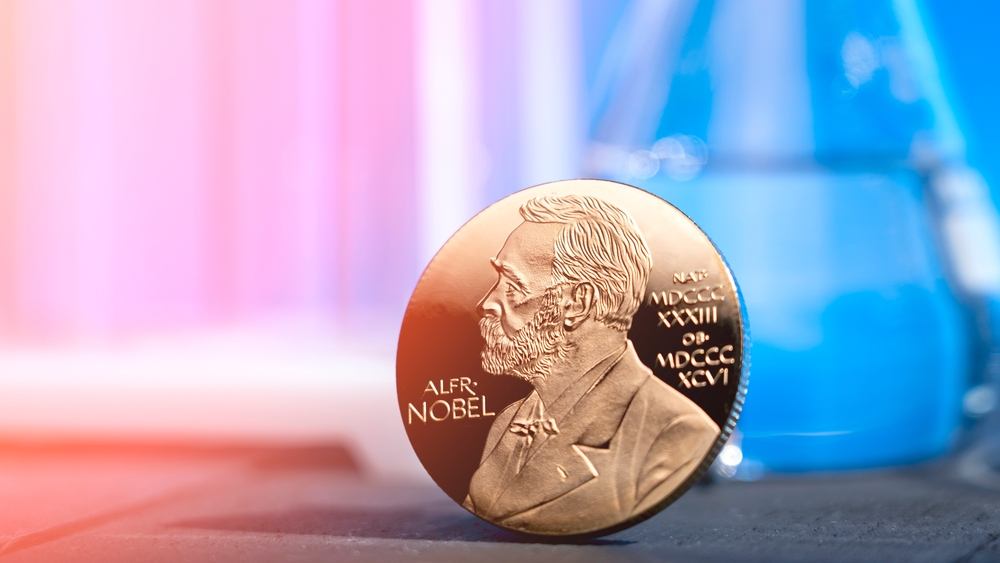
The Nobel Prize in Chemistry 2025 has been awarded to Susumu Kitagawa, Richard Robson, and Omar Yaghi for their groundbreaking development of metal-organic frameworks (MOFs).
These crystalline materials are transforming how scientists store, separate, and utilise gases and molecules.
The three laureates, from Japan, Australia, and the United States, respectively, have created molecular structures with vast internal spaces that act like intricate scaffolds.
These metal-organic frameworks can trap, store, or transform substances, opening new frontiers in energy, climate, and environmental science.
The architecture of a molecular revolution
At the heart of the award-winning discovery lies a new way to build matter.
MOFs are formed when metal ions – serving as structural nodes – connect with long organic linkers to create rigid, porous crystals. The resulting frameworks contain enormous internal cavities, much like molecular sponges.
This modular architecture allows chemists to design MOFs with precision, tailoring them to capture carbon dioxide, store hydrogen, catalyse chemical reactions, or even conduct electricity.
According to Heiner Linke, Chair of the Nobel Committee for Chemistry: “Metal-organic frameworks have enormous potential, bringing previously unforeseen opportunities for custom-made materials with new functions.”
From fragile beginnings to functional marvels
The story began in 1989, when Australian chemist Richard Robson explored how atoms could be organised into spacious, repeating structures.
His initial experiment – combining copper ions with a four-armed organic molecule – produced an elegant crystal resembling a diamond filled with microscopic cavities. Although the structure was unstable, it sparked a new scientific vision.
Building on Robson’s foundation, Susumu Kitagawa at Kyoto University demonstrated in the early 1990s that gases could move through these frameworks, proving their porosity and flexibility.
Meanwhile, Omar Yaghi, then at the University of California, Berkeley, developed robust and stable MOFs, using rational design to modify their properties and expand their potential applications.
From laboratory curiosity to global solution
Since those pioneering years, researchers have created tens of thousands of metal-organic frameworks, each with distinct chemical properties.
Today, MOFs are being explored for carbon capture, water harvesting from desert air, toxic gas storage, and environmental cleanup – such as removing PFAS or breaking down pharmaceutical residues in water.
The Nobel Committee’s decision recognises not just a scientific breakthrough but a new paradigm in chemistry – one that merges elegance in molecular design with real-world sustainability.
The 2025 Nobel Prize in Chemistry celebrates a trio of visionaries whose molecular blueprints could help solve some of the greatest challenges of our time.
Get The Latest PFAS News
Explore the latest PFAS news, updates on PFAS contamination, health risks, regulations, and environmental impact. Visit our comprehensive PFAS news archive to stay informed with in-depth reporting, expert analysis, and breaking developments. Start reading now to stay ahead on all things PFAS and ‘forever chemicals’.