High-performance tetrahedrite materials produced via scalable methods support EU leadership in thermoelectric innovation.
The START project is driving European innovation in thermoelectric (TE) materials by pioneering the use of tellurium-free tetrahedrite (TH) materials sourced from mining waste. With a strong alignment to EU sustainability goals and circular economy principles, START is entering a pivotal phase, preparing to assemble its first prototype device, marking a major step toward market readiness.
As already detailed in a previous article,¹ this Horizon Europe project is leveraging the experience and innovation of its wide consortium, from geology to mineral processing, composition design and consolidation of powder-based materials, device design and assembly, to transform its concept into reality and boost the thermoelectric industry in Europe with a sound alternative to current materials, whose supply chain is not guaranteed.
Here you can read some insight into the project’s latest results, knowing that it just entered its last year of activity, so more details will come in the next months before the end of the project.
Key results to date
Advanced materials development
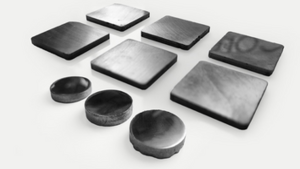
Through scalable methods such as High Energy Ball Milling (HEBM) and Upgraded-Field Assisted Sintering Technology (U-FAST) (Fig. 1 and Fig. 2), START has produced high-performance p-type TH materials. A synthetic sample achieved a record figure of merit (zT) of 1.16 at 354°C, while a mineral-derived sample (from TH-containing minerals recovered from mining waste in European mines) with 20 wt.% concentrate reached zT=0.97, demonstrating the feasibility of using secondary raw materials. Over 40 kg of mineral concentrate has been processed, validating the waste-to-energy concept.
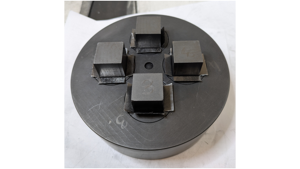
These results not only significantly outperform the literature-reported average zT values for TH, which typically range from 0.3 to 0.7 for materials produced on a laboratory scale, depending on composition and temperature, but also demonstrate greater efficiency in the production process, with 12 samples produced in a single sintering cycle. The synthetic sample exceeds the 99th percentile trend line (zT ≈ 0.308 + 0.002T), while the 20/80 mineral/synthetic sample, with zT = 0.97, is just below the 99th percentile value of 1.012 at 352°C, still placing it among the top-performing TH-based TE materials.
Comparison with commercial systems
Commercial TE materials based on Bi2Te3 or PbTe typically achieve zT values between 0.8 and 1.2 but rely on critical raw materials like tellurium (Te), which are scarce and geopolitically sensitive. START’s tetrahedrite approach matches this performance without using tellurium, offering a more sustainable and EU-sourced alternative.
Device design and simulation
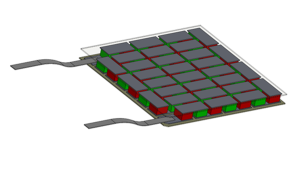
A COMSOL-based model of the TE module has been developed, integrating real temperature-dependent material data for the p-type TH and the selected n-type material (Mg3(Sb, Bi)2-based materials). Using thermoelectric simulations, the fill factors and the heights of the pellets have been optimised to match the incoming heat flux densities in combined heat and power applications. Furthermore, the interfacial layers, which include the diffusion barriers and the bonding layers, have been incorporated in the model. A thorough thermo-mechanical simulation has also been performed to optimise the thickness of the ceramic substrate. As a reference, the red and green elements in the optimised module for medium-temperature application (Fig. 3) have a size of approximately 40mm,³ and the module size is 45x45mm² and is composed of 31 unicouples of p-type and n-type legs.
Environmental and economic assessment
Life Cycle Assessment (LCA) models were carried out to measure the environmental impacts of START’s tetrahedrite-based modules with conventional BiTe and PbTe systems. Adopting a cradle-to-grave approach, the ReCiPe.² The 2016 method was adopted, along with SimaPro 9.4 software and Ecoinvent 3.11 as a database, in accordance with international standards ISO 14040:2006 and 14044:2006.
The Life Cycle Inventory (LCI) was developed using the production of 1 kWh of electricity by TE generator (TEG) modules as the functional unit, encompassing key stages such as raw material extraction, module preparation and assembly, and TEG fabrication. Concerning the different steps of the TEG production, literature was adopted to identify and characterise the most common commercially available TEG (tellurite-based, e.g. PbTe and BiTe), whereas data on TH-based TEG were obtained both from literature and from the START partners.
Preliminary results showed that the alumina plates used to build the modules show significant Global Warming Potential (GWP), Human Carcinogenic Toxicity (HCT) and Fossil Resource Scarcity (FRS) effects. This relevant environmental impact is due to the high energy consumption required for its raw material extraction. Furthermore, although the production of high-purity TH is a highly energy-intensive process, it was observed that the n-type non-TH leg has major contributions to mineral resource scarcity (MRS), significantly higher than the p-type leg.
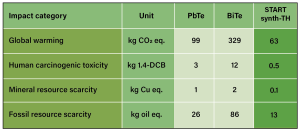
Comparing the GWP of tellurite-based and TH TEGs, the manufacturing of TH modules led to lower CO2 emissions (63 kg CO2 eq.) compared to those of BiTe and PbTe modules (respectively 329 and 99 kg CO2eq.) (Table 1). BiTe modules also have higher human toxicity (12 kg 1.4-DCBeq.), significantly higher if compared to the values of PbTe (3 kg 1.4-DCB) and TH-based devices (0.5 kg 1.4-DCB), the latter being thus considerably less detrimental for human health. TH modules also prove to be the least impactful in the Mineral Resource Scarcity (MRS) category (0.1 kg Cu eq.), if compared to those of BiTe and PbTe modules (2 and 1 kg Cu eq., respectively). Similarly, TH-based TEGs also present more environmentally sustainable values related to FRS (13 kg oil eq.), whereas BiTe and PbTe TEGs lead to significantly higher values. In agreement with ongoing research, it was concluded that TH inclusion is likely to decrease environmental impacts and increase the sustainability of the delivered TEGs.
Next steps
In the last months of the project, the goal is to test the devices that are being assembled and validate the expected performances with actual measurements.
The consortium is also extremely active in fostering the acceptance of thermoelectrics as a viable green energy production route, to be included in the European strategy for the Green Transition, in addition to the clear advantage TE has in powering up electronic devices, where the use of grid power or batteries is not practical. The project has already stimulated a follow-up COST Action (CA24120³) that will help the TE community networking and the push for acceptance, and is planning to create a specific entity to support the TE industry and aid the matchmaking between European producers and potential end users.
Disclaimer
 The START project is co-funded by the European Union. Views and opinions expressed are, however, those of the author(s) only and do not necessarily reflect those of the European Union or the European Health and Digital Executive Agency. Neither the European Union nor the granting authority can be held responsible for them.
Contributing authors:
Bruno Vicenzi
START Dissemination Manager
European Powder Metallurgy Association
Filipe Neves
START Project Coordinator
LNEG – Laboratório Nacional de Energia e Geologia, I.P.
Alvise Bianchin and Serena Busatto
START Project Members
MBN Nanomaterialia S.R.L.
Marcin Rosinski
START Project Member
GeniCore Sp. z o.o.
Patricia Almeida Carvalho
START Project Member
SINTEF
Aniruddha Ray
START Project Member
RGS Development B.V.
Hao Yin
START Project Member
TEGnology ApS
Giovanni Borsoi
START Project Member
3Drivers
References
- The Innovation Platform, Issue 18, June 2024, pp. 36-38
- Huijbregts, M.A.J., Steinmann, Z.J.N., Elshout, P.M.F. et al. ReCiPe2016: a harmonised life cycle impact assessment method at midpoint and endpoint level. Int J Life Cycle Assess 22, 138–147 (2017)
- CA24120 – Sustainable Thermoelectrics European Network (SUSTENET)
Please note, this article will also appear in the 24th edition of our quarterly publication.