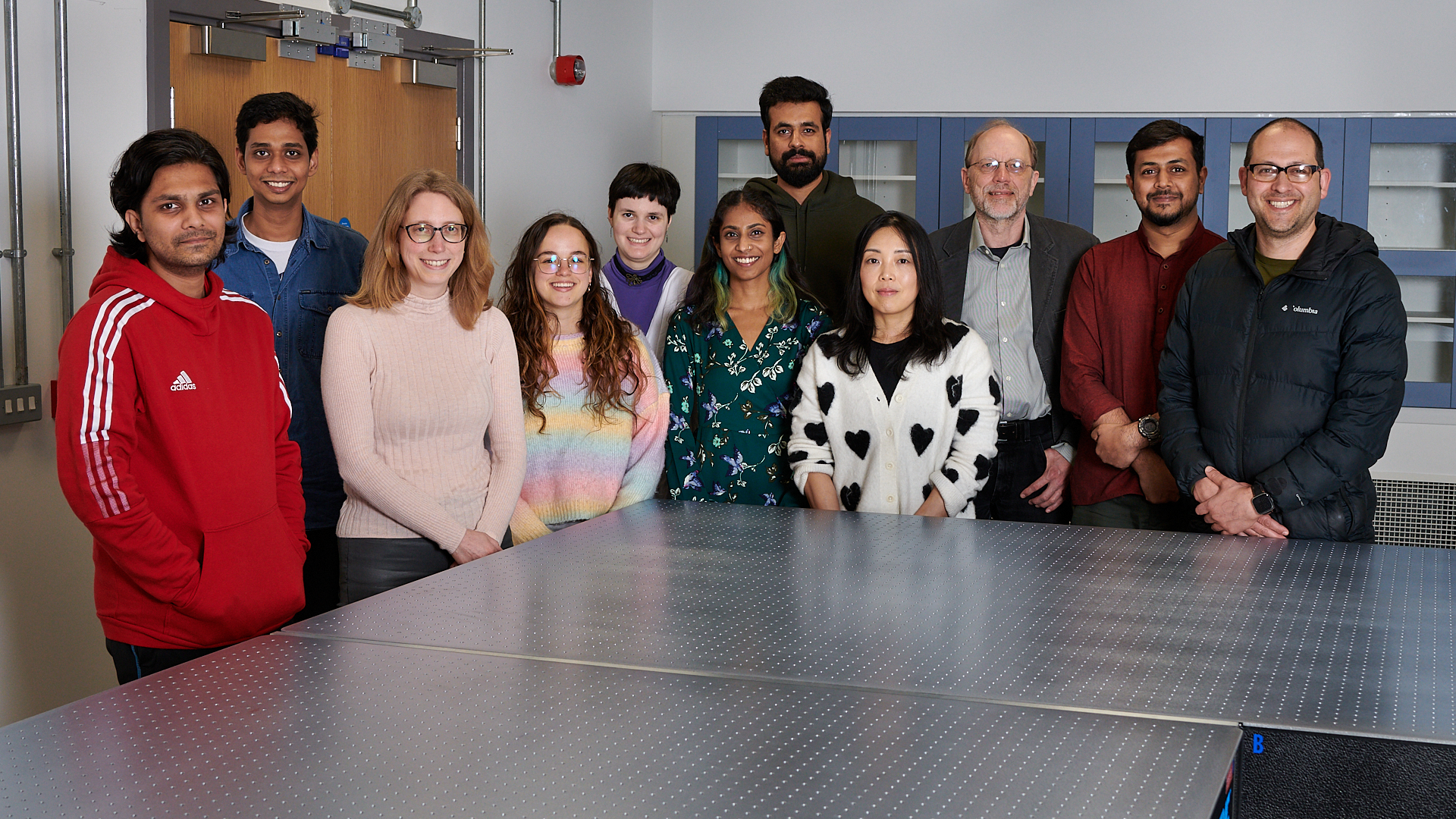
A pioneering team of physicists at Cardiff University has achieved a new milestone in the quest to understand the Universe’s most mysterious forces.
Their Quantum Enhanced Space-Time measurement (QUEST) experiment – a table-top interferometric system – has set a world record for sensitivity while searching for very high-frequency gravitational waves.
Unlike the massive, kilometre-scale detectors such as LIGO and VIRGO, the QUEST setup fits neatly on a single laboratory table. Yet, despite its compact size, the device can detect minute changes in length 100 trillion times smaller than the width of a human hair.
This unprecedented level of precision marks a new era in gravitational wave detection, offering a promising window into new physics — from the nature of space-time to the elusive signatures of dark matter and quantum gravity.
Unveiling the quantum fabric of space-time
At the heart of the QUEST project lies a profound question: is space-time quantised? In modern physics, space and time are viewed not as separate entities but as a single, intertwined fabric.
The Cardiff team aims to determine whether this fabric is made up of the smallest measurable units, similar to how energy and light are composed of discrete quanta.
The experiment represents an early step toward uncovering the quantum structure of space-time, a topic that has captivated theoretical physicists for over fifty years.
By adapting the interferometric techniques originally designed for gravitational wave observatories, QUEST brings a fresh approach to exploring the quantum realm on a smaller, more controllable scale.
Record-breaking sensitivity from a table-top
During its three-hour first science run, QUEST demonstrated a sensitivity never before achieved by a laboratory-scale instrument.
Using two ultra-precise interferometers, the team developed a correlation technique that allowed them to filter out noise and identify shared signals – a method crucial for detecting very high-frequency gravitational waves.
These waves, which ripple through the fabric of the cosmos, are thought to originate from exotic sources such as the early Universe, primordial black holes, or other unknown phenomena.
By setting new limits on their existence, the Cardiff researchers have taken a significant step toward uncovering evidence of these elusive cosmic signals.
A legacy of gravitational wave expertise
The QUEST team, based within Cardiff’s Gravity Exploration Institute, builds on more than five decades of gravitational wave research.
Their expertise in interferometric design and quantum measurement made them uniquely positioned to adapt large-scale observatory techniques for a compact environment.
Professor Hartmut Grote and his colleagues emphasise that this table-top approach offers unparalleled flexibility and precision, allowing scientists to explore new frontiers in quantum gravity and dark matter detection.
The insights gained from QUEST’s design and performance are also expected to influence the next generation of gravitational wave detectors, enhancing their ability to observe the Universe in greater detail.
A new era of space-time research
Following the success of its debut experiment, the QUEST team plans to embark on a months-long science run to push the limits of sensitivity even further.
With every advancement, their instrument brings physicists closer to answering one of the most fundamental questions in science: how does gravity behave at the smallest scales of the Universe?
The Cardiff team’s achievement demonstrates that world-class discoveries don’t always require monumental machinery – sometimes, they can emerge from a table-top experiment, redefining our understanding of gravitational waves and the very nature of reality.