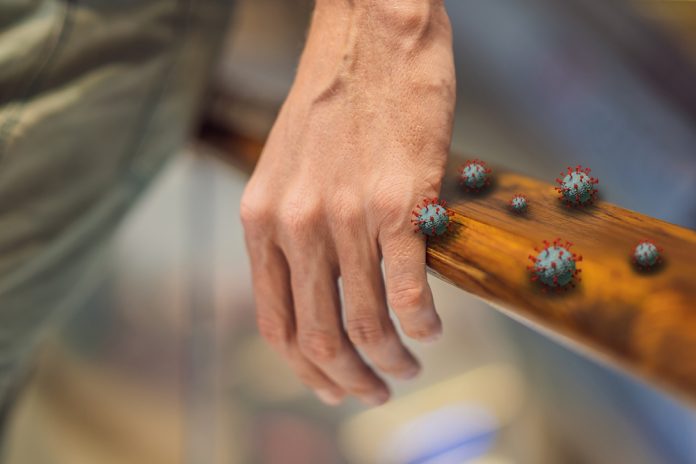
Innovation News Network explores the revolutionary Q-Field coating, which is designed to act as an antimicrobial for more hygienic surfaces and practices.
The first time you hear it, you squint. A clear coating you can roll onto walls and touchpoints that – under ordinary light – continuously knocks back bacteria, viruses and mould in the background? No silver, no harsh biocides, nothing to “leach” into the room.
Q-Field can be used in hospitals, GP surgeries, care homes, dentists, and vets, enabling cleaner, safer air and surfaces as a default state.
Although it sounds like marketing alchemy, it’s precisely why Q-Field is making waves: it asks us to imagine hygiene not as a once-a-day event, but as a steady, invisible process that hums along 24 hours a day, 365 days of the year.
Below is the plain-English version – no lab coat required.
The one-minute explainer: What is photocatalytic action?
Think of Q-Field as a solar-powered helper for your walls – except the “sun” can be any normal indoor light. The coating contains tiny minerals (semiconductors) that wake up when light hits them. Once awake, they create short-lived “cleaning sparks” (reactive species) right on the surface. Those sparks break down the outer layers of microbes (bacteria, viruses, mould and spores) so they can’t survive or multiply.
Q-Field is like a self-cleaning oven, but for microscopic grime, working at room temperature using the light you already have. And unlike a detergent, which cleans only at the moment you use it, this coating keeps working 24/7/365: it’s active all day under light, then carries a residual effect into the night.
What it’s not: a fragrance, a pesticide fogger, or a bleach film. Nothing is “sprayed into” the air; the action happens on the surface and at the air–surface boundary.
What happens in the dark?
Here’s the bit that surprises people: the surface doesn’t go to sleep the second the lights go off. After being “charged” by light during the day, Q-Field retains a reservoir of surface energy – think tiny, stored electrical charges and activated sites. That residual activation keeps working through the night.
Why Q-Field is different from older photocatalytic paints
Classic photocatalytic coatings needed UV (think sunshine or special lamps) to switch on.
Most indoor spaces don’t have much UV, so the effectiveness of UV light sources dipped.
Q-Field’s trick is that it’s engineered to be activated by all visible light – the regular LEDs and fluorescents in hospitals, clinics and homes. That means it’s “on” when the room is in use (no special fixtures), it works throughout the day (daylight, ceiling lights, task lights all count), and it carries protection into the night thanks to that residual “charge.” Because it achieves this without silver or quaternary biocides, it also reduces reliance on chemical additives, making it suitable for people, pets and the planet.
By tailoring the particles (think “band-gap tuning” and surface chemistry), Q-Field shifts from a UV-only catalyst to a visible-light catalyst; some of those light-excited charges get trapped at the surface long enough to keep the antimicrobial effect going after the lights are out, like warmth lingering in bricks after sunset.
Research groups have reported similar “store-and-keep-working” effects in visible-light catalysts that retain activity in the dark after pre-irradiation.
“Safer spaces” in real life: Where this actually helps
In hospitals and health services, it supports high-touch zones, such as bed rails, door plates, monitors, and workstation tops, and the “wet” corners where condensation and biofilms like to start. The coating provides continuous background suppression between cleaning rounds and hand-hygiene moments, and the residual night effect covers out-of-hours.
In retirement and care homes, where residents spend most of their time indoors with recirculated air, lowering microbial load on walls, furniture, and the air skimming past them adds a passive layer of protection without creating new routines for staff. Dentists and veterinary clinics deal in intermittent aerosols and splashes; a light-activated surface that keeps working after the appointment ends is a safety net for staff and the next patient.
Furthermore, in rooms prone to mustiness, it breaks down the organic films mould feeds on and disrupts spores at the surface, helping newly remediated spaces stay that way – primarily through darker months.
Importantly, Q-Field isn’t a substitute for cleaning, ventilation, leak fixes or humidity control. It’s a force multiplier that makes those basics stick.
What about silver and other antimicrobial paints?
The last decade saw a flood of “antimicrobial” paints that rely on biocides, commonly silver (including nanosilver) or quaternary ammonium compounds. They can inhibit growth, but they work by leaching actives, raising questions about long-term safety, resistance and environmental persistence.
Q-Field takes a different path: no added silver or harsh biocides. Its mode is physical and light-driven, not chemical leaching. The manufacturer also describes a stable, micro-scale surface charge effect – imagine an ultra-thin hostile terrain for microbes – that pairs with the photocatalytic action.
Nothing “doses” the room; the wall itself becomes a less hospitable landing pad. Regulators and reviews have repeatedly flagged exposure and environmental concerns around silver-based additives, which is one reason many buyers are looking for non-leaching alternatives.
Evidence from research and field trials
Visible-light photocatalysis works
Multiple peer-reviewed reviews explain how doped TiO₂ and related materials inactivate bacteria and viruses under ordinary indoor light, with lab studies showing effects against both gram-positive and gram-negative bacteria and virus surrogates without UV.
Hospitals observe the impact on actual surfaces
A controlled ward study found that photocatalytic antimicrobial coatings reduced environmental bioburden on near-patient touchpoints; treated surfaces became progressively cleaner while controls accumulated contamination.
In high-incidence units, deployment of photocatalysts has been associated with significant reductions in MRSA acquisition – evidence that these coatings can serve as an adjunct to standard infection-control measures.
Newer evaluations continue to report long-term reductions in pathogen presence on patient-care surfaces after antimicrobial (including photocatalytic) coatings are applied.
The “works in the dark” piece is real
Researchers have developed energy-storage (“photo-charged”) photocatalysts that retain bactericidal and antiviral activity for hours after the lights are off, thanks to trapped charges or redox-active species generated under light – the same carry-over effect facilities want overnight.
How to validate locally
For complex numbers, ask for or commission ISO 22196 (bacteria) and ISO 21702 (viruses); specify recognised antifungal protocols for mould. Increasingly, labs are adapting these to dry, real-life exposure conditions, rather than just wet films, which is helpful for hospital touchpoints and care-home furniture.
The bottom line is that the literature supports visible-light photocatalysis as an effective, low-burden way to suppress microbial load on surfaces and at the air–surface boundary in the kinds of places you care about most: wards, clinics, care homes, dental and veterinary rooms.
Q-Field claims that it packages these science-backed principles into a coating that activates under normal indoor light, holds residual activity in the dark, and avoids biocides. (For background features on Q-Field’s approach and deployments, see Innovation News Network’s recent coverage).
What Q-Field doesn’t do (and why that’s good news)
Q-Field does not replace hand hygiene, routine cleaning or air changes. It does not fog chemicals into the air or shed metallic additives. It does not need special UV lamps – your existing lighting is the switch. It also doesn’t suspend the laws of physics: if there’s a leak or a cold bridge, fix it first; then let Q-Field help keep the space cleaner, longer.
Those limits are strengths. They keep the solution simple, compatible with current infection-prevention regimes, and kinder to occupants (including pets).
Why this is a genuine step-change
Hospitals and care settings are built on layers of defence: source control → surface hygiene → air quality → behaviour.
Q-Field quietly strengthens two of those layers at once—surfaces and the thin film of air right next to them—and it does so continuously, with every hour the lights are on, and with a measurable carry-over effect while the lights are off.
Moving from periodic “peaks” of hygiene to a flatter, steadier baseline is precisely how you reduce the spikes that lead to outbreaks, absences and avoidable harm.
Put bluntly: photocatalytic coatings aren’t new. Photocatalytic coatings that switch on under any normal indoor light, avoid biocides, and hold their charge through dark hours are the inflexion point. That’s the Q-Field idea.
Closing the loop on “too good to be true”
Scepticism is healthy. But sometimes “too good” is just good engineering meeting good housekeeping. Q-Field is not magic; it is materials science tuned to the light you already use, layered on top of the hygiene you already do. If you fix moisture, manage ventilation, and clean as usual, the result does look a little unreal.
So, is it too good to be true? It’s too good and it’s true. The proof won’t be in the brochure. It will be reflected in your swab counts, staff sick days, outbreak logs, and the quiet relief of rooms that stay fresher, longer.