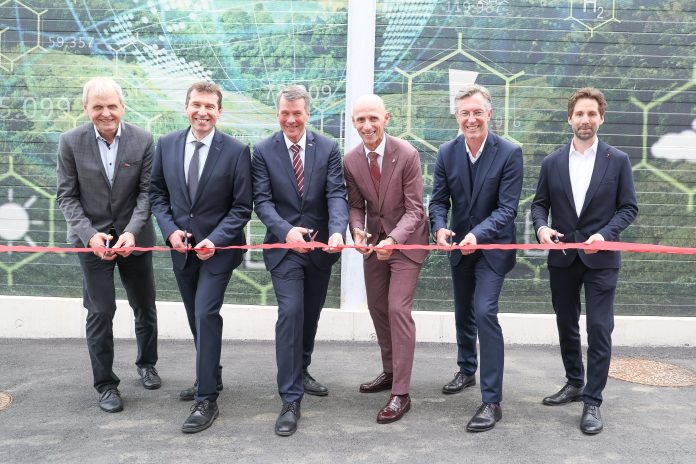
Austria has taken a bold leap toward a climate-neutral future by launching a hydrogen electrolysis test centre at TU Graz’s Campus Inffeldgasse.
This state-of-the-art facility is the first of its kind in the country and marks a major milestone in the nation’s hydrogen strategy.
Spanning 250 square metres, the hydrogen electrolysis centre houses advanced electrolysers with a total output ranging from 1.6 to 2.5 megawatts.
Powered by a dedicated transformer station, the site simulates real-world energy supply scenarios while producing up to 50 kilogrammes of green hydrogen at full capacity.
The hydrogen is compressed to 80 bar and stored in a towering 18-metre tank capable of holding 190 kilogrammes (48m³).
From there, a 315-metre underground pipeline distributes the hydrogen across several research institutes on campus, enabling 24/7 access to hydrogen for next-generation energy experiments.
A €10m investment in clean energy
Backed by €10m in federal funding, the test centre is part of a broader €17m initiative to expand hydrogen research in Styria.
Of this, €4.5m was allocated specifically to the hydrogen electrolysis facility, with the remaining funds directed toward fuel cell testing rigs, gas mixing stations, compressors, and safety instrumentation.
The Research Center for Green Hydrogen and Fuel Technologies – nicknamed the “Hydrogen Campus” – already employs around 250 scientists across four TU Graz institutes and three COMET competence centres.
Their work spans the full innovation chain, from raw material science to hydrogen production, storage, distribution, and usage in vehicles and industry.
Elevating Austria’s global hydrogen profile
By enabling industrial-scale research and development, TU Graz is positioning itself as Austria’s flagship “hydrogen university.”
This integrated research environment offers a rare opportunity to test systems under real-world conditions, supporting both academic discovery and commercial application.
The university’s collaborative approach ensures strong ties between academia, government, and industry.
This not only advances Austria’s hydrogen goals but also attracts international attention, reinforcing Styria’s growing status as a European hub for hydrogen innovation.
Complementary efforts across Styria
The region’s commitment to hydrogen goes beyond TU Graz. Montanuniversität Leoben, which received €7m in federal funding, complements the efforts in Graz through its work at the Hydrogen and Carbon Research Center Austria (HY-CARE).
Its focus lies in process technologies that scale hydrogen production for heavy industrial use while examining the entire hydrogen-carbon value chain.
Together, these institutions create a powerful network driving innovation across national borders. Joint efforts are helping to transform Styria into one of Europe’s first hydrogen valleys dedicated to industrial applications.
Real-world testing for future tech
The hydrogen generated on-site fuels a diverse portfolio of testing platforms. Researchers are now conducting rigorous assessments on large engines, turbines, hydrogen burners, and fuel cell stacks – technologies that form the backbone of tomorrow’s clean energy infrastructure.

The facility’s design supports long-term durability testing, accelerated ageing simulations, and advanced degradation analysis.
Integrated high-precision analysis tools allow real-time gas and water quality monitoring, ensuring hydrogen produced meets global standards – even before purification.
Innovation under extreme conditions
One standout feature of TU Graz’s new infrastructure is its ability to simulate extreme environmental conditions, including steep angles and high temperatures – conditions relevant to maritime and aviation uses.
A newly developed fuel cell stack test rig aims to extend operational lifespans and reduce reliance on rare earth metals like platinum.
Meanwhile, hydrogen-powered high-temperature burners are being trialled at TU Graz’s Institute of Thermal Engineering.
These experiments test hydrogen-natural gas blends at exhaust temperatures up to 1,500°C and power outputs as high as 1.2 megawatts. The results could reshape how industries use gas for heat and power.
Toward a sustainable energy future
The hydrogen electrolysis centre is a launchpad for the green technologies that will power the next generation. From fundamental science to large-scale application, TU Graz is creating an ecosystem where innovation meets implementation.
By bridging the gap between the lab and the marketplace, Austria is laying the foundation for a sustainable, hydrogen-fuelled economy and leading Europe in the race to carbon neutrality.