Large ocean animals can be protected throughout much of their lifecycle by huge Marine Protected Areas (MPAs), according to new research from the University of Exeter.
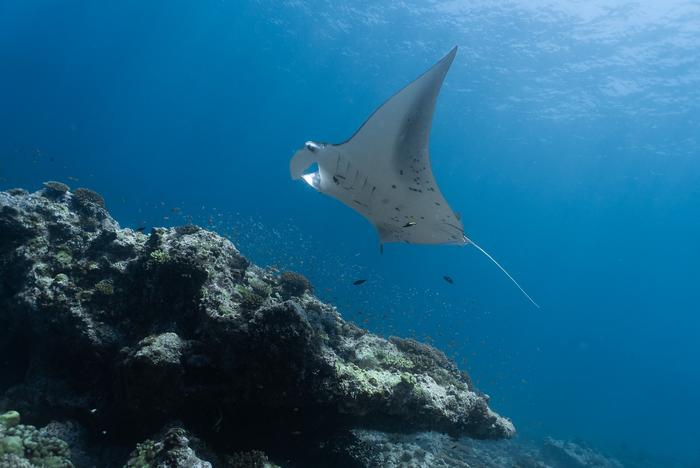
As part of the research, scientists tracked sea turtles, manta rays and seabirds – all of which travel far and wide to forage, breed and migrate – in the Chagos Archipelago Marine Protected Area in the Indian Ocean.
In total, 95% of tracking locations were recorded inside the MPA’s 640,000 square kilometre area, suggesting it is large enough to protect these wandering animals.
The study, by a team including Exeter and Heriot-Watt universities and ZSL, also assessed the impact of a smaller 100,000 square kilometre MPA and found that seabirds would be less well protected in this scenario.
“Very large Marine Protected Areas are seen as essential for meeting international goals, such as the target for 30% protection by 2030,” said Dr Alice Trevail, from the Environment and Sustainability Institute at the University of Exeter’s Penryn Campus in Cornwall.
“Our results provide clear evidence for the value of the Chagos Archipelago VLMPA for protecting a diverse range of large and mobile marine species.”
Seabirds are covered the least by Marine Protected Areas
The researchers used tracking data on hawksbill turtles, reef manta rays and three seabird species: red-footed boobies, brown boobies and wedge-tailed shearwaters.
“These large animals play a variety of important roles in marine ecosystems,” said co-author Dr Ruth Dunn, from Heriot-Watt University.
“For example, the Chagos Archipelago supports a huge number of seabirds, and the guano (droppings) from these birds helps to fertilise coral reefs and other marine species.”
In their assessment of a hypothetical smaller VLMPA (100,000 km2), the team found 97% of manta and 94% of turtle locations would still be in Marine Protected Areas.
However, just 59% of all seabird locations would be inside the MPA because they travel over a larger area.
Evaluating areas for future long-term protection
With the anticipated change in sovereignty, as the Chagos Archipelago becomes part of Mauritius, the study’s findings are increasingly important.
While providing compelling evidence for the value of Marine Protected Areas, Dr Dunn said that they also indicate areas that are priorities for future long-term protection to ensure the viability of this marine megafauna community.
Ernesto Bertarelli, President of the Bertarelli Foundation, which funded the study, commented: “Discoveries like this are only possible when scientists from different disciplines work together.
“By doing so, this team of researchers has shown how truly large Marine Protected Areas can provide vital protection to vulnerable species throughout their lives.”