GATE integrates digital twins, advanced machine learning, and trusted data-sharing infrastructures to enable sustainable urban, health, and industrial transformations.
GATE Institute is the first dedicated Big Data and artificial intelligence (AI) Centre of Excellence in Bulgaria and Eastern Europe, co-funded by the European Commission (EC) and the Bulgarian Government, and established as a joint initiative of Sofia University St. Kliment Ohridski and Chalmers University of Technology and Chalmers Industrial Technologies, Sweden. Having the vision to enable a data-driven smart society, GATE is facilitating digital transformation by leveraging the opportunities that Big Data and AI technologies create and by accelerating their impact across society. GATE performs research and creates innovations in application domains such as Future Cities and Digital Health.
As the Bulgarian hub of the International Data Spaces Association (IDSA), GATE plays a pivotal role in building secure, sovereign, and trusted environments for data sharing. Providing advanced infrastructure – platform, data, services and testing and experimentation facilities, GATE aims to be the recognisable national Data Space with credible potential. By implementing federated architectures and IDS-compliant components, GATE enables organisations to participate in collaborative innovation while preserving data sovereignty and privacy. GATE also aims at more democratic and widespread AI, building on novel decentralised machine learning (ML) algorithms that can cope with distributed collectives of local models through federated learning and knowledge distillation, device-centric AI and ML crowd training.
By combining ontological engineering models and semantic technologies with the specification of logical policies and constraints, GATE develops a new level of intelligence capable of dealing with both static and dynamic data in a variety of business domains.
Aligned with Europe’s regulatory and ethical leadership in AI, GATE contributes to the implementation of the EU AI Act, supporting businesses, governments, and academia in understanding and applying compliance-ready AI. Its expertise in responsible and human-centric AI ensures that innovation goes hand in hand with legal, ethical, and societal safeguards.
The Future Cities application domain
The Future Cities application domain explores the potential of digital twin technologies to address real-world urban challenges in planning, design, and service delivery. The pilot project develops a scalable city digital twin as a technical solution for the design, exploration, and experimentation of urban environments and processes. The objectives include the production of a high-quality 3D city model of Sofia, semantic enrichment of the model, and its application for simulation, analysis, and visualisation. The digital twin approach – ‘design, test, and build first digitally’ – demonstrates the added value of data-driven methods for decision-making and promotes the integration of digital twins into city processes.
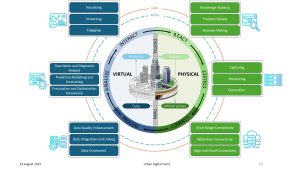
The 3D model of Sofia has been created using cadastral data describing buildings, green spaces, relief, and the road network. The model is continuously enhanced with remote sensing data such as orthophotos and satellite imagery to achieve higher levels of detail. Built on widely adopted standards such as CityGML and extended with FIWARE Smart Data Models or custom-designed models for specific use cases, the 3D model is visualised using a Caesium virtual globe for interactive exploration.
As part of ongoing innovation, a conceptual Application Domain Extension (ADE) of the CityGML 3.0 Vegetation module has been proposed. This extension enhances the modelling of trees and green spaces through the new ‘hook’ mechanism in CityGML 3.0 and incorporates dynamic aspects of vegetation growth and management using the Dynamizer module. New data types, code lists, and enumerations provide a unified and comprehensive description of vegetation characteristics, supporting advanced research in areas such as urban heat island effects, vegetation dynamics, and environmental impact assessment.
Several use cases illustrate the potential of the city’s digital twin. In urban planning and environmental analysis, solar radiation studies are conducted at the city scale to inform energy harvesting with PV panels, passive building heating, cooling load management, and microclimate evaluation. These studies integrate 3D building data with remote sensing for an accurate representation of shading in Sofia’s mountainous context. In transportation planning, a novel digital-twin-based micro-traffic simulation approach is developed to improve urban mobility and safety. Leveraging data from the GATE City Living Lab, including LiDAR monitoring of vehicles and pedestrians, traffic simulations are performed using SUMO (Simulation of Urban MObility). Machine learning methods, such as Random Forest models, are applied for the reclassification of unrecognised objects, enabling more accurate trajectory and object analysis. This workflow provides a scalable solution for traffic management and urban planning that can be adapted to different urban settings.
The Future Cities domain demonstrates how digital twins and advanced modelling can create actionable insights for sustainable and data-driven urban development, supporting more efficient planning, safer transportation, and improved quality of life.
The Digital Health application domain
In the Digital Health (DH) application domain, GATE advances research and innovation along several interconnected streams. One important line of work focuses on biomarkers for the early diagnosis, prognosis, and treatment of neurological diseases. The goal is to identify relevant biomarkers and develop robust methods for patient classification and cognitive trajectory estimation. To this end, GATE applies a range of AI/ML and segmentation methods, including convolutional neural networks (CNNs) and autoencoders, combined with local data–driven insights. Current research has already demonstrated significant progress in the early diagnosis of Alzheimer’s disease, and the methodologies are now being extended to other neurodegenerative ‘hypersynchrony’ diseases. By incorporating brain connectivity as a foundation for mechanistic understanding, AI/ML approaches are further adapted to detect and refine disease-specific parameters across multiple conditions.
Another stream of research addresses real-time patient monitoring and alerting for hazardous events. Here, GATE develops systems that use remote optical sensors to detect seizures, life-sign disruptions, or lethal syndromes such as SUDEP, SIDS, and central apnea. In collaboration with the Centre of Expertise for Epilepsy and Sleep Disorders SEIN (The Netherlands), a real-time motor seizure detection and warning device has been developed. While the Dutch partner is focusing on a clinical-use version, GATE is creating a home-use device, which integrates AI/ML for personalisation together with a patented GATE subsystem for optical patient tracking and PTZ camera control. Both versions are now in the final phases of testing and validation.
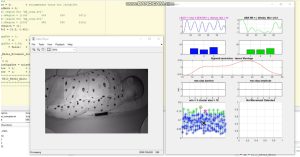
Building on this foundation, GATE also explores the integration of biomarkers with real-time detection and alerting in the context of telemedicine, where the combination of these capabilities contributes to more effective remote healthcare solutions. At the same time, methods initially developed for patient monitoring are being extended to applications beyond health. For instance, real-time fall detection is being adapted for smart city environments, creating synergies between the Digital Health and Future Cities domains and demonstrating how big data can generate real-time societal impact.
Across all these research areas, GATE is advancing innovations in machine learning itself. Current work emphasises online learning, personalisation, and adaptive systems – approaches that, although still in early development, have the potential to significantly expand the applicability and impact of the technologies. Importantly, all algorithms, subsystems, and modules developed within the DH domain are designed in a modular way, allowing them to be reused and integrated into diverse systems, particularly in contexts where strong cross-domain synergies exist.
GATE Data Space Lab
As the Bulgarian hub of the International Data Spaces Association (IDSA), GATE drives the development of sovereign and standards-based infrastructures for trustworthy data sharing. A key initiative is the GATE Data Space Lab, an innovation environment for experimentation, demonstration, and training. The lab functions as a fully operational testbed, designed in alignment with international standards and equipped with IDSA-certified components, including a sandbox for implementing and validating data-sharing scenarios. Complemented by services such as technical and legal training and business model development, the lab accelerates the deployment of real-world data space use cases.
At the core of this infrastructure is the GATE Dataspace Connector, the first in Eastern Europe to achieve IDSA Assurance Level 1 Certification. The connector guarantees interoperability, compliance, and secure exchange of data, while safeguarding full data sovereignty. It enables organisations to define and enforce usage policies, track provenance securely, and manage access with precision.
These capabilities underpin the development of Bulgaria’s first Urban Data Space, supporting complex urban applications in areas such as air quality monitoring, sustainable mobility, energy efficiency, and data-driven urban planning. Leveraging federated software architectures and federated machine learning, this infrastructure allows insights to be drawn from distributed datasets without transferring sensitive information outside secure environments. Such an approach enhances predictive modelling – optimising traffic flows, reducing pollution exposure, or managing energy demand – while strengthening trust among stakeholders managing critical or personal data.
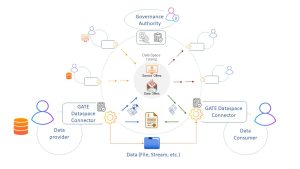
Through its certified connector, demonstrator lab, and active contribution to European initiatives, GATE is building a resilient, interoperable ecosystem for data-driven innovation in Big Data and artificial intelligence.
The GATE Data Platform
The GATE Data Platform underpins research and innovation by providing both infrastructure for internal projects and a hosting environment for external partners and clients. Built on the modern concept of a private cloud, the platform integrates a wide range of system resources, including GPUs, application servers, and advanced software tools. These resources are accessible locally in client/server mode as well as remotely via the Internet, ensuring flexibility and scalability.
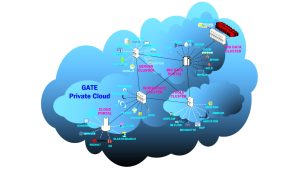
The platform is fully virtualised, supporting multiple levels of operation – virtual machines, containers, application servers, and standalone services. It incorporates four distinct database systems capable of storing data in formats such as SQL, JSON, RDF, and CityGML. Direct integration with the local distributed file system of a Cloudera Hadoop cluster enables efficient processing of Big Data in both offline and real-time modes.
Designed to accommodate both software-centric and data-centric projects, the platform aligns with modern engineering practices, including DevOps, DataOps, AIOps, and MLOps. It offers a full stack of preinstalled tools to support data management across the entire lifecycle – from data acquisition and transport, through platform-level processing and repository storage, to advanced analysis and interpretation. Cutting-edge AI techniques such as semantic integration, data enrichment, deep machine learning, reinforcement learning, and prompt engineering are natively supported.
The platform also hosts data services for major international projects. Notably, it supports DiverSea, a European initiative studying the dynamics of marine biodiversity across coastal regions from the Black Sea to the North Sea, demonstrating its capacity to enable large-scale, data-intensive research with societal and environmental impact.

The Project “Big Data for Smart Society” (GATE) is funded by Horizon 2020 Teaming programme and Operational Programme “Research, Innovation and Digitalisation for Intelligent Transformation“ 2021-2027 r., co-funded by the European Union.
Please note, this article will also appear in the 24th edition of our quarterly publication.