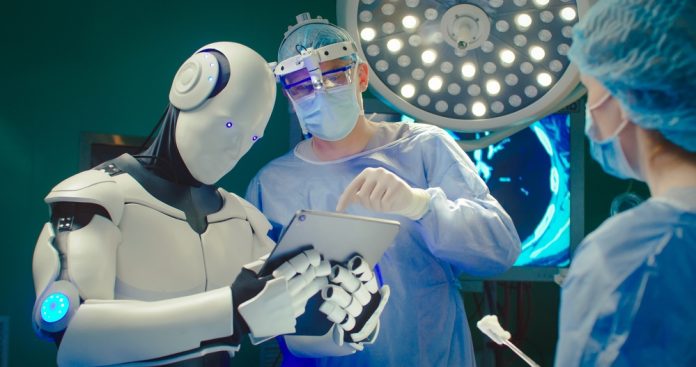
Interim trial data has shown that a revolutionary AI doctor assistant can dramatically reduce admin and improve patient care.
NHS clinicians will be supported to use the AI doctor assistant to take notes to free up staff time and deliver better care to patients, thanks to guidance published today.
The new technology means more people could be seen in A&E, clinicians could spend more time during an appointment focusing on the patient, and appointments would be shorter.
Through its Plan for Change, the UK Government says it is getting the NHS back on its feet and slashing waiting lists.
Guidance published today will encourage using these products, which use speech technologies and generative AI to convert spoken words into structured medical notes and letters across various primary and secondary care settings, including hospitals and GP surgeries.
AI doctor aids set to reform the health system
The government’s mission-led approach is driving forward the use of new technologies, such as the AI doctor assistant, to reform the health system and improve care for patients, offering them quicker and smarter care.
One of the tools – ambient voice technologies (AVTs) – can transcribe patient-clinician conversations, create structured medical notes, and even draft patient letters.
Patient safety and privacy will be paramount. This is why the guidance will focus on data compliance and security, risk identification and assessment, while ensuring that staff are properly trained before using the technology.
Health and Social Care Secretary Wes Streeting said: “AI is the catalyst that will revolutionise healthcare and drive efficiencies across the NHS, as we deliver our Plan for Change and shift care from analogue to digital.
“I am determined we embrace this kind of technology, so clinicians don’t have to spend so much time pushing pens and can focus on their patients.”
Capabilities of AVT technologies
The NHS England-funded, London-wide AVT work, led by Great Ormond Street Hospital for Children, has evaluated AVT capabilities across a range of clinical settings – Adult Outpatients, Primary Care, Paediatrics, Mental Health, Community care, A+E, and across the London Ambulance Service.
This multi-site evaluation involving over 7000 patients has demonstrated widespread benefits. Interim data shows:
- An increase in direct care: Clinicians are spending more time with patients rather than typing on a computer.
- An increase in productivity in A&E: The AI doctor assistant has supported more patients to be seen in emergency departments by carrying out administrative tasks for A&E staff.
At GOSH, AVTs have listened to consultations and drafted clinic notes and letters. These were then edited and authorised by the clinician before being uploaded to the secure electronic health record system and sent on to patients and their families.
Clinicians agreed that the AI doctor assistant helped them offer more attention to their patients without affecting the quality of the clinic note or letter.
Dr Maaike Kusters, Paediatric Immunology Consultant at GOSH, explained: “The patients I see in my clinics have very complex medical conditions and it’s so important to make sure I capture what we discuss in our appointments accurately, but often this means I am typing rather than looking directly at my patient and their family.
“Using the AI assistant during the trial meant I could sit closer to them face-to-face and really focus on what they were sharing with me, without compromising on the quality of documentation.”