On the west coast of Canada, in a particle accelerator laboratory nestled beneath Vancouver’s misty skyline, a new vision for Canadian subatomic physics research and innovation is emerging.
TRIUMF, Canada’s national particle accelerator centre, has released its 2025–2030 Five-Year Implementation Plan—a sweeping vision that lays out how this globally connected lab will continue to push the boundaries of knowledge while delivering transformative, real-world benefits, strengthening Canada’s international connections and supercharging the national science ecosystem.
New horizons for Canadian subatomic physics
At its heart, TRIUMF is an institution driven by the biggest questions in science: What is the Universe made of? How do stars forge the elements? Could there be unknown particles or hidden forces shaping our reality? Researchers from Canada and around the world explore these mysteries using TRIUMF’s world-unique accelerator infrastructure and isotope production technologies, accelerating subatomic particles to immense energies and probing the very building blocks of matter and the forces that bind them.
TRIUMF research resonates far beyond the realm of the atom; the impacts of this research are profound and wide-reaching. TRIUMF’s strength lies not just in fundamental discovery but also in the laboratory’s vision for the applications and benefits of subatomic physics for society.
The lab’s infrastructure enables researchers to not only gaze deeper into the nuclear forces and the laws that govern the cosmos but also to produce much-needed radioactive atoms for scanning, diagnosing and treating diseases like cancer or Alzheimer’s. By producing life-saving medical isotopes and developing advanced radiopharmaceuticals, TRIUMF is driving advances in the detection and treatment of disease with ever-greater precision.
These advances, including targeted alpha therapies, aren’t just theoretical tools – they are being directly applied in trials and clinics and hospitals today, improving lives through better health outcomes in Canada and around the world. This work continues to evolve as TRIUMF explores new ways to image disease at the molecular level, deliver therapies targeted to novel biomarkers, and incorporate new isotopes.
This philosophy of impact extends beyond medicine. For decades, they have pioneered a technology transfer-centred approach to fundamental research, turning subatomic physics studies into applied technologies. This work spans the characterisation and optimisation of novel molecules and materials, superconductors or next-generation batteries to testing and validating aeronautics components destined for long-range space exploration.
Further, TRIUMF researchers are exploring how the same technologies used to study subatomic particles can be applied to national security, clean energy, and the emerging world of quantum computing. High-precision detectors, isotope-based sensors, and advanced materials are being developed not just to answer scientific questions but to tackle society’s most pressing challenges.
Investing in future leaders
To continue driving these breakthroughs and translating science impact into real-world benefits, TRIUMF is investing in people. Each year, the lab trains hundreds of students, postdoctoral researchers, and technical staff, offering a hands-on education that connects cutting-edge research with real-world skill-building. This talent-building draws on and benefits from TRIUMF’s deep connections to its university member network, which reaches across Canada from coast to coast.
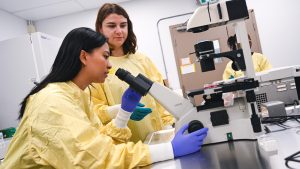
Many of TRIUMF’s trainees go on to become Canada’s leaders in academia, industry, and policy. The lab is also deepening its commitment to equity and inclusion, building a culture where a diversity of perspectives drives innovation and where all voices are empowered to shape the future of science.
Advancements in infrastructure: TRIUMF’s commitment to the future of subatomic physics
Behind the scenes, TRIUMF is also prioritising the modernisation of its major research and accelerator infrastructure to serve its long-term mandate better and fulfil this vision for subatomic physics research. From upgrading digital systems to renewing critical facilities, the lab continues to build capacity to sustain the ambitious goals laid out not only in its Five-Year plan but also its associated 20-Year Vision.
One key initiative, the refurbishment of a critical primary beamline, will provide enhanced operational stability crucial for science delivery across the coming decades, securing TRIUMF’s position as a world leader in accelerator science and isotope production.
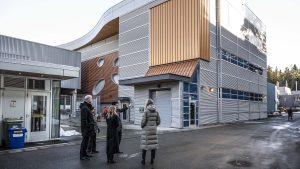
Elsewhere, the laboratory is driving towards completion on two major research facilities also years in the making: the Advanced Rare Isotope Laboratory (ARIEL), which brings online the world’s most powerful superconducting linear accelerator for producing rare isotope beams; and the Institute for Medical Isotopes (IAMI), a state-of-the-art facility for research into next-generation, life-saving medical isotopes and radiopharmaceuticals.
Fostering global collaboration in scientific innovation
At the forefront of TRIUMF’s planning and long-term vision is its global impact and a well-established reputation as an international leader that is a key defining part of its identity. While it pursues essential internal work to set the lab up for future long-term success, TRIUMF is also working to further open its doors to the world, creating new collaborative spaces for interdisciplinary research and welcoming scientists from across Canada and around the globe to take part in its mission.
As one of Canada’s leading contributors to and a portal for international ‘Big Science’ initiatives, TRIUMF plays a key role in projects like the ATLAS experiment at CERN’s Large Hadron Collider (LHC) – one of the most complex scientific instruments ever built.
Here, Canadian researchers are building on decades of contributions to ATLAS that have delved into the structure of the atom with unprecedented precision, allowing us to analyse the fundamental collisions that could reveal the nature of dark matter or even reshape our understanding of physics itself. And, as the Large Hadron Collider’s research communities prepare for the forthcoming High Luminosity upgrades, TRIUMF is aligning its long-term vision to solidify Canadian leadership in the LHC and other global collaborations and shared initiatives.
TRIUMF collaborates closely with partners at CERN, as well as with national labs and research centres across Germany, France, and beyond. These relationships reflect more than just shared data – they represent a shared vision for how countries can work together to advance knowledge and tackle challenges that no single nation could solve alone.
Cultivating a sustainable scientific future
As science communities around the globe navigate increasing uncertainty, these connections will become increasingly important for continuing to advance shared global priorities and drive the benefits of research from the lab bench to society.
All of this – the discovery, the innovation, the training, and the global advancements – adds up to a bold and integrated vision. TRIUMF is not a science lab locked away in an ivory tower; it is a modern, dynamic, and deeply connected institution that translates the wonder of the Universe into progress and tools that improve our lives, partnerships that unite nations, and knowledge that lasts generations. As the 2025-2030 Implementation Plan makes clear, TRIUMF’s work is guided by both ambition and purpose.
It’s about looking outward – to the stars, the atoms, and the frontiers of possibility – and also inward, to the values that define a thriving, sustainable, inclusive scientific community. From this balance, a powerful vision emerges: science not just as a pursuit of truth but as a force for good.
Please note, this article will also appear in the 22nd edition of our quarterly publication.