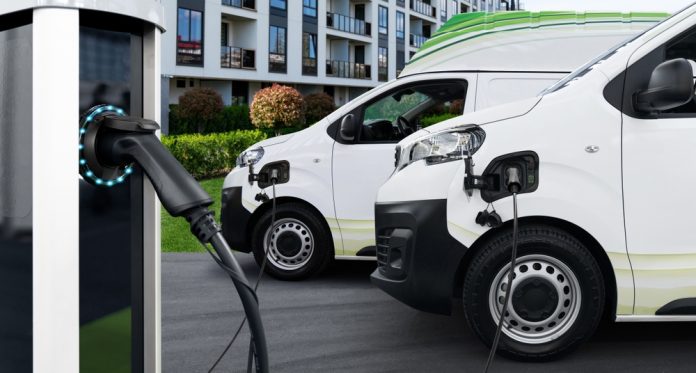
The UK’s journey to net zero is at risk of stalling, with new analysis revealing a major roadblock to decarbonising the nation’s commercial vehicle fleet: commercial EV charging infrastructure.
Despite the growing availability of zero-emission vans and trucks, operators face crippling delays – up to 15 years – for grid connections at depots, threatening the transition away from fossil fuels even before legislative deadlines come into effect.
According to the Society of Motor Manufacturers and Traders (SMMT), the current grid connection process is ill-equipped to support the UK’s ambition to end new non-zero emission van and HGV sales by 2035 and 2040 respectively. Without urgent reform, the UK risks missing critical decarbonisation targets.
Mike Hawes, SMMT Chief Executive, explained: “We cannot deliver net zero and improve air quality without decarbonising commercial vehicles.
“But if operators have to wait up to 15 years just to be able to plug them into their depots, there is no case for investment.
“Prioritising grid connections, alongside reform to planning and action on energy costs, would reduce barriers to adoption, ensuring commercial vehicles continue to carry the loads that keep our economy on the move whilst doing the heavy lifting the nation needs to reach net zero.”
Commercial vehicles: High mileage, high stakes
The UK’s commercial fleet is vast, with 5.1 million vans and 626,000 trucks responsible for transporting over 80% of domestic freight and contributing £13.5bn annually to the economy.
Though these vehicles comprise just 14% of total road traffic, they emit over a third of all road transport CO₂ and account for 12% of the UK’s total carbon footprint.
Replacing diesel and petrol-powered commercial vehicles with zero-emission models would generate CO₂ savings greater than the entire national emissions of Sweden.
But this monumental shift hinges on operators being able to access reliable, scalable commercial EV charging infrastructure – both at depots and across the strategic road network.
Supply grows, but demand stumbles
Manufacturers have delivered in scale, offering 35 electric van models, covering over half the market, and more than 30 electric HGVs. Yet uptake lags far behind expectations.
Just 8.3% of new van registrations are currently electric, well below the government’s ZEV mandate target of 16% for 2025. The HGV sector is even further behind, with zero-emission trucks making up just 0.5% of registrations.
At this rate, the van market will only reach 25% ZEV share by 2027 – well below the mandated 34%. Operators cite infrastructure as the primary obstacle.
Affordable electricity, depot charging availability, and reliable roadside charging are crucial. Without them, even well-funded fleets cannot justify the operational risks of switching.
The urgent need to expand commercial EV charging
Expanding commercial EV charging is a national necessity for the UK. Commercial vehicles are the backbone of logistics, retail, construction, and services. Unlike private EVs, they require more power, more space, and more predictable charging solutions.
The government’s move to fast-track grid connections for sectors like data centres and renewables must be mirrored in transport, says SMMT.
Prioritising depot grid access, standardising local planning policies, and expanding public charging for large vehicles would unlock stalled investment.
Without this, the UK risks derailing its decarbonisation strategy and delaying the broader benefits of cleaner air, lower emissions, and global EV leadership.
The road ahead
While incentives like the Plug-in Van Grant and the Zero Emission HGV and Infrastructure Demonstrator (ZEHID) scheme are helping, infrastructure remains the weak link in the commercial EV chain.
To meet upcoming ZEV sales mandates, the government must urgently accelerate commercial EV charging rollout and eliminate grid bottlenecks.
Time is running out, and the cost of inaction will be counted in carbon, congestion, and lost competitiveness.