Can we do away with the troublesome singularity at the heart of black holes? A new research study has reimagined these extreme objects in light of current knowledge.
In 1915, Einstein published his seminal work on general relativity. Just a year later, German physicist Karl Schwarzschild found an exact solution to those equations, which implied the existence of extreme objects now known as black holes.
From the beginning, however, problematic aspects emerged and sparked a decades-long debate.
Despite the ongoing debate around singularities, scientific evidence for the existence of black holes has continued to grow since the 1970s, culminating in major milestones such as the 2017 and 2020 Nobel Prizes in Physics.
However, none of these observations has so far provided definitive answers about the nature of singularities in black holes.
The unknowable territory of black holes
We can describe black hole physics only up to a certain distance from the centre. Beyond that lies mystery, an unacceptable situation for science.
This is why researchers have long been seeking a new paradigm, one in which the singularity is “healed” by quantum effects that gravity must exhibit under such extreme conditions.
This naturally leads to models of black holes without singularities, like those explored in the work of Stefano Liberati and his collaborators.
Two non-singular alternatives
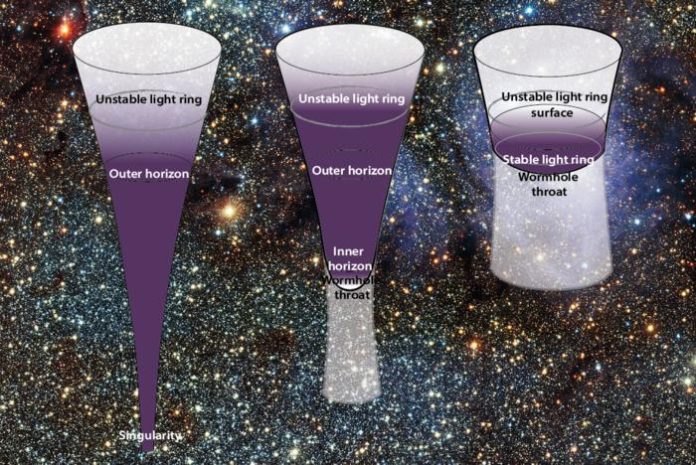
Within the study, three main black hole models were outlined: the standard black hole predicted by classical general relativity, with both a singularity and an event horizon; the regular black hole, which eliminates the singularity but retains the horizon; and the black hole mimicker, which reproduces the external features of a black hole but has neither a singularity nor an event horizon.
The paper also describes how regular black holes and mimickers might form, how they could possibly transform into one another, and, most importantly, what kind of observational tests might one day distinguish them from standard black holes.
While the observations collected so far have been groundbreaking, they don’t tell us everything. Since 2015, researchers have detected gravitational waves from black hole mergers and obtained images of the shadows of two black holes: M87* and Sagittarius A*. However, these observations focus only on the outside and provide no insight into whether a singularity lies at the centre.
“But all is not lost,” said Liberati. “Regular black holes, and especially mimickers, are never exactly identical to standard black holes — not even outside the horizon. So observations that probe these regions could, indirectly, tell us something about their internal structure.”
To do so, researchers will need to measure subtle deviations from the predictions of Einstein’s theory, using increasingly sophisticated instruments and different observational channels.
For example, in the case of mimickers, high-resolution imaging by the Event Horizon Telescope could reveal unexpected details in the light bent around these objects, such as more complex photon rings. Gravitational waves might show subtle anomalies compatible with non-classical spacetime geometries.
The future of singularity observation
Current knowledge is insufficient to determine exactly what kind of perturbations we should be looking for, or how strong they might be.
However, significant advances in theoretical understanding and numerical simulations are expected in the coming years. These will lay the groundwork for new observational tools, designed specifically with alternative models in mind.
This line of research holds enormous promise: it could help lead to the development of a quantum theory of gravity, a bridge between general relativity, which describes the universe on large scales, and quantum mechanics, which governs the subatomic world.
“What lies ahead for gravity research is a truly exciting time,” Liberati concluded. “We are entering an era where a vast and unexplored landscape is opening up before us.”