The future of sustainable, profitable livestock production is here. Agscent’s innovative technology doesn’t just measure emissions and detect early pregnancy—it unlocks new pathways to productivity, efficiency, and market premiums for producers worldwide.
Every burp your livestock makes could cost you money. Methane emissions aren’t just an environmental concern – they’re literally profit escaping into thin air. Now, you can recapture that value. Agscent’s breakthrough greenhouse gas (GHG) sensors put the power of precision monitoring in your hands with technology that’s easy to use, accurate, and tough enough for any farm environment. Whether you run extensive grazing operations or intensive systems, affordable methane monitoring is finally within reach – turning invisible losses into visible opportunities for your bottom line.
Optimising management for productivity, efficiency, and sustainability
To transform your operation, you need data that matters. Real-time methane monitoring gives you insights into making decisions that simultaneously cut emissions, boost animal performance, and increase profitability. Without measurement, you’re guessing – whether it’s testing feed additives, adjusting nutrition plans, modifying grazing patterns, or selecting superior genetics. Agscent’s technology verifies which strategies deliver results, eliminating costly trial and error while maximising return on every management change you implement.
Breeding for lower-emission, more efficient cattle
Methane emissions vary significantly across animals in a herd. Methane emissions are also heritable, and including methane in breeding programmes provides long-term and permanent reductions in emissions. The inclusion of methane into breeding values and the selection of lower-emitting breeding animals within a herd requires monitoring to realise this potential reduction.
Improving animal health and productivity
Monitoring methane emissions provides valuable insights into the health and wellbeing of livestock. Methane production is associated with the efficiency of digestion, nutrient utilisation, and overall gut health. By identifying high methane emitters, farmers can implement management practices that improve animal health and productivity, leading to more efficient farming operations and improved animal wellbeing.
Participating in carbon markets and premium supply chains
Carbon markets enable livestock producers to monetise emission reductions and improve their climate footprint. With significant variation in emissions limiting methane modelling accuracy, real-time verified data is essential for market trust and transparency. Similarly, premium supply chains require validated environmental data alongside quality and economic metrics. Forward-thinking producers with verified low-emission credentials can differentiate their products in increasingly environmentally conscious markets.
Agscent’s offerings in methane monitoring
To increase livestock emissions monitoring to the levels needed to realise these benefits, an easy-to-use, simple, accurate, and mobile system of measuring and monitoring methane and live weights in animals is needed. This is where the Agscent devices really stand out:
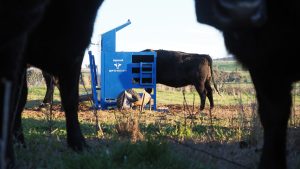
Agscent Air GHG x Optiweigh system
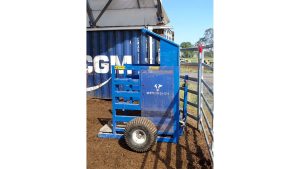
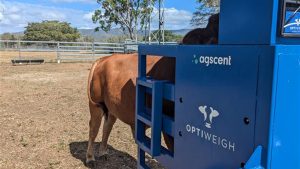
This GHG sensor unit is integrated into Optiweigh’s automatic weighing technology, capturing individual animal productivity (i.e., weight data), which is then paired to individual methane and CO2 readings remotely and automatically sourced from grazing and feed yards production systems.
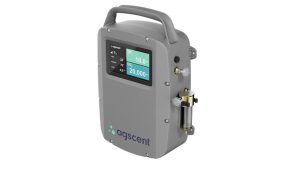
Agscent Air: GHG 2100
This flexible device is a mobile, real-time, precise methane data measurement system with the flexibility of mounting the sensors in a location of our customers’ choosing. Data is accessible remotely and can include individual animal identification readers, additional VOC sensors, and be solar-powered.
Transformative value: For producers and the planet
Examples of how the Agscent Air GHG products are currently being used include:
Selection for low-methane genetics
A seed stock producer in the Southern Tablelands of NSW, Australia, is using the Agscent Air: GHG x Optiweigh model to measure methane and inform breeding decisions, creating permanent, cumulative improvements in both emissions and feed efficiency across generations.
Feed additive optimisation
Commercial trials in Australia and the US have used the Agscent Air: GHG x Optiweigh and Ascent Air: GHG 2100 technology to quantify methane reductions from innovative feed additives. These results have provided independent verification for marketing claims and carbon credit applications.
Queensland’s South Burnett region
A customer has been using the Agscent Air: GHG x Optiweigh system to measure emissions in feedyard cattle when a feed additive was included in the diet.
What they found: Approximately 50% reduction in methane emissions, with rapid decreases immediately after the addition of the additive.
Outcomes: Expanded their research agenda to further validate their product, including renting additional Agscent Air: GHG x Optiweigh units for these expanded producer trials.
Australian feed additive developer
Another customer in Australia has been using the Agscent Air: GHG 2100 for controlled semi-enclosed pen trials of a feed additive with young cattle in NSW, later expanding to dairy cattle trials with additional units.
What they found: Their innovative additive provided up to 90% reduction in emissions in controlled trials, with immediate positive results upon additive inclusion.
Outcomes: Expanded their research agenda, closed a Series A funding round, added additional Agscent methane monitoring systems to their research programme,
and integrated Agscent data into supply chain reporting as an adoption tool.
US Great Plains region
A company in the United States’ Great Plains region has been assessing the methane-reducing capacity of a feed additive with an Agscent Air: GHG x Optiweigh in feed yard cattle as part of a trial to develop a premium low-emission beef brand by a major US retailer.
What they found: The feed additive showed a greater than 50% reduction in methane emissions, with rapid decreases following additive introduction.
Outcomes: Expanded their research agenda with follow-up trials throughout the US and internationally. They have closed a Series A capital round and are continuing to use Agscent devices, including for the registration of their product for methane credits.
Scientific validation
Agscent Air: GHG technologies have been evaluated in validation trials with the University of Sydney (Australia), Cornell University (USA), and CSIRO (Australia). Additionally, the technology has been used in trials at Kansas State University, collecting methane emissions phenotypes for genetic selection of lower-emission cattle.
The University of Sydney, Australia
Agscent GHG x Optiweigh station was evaluated in three trials under pen and paddock grazing conditions against feed intake, live weight, and growth rate of 20 beef cattle and GreenFeed™.
Key findings:
- Agscent Air: GHG x Optiweigh unit (ppm) had strong correlations (p< 0.001) with CH4 (g/d) from the GreenFeed™ system (r ~ 0.70), feed intake (r ~ 0.50), live weight (r ~ 0.80), and growth rate (r ~ 0.50).
- Wind speed did not play a role in the estimation of emissions.
- Data collected for longer periods and averaged for each animal resulted in stronger correlations.
Cornell University, USA
Cornell University has conducted validation trials on both the Agscent GHG x Optiweigh unit and the Agscent Air: GHG 2100 standalone unit.
The Agscent Air: GHG x Optiweigh and GreenFeed™ was compared to respiration chambers. The trial involved 12 late-lactation, pregnant Holstein cows measured with three replicates for three days across each system. In addition, the Agscent Air: GHG 2100 unit was placed inside the respiration chamber for five days to measure CH4 and CO2 concentrations.
Key findings: Significant correlations were found between the Agscent Air GHG 2100 standalone sensor and respiration chamber measurements, with Pearson’s correlation coefficients of 72% for methane, 66% for carbon dioxide, and 93% for ambient temperature (p < 0.01).
Additional analysis of Cornell University Data
Agscent found that the Agscent Air: GHG x Optiweigh CH4 ppm was significantly (p=0.006) correlated 74% to the respiration chamber g/day. Further, the coefficient of variation (CV) analysis demonstrated that, as variability increased in respiration chamber measurements, a corresponding increase occurred in Agscent Air: GHG x Optiweigh measurements.
CSIRO, Australia
Four Droughtmaster steers (Bos indicus x Bos taurus) had their methane levels measured by the Agscent Air: GHG 2100 standalone unit, the Agscent GHG x Optiweigh unit, and respiration chambers.
Key findings: Comparative analysis between Agscent Air: GHG 2100 and CSIRO’s respiration chambers demonstrated a dilution rate of 45% and the ability of Agscent Air: GHG 2100 device to successfully ranking the animals similarly to the CSIRO chamber, indicating reliability in relative measurements. This finding is particularly significant for selective breeding applications, where relative rankings drive genetic selection decisions.
Additional analysis of CSIRO data
Agscent found that, when comparing animal average methane emission data, measurements from the Agscent Air: GHG 2100 standalone device (configured as a sniffer in respiration chambers). Further, the Agscent Air: GHG x Optiweigh system (deployed in paddocks) showed strong correlations of 0.91 and 0.89, respectively, with the CSIRO respiration chamber measurements.
Contact Agscent today
Agscent Air:
Where precision measurement
meets productivity
Please note, this article will also appear in our Animal Health Special Focus publication.