CoreWater is committed to the environment and is working to develop technologies that will create a safer world for generations to come.
With a mission to eliminate harmful per-and poly fluoroalkyl substances (PFAS) forever, CoreWater Technologies (CWT) has developed an innovative technology that offers a safer, cost-effective way to remove PFAS chemicals from water. The solution provides an in situ process for complete PFAS remediation – achieving PFAS adsorption, removal, isolation, and destruction. The technology can also reduce the impact on landfills and the air we breathe.
The company’s flagship technology, Core+™, utilises the industry-standard media granular activated carbon (GAC) and adds a functionalised coating to effectively remove PFAS from water.
To learn more about the technology, The Innovation Platform spoke to Dennis M. Flood, President and CEO of CoreWater Technologies, Inc.
What inspired the founding of CoreWater Technologies, and what problem were you aiming to solve from the start?
CoreWater Technologies was founded with a singular mission: to remove and destroy the PFAS contaminating the world’s drinking water. We recognised early on that legacy technologies were falling short because 1) they were simply deferring the problem; and 2) they were ultimately unsustainable. Our goal was to create a solution for eliminating PFAS from the environment that was not only effective but also scalable, accessible, and sustainable.
What sets CoreWater apart from other companies tackling PFAS contamination?
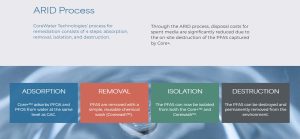
Unlike many players in the PFAS space, we don’t just adsorb PFAS – our ARID Process™ (Adsorb, Remove, Isolate, Destroy) allows for the complete destruction of them. Our technology is designed for closed-loop treatment, eliminating the need for costly reactivation or disposal. We are also prioritising modularity, making our systems viable for communities of all sizes.
There are several proven PFAS destruction technologies that are currently used for landfill leachate and spill site cleanup but cannot be effectively or economically applied to potable water production. They need a concentrated source of PFAS and are not able to handle the potentially millions of gallons of water at water treatment facilities. CoreWater’s technology provides a ‘bridge’ for those destruction technologies to be applied to potable water production.
Can you explain how your patented composite particle works to adsorb and how the PFAS are destroyed?
Core+™ is designed to strongly enhance hydrophobic adsorption of PFAS. This provides a stronger bond than is achieved through the van der Waals or electrostatic binding capabilities of regular GAC. The hydrophobic bond gives Core+™ specificity for PFAS and also allows for a simple chemical rinse to be performed in situ. This eliminates the need to empty the filter bed when breakthrough has occurred.
Once removed from and isolated from the Core+™, the PFAS molecules can be destroyed by any of several proven destruction methods, such as electrochemical oxidation (EO), supercritical water oxidation (SCWO), hydrothermal alkaline treatment (HALT), etc. Our R&D has shown that one bed volume of Core+™ can be rinsed and reused multiple times with minimal and predictable loss of effectiveness.
The final rinse of a bed of Core+™ will result in a GAC-based particle that can be repurposed for use in other carbon-based applications. Possibilities include conductive composites, mechanical reinforcement of thin films, as a filler in composite materials, initiation sites for graphite polymerisation, and many more.
What makes your approach to PFAS remediation more sustainable or cost-effective than traditional methods like GAC or anion exchange resins?
Traditional methods, like GAC and anion exchange resins, adsorb PFAS and become hazardous substances that require their own expensive disposal and/or reactivation processes. Our technology eliminates that burden by isolating and destroying PFAS on site. This reduces operational costs, carbon footprint, and long-term liability.
The anion exchange resins most widely used for PFAS removal are not reusable. The result is that the resins cannot be recovered in situ. The same applies to standard GAC. GAC renewal requires the entire bed to be emptied and trucked to a central facility, where it must go through a high-temperature reactivation process. That process, itself a large-scale source of greenhouse gas emissions, will destroy 15-25% of the original GAC. Replacing that 15-25% with new, virgin GAC can more than double the production of greenhouse gases per reuse. There is also a limit on the number of reactivations that can be made on the initial volume of GAC, meaning full replacement with virgin GAC will be required sooner rather than later.

PFAS captured by Core+™ can be removed from the bed in situ, isolated, and destroyed. Current R&D at CWT indicates that Core+™ can be reused at least ten times. An absolute upper limit has not yet been established. Coupled with the ARID Process™, we have developed a sustainable solution for PFAS remediation. Eliminating GAC reactivation alone reduces greenhouse gas (GHG) emissions by 90% and there is no longer a need to truck millions of pounds of hazardous material to reactivation plants. We deliberately designed our technology and process to be sustainable by not only being able to reuse the Core+™ absorbent but also the rinse solution.
What kind of third-party validation or pilot-scale testing has CoreWater’s technology undergone to date?
The company has extensive laboratory data validating all aspects of its technology and has started a series of independent third-party pilot tests. It is worth bearing in mind that the pilot tests needed to validate CoreWater’s full ARID Process technology are more complex than simple adsorption testing. The pilot test skid needs to have a complete, properly scaled reproduction of the full ARID Process™, not just an adsorbing column. The first absorption-only pilot test is scheduled to be run by an independent third-party in early autumn 2025. That will be followed by the full pilot skid system soon after.
How does your technology integrate with existing municipal or industrial water treatment systems?
Our patented adsorbent, Core+TM, is designed for plug-and-play integration. It has been developed as a drop-in replacement for the both the GAC and anion exchange resins used in existing water treatment systems. If the utility has an existing PFAS ‘polishing step’ already removing PFAS from its output water flow, the estimated additional CapEx needed for the full ARID system (without destruction) will be on the order of 10-15% of the already installed adsorption system CapEx. There would be a very small OpEx for an installation of Core+™ and The ARID Process™ compared to the cost of full changeout and off-site treatment for traditional GAC and anion exchange resins.
How is CoreWater thinking about environmental justice – ensuring that small or under-resourced communities can access your solution?
CoreWater’s technology is scalable across a wide range of community water systems. These systems are defined in the United States by the United States Geological Survey (USGS) and are divided into a set of population/customer ranges. CoreWater’s technology can be delivered either as a built-in polishing step for a new or existing PFAS removal system, or a leased system skid for any size utility that cannot otherwise afford the CapEx. The latter approach should make the technology accessible for smaller utilities for which obtaining CapEx is a major issue.
What kinds of clients or sectors will benefit from using CoreWater’s solutions – municipalities, industry, or consumers?
The technology can be used in all three market segments, both as a capital add-on polishing step for larger utilities and industrial users as well as an interchangeable leased subsystem for smaller entities in the utility, industrial commercial, and hospitality services markets.
What are the biggest challenges CoreWater faces in the PFAS remediation space today?
CWT’s biggest challenge is achieving commercial readiness for its technology in a timely manner. The technology development roadmap is well laid out. The company is on schedule to have a commercial full system skid ready for lease or sale to a small/medium-scale community water systems by the end of the first quarter of 2026.
How do you see regulatory changes – like the EPA’s new PFAS limits – impacting demand for your technology?
United States Federal regulations that call for reducing and ultimately eliminating exposure to PFAS in potable water, food and everyday products will more than significantly increase demand for CWT’s full ARID process technology. The current U.S. EPA has pushed back the timelines for water treatment facilities to install PFAS remediation solutions. This gives the company more time to work with established PFAS system providers as potential licensees and distributors of the technology.
What role does public awareness play in driving adoption of PFAS remediation technologies?
The rapid growth in public awareness has and will play a major role in implementing PFAS remediation from the environment and eliminating its impact on public health worldwide. State regulations have outpaced Federal regulations across the board. Several states have already implemented stricter guidelines for PFAS exposure and remediation.
How does CoreWater plan to compete with incumbents in the PFAS space – on performance, price, or something else?
CoreWater plans to work with existing providers of PFAS capture systems to expand their capability to include complete remediation of PFAS, not just removal from one area of the biosphere to another. There are, at present, no incumbent providers in the PFAS space that can offer complete remediation. Given the magnitude of the problem worldwide, competition from other full-solution providers (there are no doubt several in various stages of development) does not present a threat to gaining a large market presence.
It is going to take a collective effort to remove PFAS from our water and from the environment. No one company or technology will be able to complete the job. It will take several.
Has CoreWater considered licensing its technology, or will it pursue direct market entry and manufacturing?
CoreWater’s primary business objective has been to license the technology to established GAC providers who already have market presence along with the needed infrastructure to service it. Building such an enterprise from the ground up would leave far too many people at risk for the health problems already known to be an issue from exposure to PFAS contamination.
What’s next for CoreWater Technologies in terms of R&D or product development?
Completing product development, including NSF-I certification of Core+™ and the ARID Process™, are important to achieve.
If PFAS were no longer a major global problem in ten years, what role would you hope CoreWater had played in that outcome?
We anticipate that CoreWater will have made a substantial contribution to the elimination of PFAS from the world environment.
Please note, this article will also appear in the 23rd edition of our quarterly publication.