As the climate crisis accelerates, food production is under growing pressure from unpredictable weather, dwindling water supplies, and degraded soils.
The UK, which imports the vast majority of its lettuce during winter, faces particular risks as southern Europe grapples with rising droughts. Against this backdrop, vertical farms are being championed as a high-tech answer to food insecurity.
By growing crops indoors under carefully controlled conditions, these farms can deliver fresh produce year-round while using far less land and water than conventional agriculture.
But a new study from the University of Surrey reveals a complex reality: while vertical farms boast dramatically higher yields and impressive water savings, they also carry a heavier carbon footprint than field-grown lettuce.
The findings raise a crucial question for the UK: Can vertical farming evolve quickly enough to become both a secure and sustainable source of food in an era of climate uncertainty?
Vertical farming explained
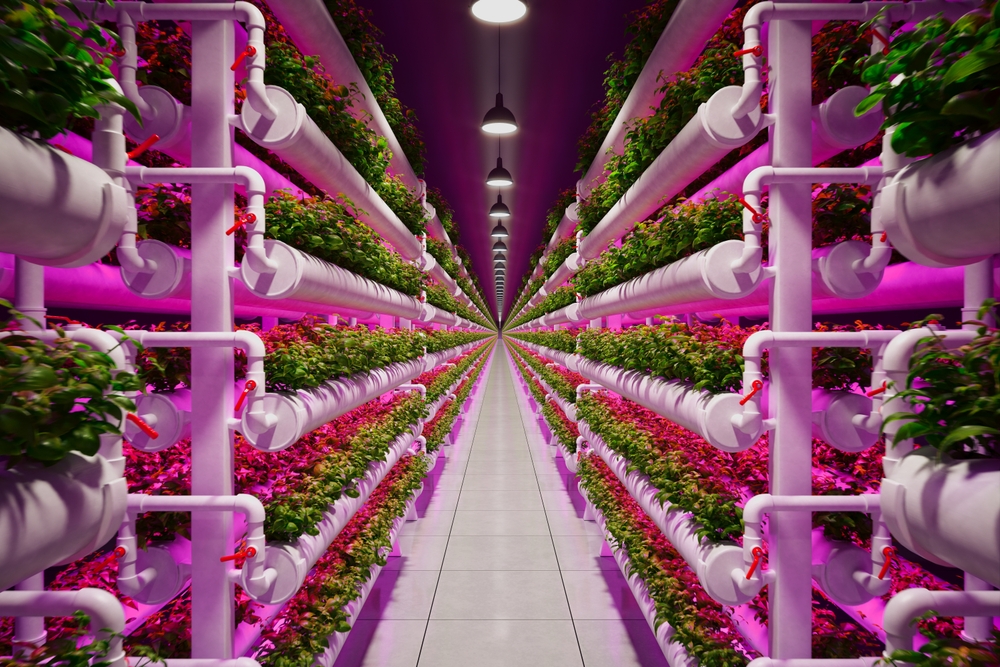
Vertical farming is a method of growing crops indoors in stacked layers, often using hydroponics or aeroponics instead of soil.
These farms rely on carefully controlled environments – temperature, humidity, light, and nutrients – to maximise growth while drastically reducing land and water use.
Instead of sprawling fields, crops such as lettuce can be grown in warehouses or even high-rise buildings, often located near major cities.
Advocates argue this could cut transport emissions, reduce dependency on imports, and help countries like the UK secure a reliable supply of fresh produce.
Record yields and lower water use
The study compared vertical farming with traditional lettuce production in the UK and Spain. Results revealed staggering differences in productivity.
Vertical farms delivered around 97 kilogrammes of lettuce per square metre, compared with just 3.3 kilogrammes from field farms.
Water savings were also significant: vertical systems required 0.9 m³ per kilogramme of lettuce, compared with up to 7.3 m³ in Spain’s irrigated fields.
This efficiency could prove vital as southern Europe faces worsening droughts and the UK relies heavily on imported lettuce during the winter months.
The carbon footprint problem
Despite the clear benefits in yield and water use, vertical farms currently fall short when it comes to greenhouse gas emissions.
The research found that vertically farmed lettuce produced 0.93 kilogrammes of CO₂ equivalent per kilogramme, compared with 0.57 kilogrammes from UK field farms.
Much of this impact stems from the energy demands of artificial lighting and climate control systems, as well as the use of jute fibre plugs for growing.
Even when powered by renewable electricity, the energy intensity remains higher than that of open-field farming.
Opportunities for innovation
The researchers suggest that the environmental costs of vertical farming can be reduced with better technology and materials.
For example, switching from jute plugs to alternatives like coconut coir could cut the land footprint by over 95%.
Similarly, improvements in energy efficiency and greater integration with renewable power could make vertical farms far more sustainable in the long run.
If these hurdles can be overcome, vertical farms could help the UK reduce its reliance on imports, free up farmland for ecological restoration, and provide a consistent supply of fresh vegetables year-round.
Michael Gargaro, Postgraduate Researcher at the University of Surrey’s Centre for Environment and Sustainability and lead author of the study, added: “Vertical farming has the potential to transform food security in the UK, particularly as climate change and seasonal drought place growing pressure on traditional agriculture.
“Our research shows that while the technology can bring far higher yields and reduce water use, it currently comes with a higher carbon cost. The challenge now is to make vertical farming more energy-efficient and better integrated with renewable systems, so that it can become a truly sustainable solution.”
The future of food security
With 95% of UK winter lettuce currently imported from Spain, vertical farms could play a pivotal role in building resilience against climate change and global supply chain disruptions. However, their future success depends on solving the carbon challenge.
This research underscores a critical balance: vertical farms offer extraordinary productivity and resource savings, but without breakthroughs in energy use, they risk trading one environmental problem for another.
For now, vertical farming may not be the greenest option, but with innovation and investment, it could become a cornerstone of sustainable agriculture in the decades ahead.