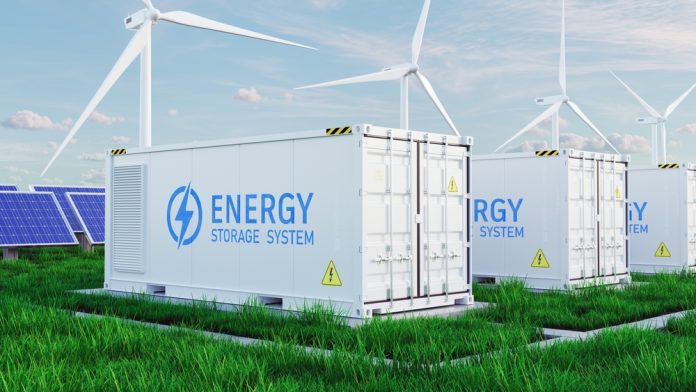
The EU-funded HiHELIOS project is developing TRL 7 innovative modular hybrid battery systems to accelerate renewable energy integration and secure electricity supply.
Europe’s energy landscape is undergoing a strong transformation towards climate neutrality, leading to a higher integration of renewable energy sources like wind and solar photovoltaic (PV). This transition requires new grid flexibility to balance electricity consumption and production. Battery Energy Storage Systems (BESS) are a key solution, but current technologies often force a compromise between power and energy capacity. No single chemistry excels at delivering both high power for grid stability and high energy for long-duration storage.
This is the challenge the Horizon Europe project HiHELIOS aims to solve. By pioneering an innovative Hybrid Energy Storage System (HESS), the project is developing a single, integrated solution that combines the best of both storage technologies, targeting long-duration storage, an estimated lifespan of over 5,000 cycles, and a levelised cost of storage (LCOS) below 0.05 €/kWh by 2030.
The power of hybridisation
The core innovation of HiHELIOS lies in its hybrid design, combining two distinct types of energy storage technologies:
- High-energy storage: For long-duration needs, HiHELIOS leverages second-life Nickel Manganese Cobalt (NMC) battery modules repurposed from electric vehicles (EV). This provides cost-effective, high-capacity storage while reducing the environmental impact of EV batteries by extending their lifespan.
- High-power storage: To handle rapid bursts of power for grid services like frequency regulation, the system integrates either Lithium Iron Phosphate (LFP) batteries or supercapacitors. These components react in milliseconds, providing the instant power needed to ensure grid stability.
This modular approach allows each HiHELIOS system to be precisely tailored to the application’s needs, optimising performance, lifetime, and cost-effectiveness far beyond conventional single-chemistry systems.
A smart, layered control architecture
HiHELIOS is developing an advanced, multi-layered control architecture to ensure the high-energy and high-power systems work in synergy. This hierarchical system consists of three main layers:
- Energy Management System (EMS): Operating in the cloud, the EMS is the high-level strategist. It uses advanced forecasting (weather and energy demand), along with market prices, to plan the optimal charging and discharging schedule over hours or days to maximise revenue and efficiency.
- Power Management System (PMS): Located on-site, the PMS is the tactician. It translates strategic commands from the EMS into real-time actions, making second-by-second decisions on how to split power between the hybrid components and responding accurately to local grid conditions and service requests.
- Battery Management System (BMS): The BMS is the battery guardian. It continuously monitors the health, temperature, and state of charge of every battery cell, ensuring they operate safely and within their limits. It provides such data upwards to the PMS.
This intelligent framework will be enhanced by advanced battery models and ‘digital twins’ for real- time diagnostics and predictive maintenance, further extending the system’s life.
Four diverse user cases in three countries
To prove its versatility, HiHELIOS is deploying its HESS in four distinct use cases across Europe, each tackling a unique grid challenge with both short- and long-duration energy storage needs locally (Fig. 1):
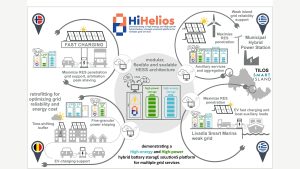
- EV fast-charging support (Norway): At a fast-charging station to manage extreme power peaks caused by multiple EVs charging simultaneously, thus avoiding costly grid reinforcements, as well as to have enough energy to store excess of local PV production.
- Smart EV charging and grid support (Belgium): Retrofitting an existing battery system to optimise a local energy community management with EV charging, solar power integration, and flexibility services procurement to the building and the local grid.
- Weak and islanded grid support (Greece): On the island of Tilos, two HESS demonstrators will be deployed. One will support a smart marina’s microgrid at the end of the distribution grid antenna, enhancing reliability for EV charging and local loads and avoiding congestion. The second HESS will be part of a municipal hybrid power station with already existing BESS, wind and PV production, providing additional critical stability services as black start capability to the island’s weak power system, as well as increasing energy storage capabilities to daily shift renewable production to consumption periods.
From TRL 7 demonstration to market-ready solution
HiHELIOS is more than a research project; it is a direct pathway to commercialisation. The primary goal is to deliver four fully operational demonstrators at Technology Readiness Level (TRL) 7. At the project’s conclusion, these systems will remain in service, providing long-term, real-world validation of their performance, reliability, and economic viability.
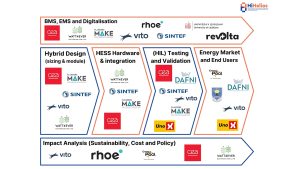
The project brings together 12 partners from six countries, ensuring a direct path from R&D to market application (Fig. 2). We are already building a concrete roadmap to achieve TRL 9 and prepare for industrial-scale deployment.
HiHELIOS is actively seeking stakeholders, investors, and industrial partners to develop technical or commercial partnerships and help shape a resilient, sustainable, and competitive European energy future. Please visit our website!
Please note, this article will also appear in the 24th edition of our quarterly publication.