Learnings from the multidisciplinary ConsenCUS innovation project and how it enables a sustainable future.
Emissions of greenhouse gases such as carbon dioxide in the atmosphere need to be avoided to prevent dramatic climate change. In fact, Europe leads the way by targeting net-zero emissions and, thus, full climate neutrality by 2050. Capturing CO2 from industrial processes (or air) and subsequent utilisation or storage of this gas (CCU/S) is necessary to reach those targets. However, CCU/S comes at a steep energetic cost itself, so this process should not only be accelerated in terms of deployment, but also be made more sustainable to reach net-zero industrial emissions.
The ConsenCUS project
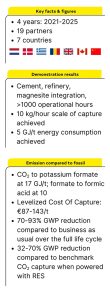 Since 2021, a consortium of 19 industrial and academic partners has been working on ground-breaking innovations that all aim to make CCUS compatible with a net-zero world. The core strategy revolves around using electricity for the capture and conversion processes, which is much easier to decarbonise than the heat-powered solutions on the market. In a nutshell, the ConsenCUS project aimed to achieve its acronym: CarbOn Neutral cluSters through Electricity-based iNnovations in Capture, Utilisation and Storage. Now, the project is in its final months. It has demonstrated the technical feasibility of the solutions with a three-stage pilot campaign and its economic, environmental, and societal impact potential if the innovations are implemented at full scale through multidisciplinary analyses.
Carbon capture and utilisation demonstrated
The ConsenCUS carbon capture technology uses the natural equilibrium between CO2 and water: at high pH, a potassium hydroxide solution absorbs the CO2 directly from factory exhaust fumes passing through an absorption column. In a separate regeneration module, the pH is lowered using electrochemically active membrane stacks, which bubble out the CO2 and recycle the solvent for the absorption process.
The central challenge in the project was to bring this concept, not demonstrated for carbon capture before, from the lab scale to a real industrial environment. After careful design and construction, the demonstration modules proved capable of dealing with starkly different flue gas compositions at the sites of a cement production plant in Aalborg (Denmark), a refinery near Ploiesti (Romania), and a magnesite production plant in Yerakini (Greece). The main challenges that were addressed: reaching low energy consumption and high CO2 capture efficiency, so that the technology can compete with benchmark technology when applied at full scale.
The captured CO2 was used to feed the adjacent CO2 utilisation module, where the CO2 was pressurised and converted into potassium formate, also using electricity. This biodegradable product is a preservative with an associated billion-dollar market, but can also be used to produce formic acid or in protein or fuel production to further increase its value. Even at this pilot scale, this process was found to be less energy-intensive than the conventional fossil route to produce potassium formate and formic acid, with the potential for full sustainability when renewable electricity is used.
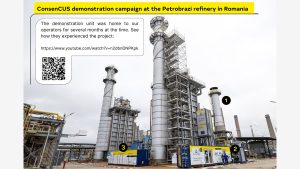
As shown in the picture, the capture process consists of:
1. The CO2 absorption column;
2. Solvent regeneration and CO2 separation module; and
3. CO2 utilisation module deployed to convert CO2 into useful chemical building blocks.
Net zero industry needs safe CO2 pipelines and storage
Even with carbon capture and utilisation technology fully developed and decarbonised, CO2 would need to be moved to the optimal location for conversion or storage to achieve net-zero industries. The ConsenCUS project results contribute to three important prerequisites:
- Safety assessment of permanent underground CO2 storage locations (e.g., Stenlille, Denmark) and the gas quality and geological characteristics of temporary underground CO2 storage during multiple on- and offloading sequences, which may be relevant in the future.
- Risk assessment on CO2 pipeline transport, specifically with regard to rupture in varying weather conditions.
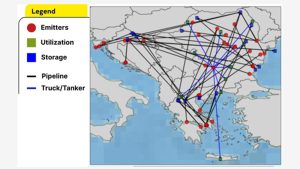
- A mathematical model for optimisation of the logistics of CO2 between emitters and users or storage locations, applied to case studies of sustainable aviation fuel production and Southeast Europe as a net-zero industrial cluster.
People and planet
ConsenCUS field research through online and town hall meetings, visits to schools and community centres provided insight into the level of awareness and acceptance of CCU/S among the general public. It was found that social awareness of any CCU/S technology is low, and acceptance of CCU/S depends on the high levels of complexity, uncertainty, and diversity with regard to each unique project’s specifics. Community members still preferred to have early and highly transparent engagement, even for pilot projects such as ConsenCUS. Honest communication on technology benefits and disclosure of risks was found to be a desirable strategy, but enabling community members with the means to participate (time or financial compensation) is necessary for this. Without this, the identified challenges of engagement fatigue, token engagements, and unequal partnerships are difficult to overcome.
Local acceptance is, perhaps unsurprisingly, connected to local environmental concerns. Water consumption worried community members in Greece, where alternative CO2 mitigation projects such as forestation were therefore seen more positively. While the ConsenCUS capture and conversion technologies decarbonise CCU by enabling renewable energy usage, it is important for the environmental performance as well as the social acceptance that other strains on the planet’s resources are known and taken into account. Full life cycle analysis of environmental strains and a dynamic life cycle cost analysis demonstrate the benefits and potential economic value of the ConsenCUS solutions, although the carbon footprint and price of the electricity that is being used are critical in these two aspects.
Industrial carbon management in the EU
Based on early project results, the consortium advocated for CCU/S development and deployment to be accelerated, and the consideration of the (carbon) footprint of CO2 emission mitigation strategies in planning for a net-zero future. With the Net Zero Industry Act and the Clean Industrial Deal and Industrial Carbon Management strategy of the EU now in place, the support for CCU/S has seen a major uptick over the course of the four-year project. To achieve the goals the Union has set for itself, we have further recommendations on how to maximise the impact of innovation within the EU member states.
Five recommendations for the EU’s industrial carbon management (ICM) policy
1. Support for ICM technologies should enable both next-generation technologies and the deployment of existing mature technologies.
2. The EU’s research and innovation (R&I) frameworks must acknowledge the importance of demonstrating, not just developing, innovative ICM technologies. This means fostering ‘learning-by-doing’, providing resource flexibility, and aligning project success indicators with the long timelines for demonstrating new technologies in real operational conditions.
3. Mechanisms to mitigate the high energy costs faced by industry, while still maintaining climate ambition, will be essential to ensure the operational feasibility of carbon capture.
4. Support for ICM demonstration and deployment must acknowledge the trade-offs between technology characteristics such as cost, environmental footprint, capture efficiency, energy consumption, scalability potential, and others.
5. To improve the EU’s competitiveness in ICM, R&I frameworks must be relatively unbureaucratic and allow flexibility for project consortia to recruit expertise with minimal administrative constraints, supported by appropriate human and knowledge resources from EU agencies.

the tailored open-access PlayDecide conversation card game
As the ConsenCUS project is ending in 2025, the consortium is confident that CCU/S has improved its position as a viable and necessary strategy to prevent global climate change, while maintaining European industrial competitiveness and relevance. Scaling up the electrochemical CO2 capture and utilisation technology to full commercial scale, in collaboration with local communities and governments to optimise its logistics and place in the energy system, fits well in the net-zero future of Europe.
Visit our website (www.consencus.eu) for background reports on the various topics of our research project.
Disclaimer

This project has received funding from the European Union’s Horizon 2020 research and Innovation programme under grant agreement N° 101022484. This article reflects only the author’s view. The European Climate, Infrastructure and Environment Executive Agency (CINEA), under the powers delegated by the European Commission, is not responsible for any use that may be made of the information it contains.
Please note, this article will also appear in the 24th edition of our quarterly publication.