REMEDY revolutionises architecture with living, microbial tattoos that transform buildings into responsive, sustainable ecosystems promoting health and resilience.
The REMEDY project is pioneering a transformative approach to architecture. It merges microbiology, biotechnology, materials science, and design into a combined vision of living, responsive, and sustainable buildings. REMEDY proposes a revolutionary concept: the archibiome tattoo, a form of engineered microbial inks that can be used to decorate, protect, and even heal buildings, similar to probiotic skincare that revitalises the human body. The tattoo technology represents more than just an aesthetic or functional improvement. It boosts the probiotic architecture, where buildings are no longer inert structures but dynamic ecosystems that contribute to environmental health, resilience, and wellbeing.
A game-changing concept: The archibiome tattoo
Traditional building materials are static. Once constructed, they gradually deteriorate under the influence of weather, pollution, and microorganisms. The REMEDY project turns this paradigm by designing engineered living materials (ELMs) that are self-sustaining, self-healing, and ecologically beneficial. The archibiome tattoo enables high-resolution decoration and functionalisation of both new and existing buildings. By using customised microbial inks, architects and designers will be able to print patterns directly onto surfaces. These living inks will contain engineered consortia of microorganisms that work symbiotically to perform useful functions. Similar to probiotics augmenting human health, these microbial inks will enhance the health of buildings and their surrounding environments. They can be tailored to:
- Sequester carbon, contributing to climate mitigation.
- Produce oxygen, improving local air quality.
- Degrade pollutants, enabling bioremediation of urban environments.
- Resist pathogenic microorganisms, acting as a living antimicrobial layer.
- Adapt to environmental conditions, maintaining structural and biological balance.
With the creation of autopoietic surfaces, this approach introduces life as a material property, redefining what it means to design and experience architecture.
From microbiology to architecture: An interdisciplinary vision
The ambition of REMEDY extends beyond innovation in material science. It aims to build a bridge between the life sciences and the built environment. To achieve this, the consortium combines computational biology with experimental biofabrication, enabling the creation of truly bespoke, intelligent materials capable of evolving with their surroundings. This powerful combination of computational biology and experimental manufacturing enables REMEDY to create truly bespoke and intelligent materials, capable of evolving with their surroundings. The architectural implications of REMEDY are profound.
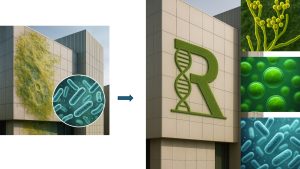
For centuries, microorganisms have been viewed as threats to buildings, agents of decay, contamination, and disease. The REMEDY consortium challenges this perception by advancing the idea of microbial integration in architecture, reframing microorganisms as allies in creating healthier, more sustainable spaces. By integrating living microbial systems into architecture, the project introduces metabolic thinking into the circular building industry. Buildings could one day operate like biological organisms, breathing, regenerating, and interacting with their environment in beneficial ways. This microbial revolution also redefines material lifecycles. Instead of passive, energy-intensive materials that deteriorate over time, the project envisions active, regenerative surfaces that capture carbon, degrade pollutants, and even contribute to urban biodiversity. The concept of probiotic architecture, first emerging at the intersection of ecology and design, becomes tangible through REMEDY’s living inks in the architectural context.
The consortium behind REMEDY
The strength of REMEDY lies in its interdisciplinary and international collaboration. The consortium brings together six partners from four European countries: Slovenia, Austria, the Netherlands, and Slovakia, uniting complementary expertise across science, technology, and industry. The collaboration includes University of Primorska (coordinator), University of Ljubljana, Technical University of Graz, TIGER Coatings, Xylotrade B.V., and Qres Technologies. Together, these partners form a synergistic ecosystem capable of moving from concept to prototype, and from scientific insight to tangible architectural solutions.
Part of the EIC Pathfinder Engineered Living Materials Portfolio
REMEDY is part of the EIC Pathfinder Portfolio of Engineered Living Materials, a visionary initiative of the European Innovation Council (EIC). The EIC supports the development of new technologies and platforms that enable the creation of living materials with programmable functionalities, dynamic behaviours, and adaptive capabilities. REMEDY aligns perfectly with these goals, advancing the frontiers of sustainable material science. The project’s inclusion in the ELM portfolio not only demonstrates its scientific ambition but also positions it within a broader European network of researchers and innovators working toward a shared vision of sustainable biofabrication. Moreover, REMEDY has secured an EIC Booster Grant, further supporting its integration and collaboration within this growing community of ELM innovators. This funding strengthens the project’s potential to translate laboratory research into deployable, real-world applications in architecture and the building industry.
A living future for materials and design
REMEDY reimagines how to design, build, and inhabit the environments. The outcome will not only be new materials but a new design philosophy, one that views architecture as an evolving, living interface between humans, nature, and technology. The buildings of the future may host living microbial layers that clean the air, produce oxygen, or adapt their colours and textures in response to light and humidity. Such advances could fundamentally transform the relationship with the built environment, making cities more resilient, regenerative, and symbiotic. REMEDY’s interdisciplinary approach exemplifies how European research and innovation can lead global change. By merging microbiology with architecture, computation with manufacturing, and ecology with engineering, REMEDY embodies the future of living design.
Discover more about REMEDY at the project website and stay updated by following us on LinkedIn.
Acknowledgments

This research has received funding from the European Union’s Horizon Europe research and innovation programme under grant agreement No 101185862. Views and opinions expressed are, however, those of the authors only and do not necessarily reflect those of the European Union or European Innovation Council and SMEs Executive Agency (EISMEA). Neither the European Union nor the granting authority can be held responsible for them. REMEDY project has received funding from the European Union’s Horizon Europe programme through the BOOST initiative, under grant agreement No 101192038.
Please note, this article will also appear in the 24th edition of our quarterly publication.
Please Note: This is a Commercial Profile

This work is licensed under Creative Commons Attribution-NonCommercial-NoDerivatives 4.0 International.