Researchers from Hirosaki University have discovered that signals from pulsars suggest that ultra-low-frequency gravitational waves are rippling through the cosmos.
The signal seen by international pulsar timing array collaborations in 2023 could come from a stochastic background of gravitational waves or from a single nearby binary of supermassive black holes.
To tell these apart, Hideki Asada and Shun Yamamoto of Hirosaki University proposed a method that exploits beat phenomena between gravitational waves at nearly the same frequency, searching for their imprint in the tiny shifts of pulsars’ radio-pulse arrival times.
Discovering the secrets of the Universe with cosmic clocks
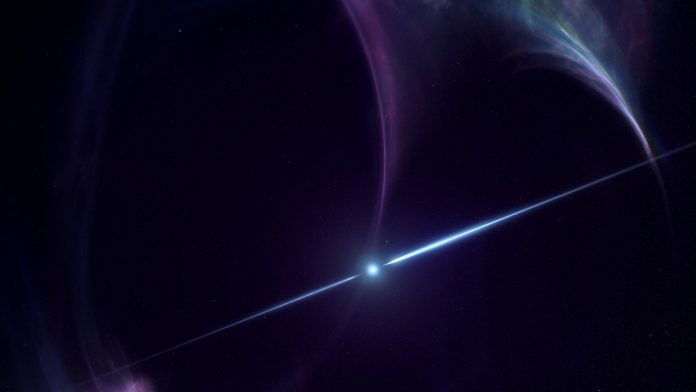
The sky is filled with exquisitely precise “cosmic clocks”: pulsars, neutron stars that emit radio pulses at regular intervals, like a steady tick-tock.
Radio telescopes on Earth monitor their periodicity – not only to study pulsars themselves, but also to use them as tools to probe the Universe.
If something invisible distorts spacetime along the path from a pulsar to Earth, the pulses’ regularity changes. The anomaly isn’t random, as similar deviations appear across pulsars in certain sky regions, as if an undulating ripple were sweeping through.
“In 2023, several pulsar timing array collaborations – NANOGrav in the US and European teams – announced strong evidence for nanohertz gravitational waves,” Asada commented.
To probe such scales, we rely on distant, stable pulsars hundreds to thousands of light-years away.
The first detection of nanohertz gravitational waves
Asada said: “The signal was statistically reliable but below the 5-sigma threshold that particle physicists usually require.
“It’s strong evidence but not yet a confirmed detection, but the cosmology and astrophysics community believe we are approaching the first detection of nanohertz gravitational waves.”
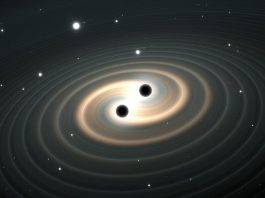
One candidate for nanohertz gravitational waves is cosmic inflation, which would have created spacetime fluctuations in the very early Universe, later stretched to cosmic scales. The other is supermassive black hole binaries, which form when galaxies merge.
Overcoming difficulties with pulsar timings
The difficulty is that the correlation patterns in pulsar data – the way timing residuals from different pulsars correlate – were long thought to look the same in both cases.
“As part of our research, we explored the situation where a nearby pair of supermassive black holes produces a particularly strong signal,” Asada explained.
“If two such systems have very similar frequencies, their waves can interfere and create a beat pattern, like in acoustics. That feature could, in principle, allow us to distinguish them from the stochastic background of inflation.”
Therefore, the researchers leveraged a familiar acoustic effect: beats. When two waves have almost the same frequency, their superposition produces periodic strengthening and weakening.
Applied to gravitational waves, two supermassive black hole binaries with similar frequencies would imprint a characteristic modulation in the pulsar-timing signal. The method involves looking for this modulation in the pulsar correlation patterns. If it’s present, that strongly suggests the signal is not a diffuse background but arises from specific, relatively nearby binaries.
Working out the origins of the gravitational waves
Asada concluded: “I think once a confirmed detection at 5-sigma is achieved, maybe within a few years, the next step will be to ask: what is the origin of the waves?
“At that point, our method could be useful to distinguish whether they come from inflation or from nearby supermassive black hole binaries.”