A major new study has provided fresh clarity in the long-running debate over whether electric vehicles (EVs) truly deliver on their climate promises.
According to research published by scientists at Duke University, battery-electric vehicles (BEVs) begin to outperform traditional gasoline-powered cars in terms of EV lifecycle emissions after just two years of use.
While early production of lithium-ion batteries is energy-intensive, resulting in higher initial carbon footprints, the study finds that EVs rapidly make up the difference through lower operational emissions – especially as the US power grid continues to decarbonise.
The challenge of measuring true carbon impact
Transportation remains the largest contributor to US greenhouse gas emissions, accounting for roughly 28% of the total.
Policymakers have long championed the transition to electric mobility as essential for meeting climate goals. Yet critics have questioned whether EVs are as clean as advertised once the entire production chain – from lithium mining to vehicle assembly – is factored in.
To answer this, researchers used the Global Change Analysis Model (GCAM), a sophisticated tool that assesses global energy and emissions trends.
They modelled four scenarios of rising EV adoption across the US through 2050, comparing both battery electric and internal combustion engine (ICE) vehicles across their full lifecycles, including raw material extraction, fuel and electricity generation, manufacturing, and on-road operation.
The two-year turning point
The findings reveal a striking crossover point. During their first two years, BEVs generate about 30% more CO₂ emissions than their gasoline counterparts when the entire production and use cycle is considered.
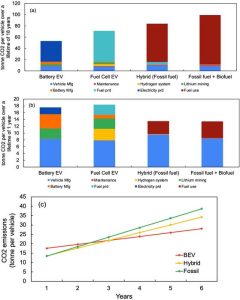
This is largely due to the high energy demands of battery production and lithium extraction, processes still heavily reliant on fossil fuels.
However, once an electric car has been driven for two years, it starts to deliver net carbon savings. Over time, these benefits accumulate rapidly.
By 2030, every additional kilowatt-hour (kWh) of battery capacity is expected to prevent around 220 kilograms of CO₂ emissions, falling slightly to 127 kg by 2050 as the grid becomes cleaner and manufacturing efficiency improves.
Long-term EV environmental and economic gains
Beyond CO₂ reductions, the study also accounted for air pollution-related health and environmental impacts.
When both climate change and air quality damage were monetised, the lifetime environmental cost of gasoline cars was estimated to be two to three-and-a-half times higher than that of BEVs.
In economic terms, the researchers found that even with the higher upfront environmental cost of production, EVs offer superior long-term returns – both for the planet and for public health.
These findings underscore how the benefits of electrification are expected to expand as the US grid continues to transition toward renewable energy sources.
Assumptions and future outlook
The authors acknowledged that the analysis relies on several assumptions about vehicle lifespan, annual mileage, and average battery size.
The model also excluded the emissions associated with building and maintaining new charging infrastructure. Nevertheless, the results point decisively to a growing advantage for electric mobility.
As renewable energy becomes dominant in power generation, EV lifecycle emissions are projected to fall even further, reinforcing the case for rapid electrification of the US vehicle fleet.
The research ultimately strengthens the argument that, while EVs are not emissions-free, they represent a critical step toward achieving meaningful, long-term reductions in carbon pollution.
In the evolving race toward cleaner transportation, it appears the electric vehicle’s real victory begins after year two.