Tobias Gerfin, Federation of the European Cookware, Cutlery & Houseware Industries (FEC), discusses concerns about PTFE as a coating for pans and cookware and explores the potential alternatives currently under research.
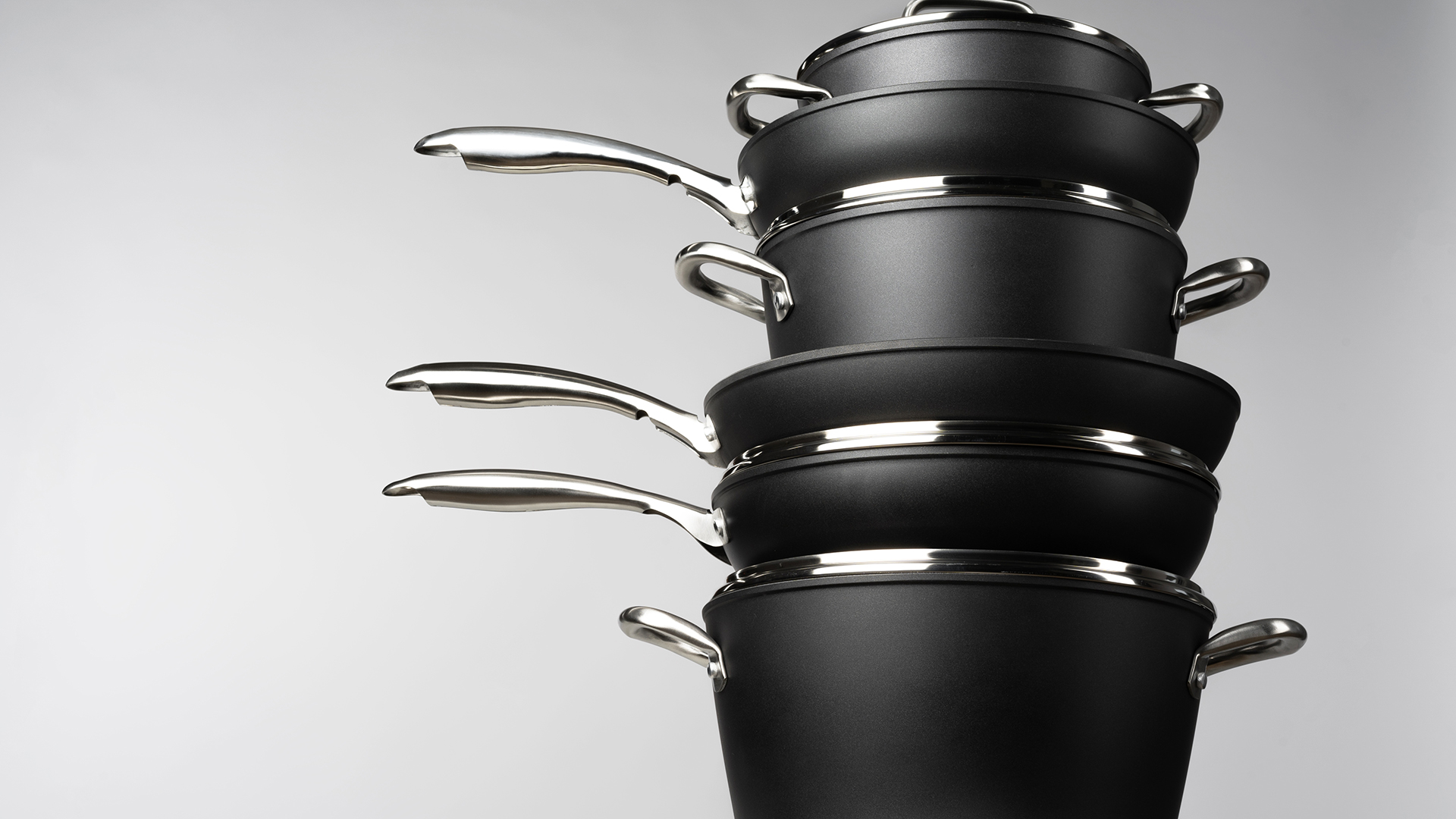
Polytetrafluoroethylene (PTFE) has been the material of choice for coated frying pans and cookware for decades. This material meets virtually all user and regulatory requirements. However, as PTFE belongs to the per- and polyfluorinated alkyl substances (PFAS) group, the objective of some regulators is to replace PTFE. Research into alternatives has been ongoing for many years already, but so far only the sol-gel siloxane system has established itself on the market. However, this solution is not yet completely equivalent to PTFE, so the search continues and there is plenty of room for innovation.
Cooking and frying are very demanding processes. The temperature range varies between 90°C and 230°C, the food can be very acidic or alkaline, and the base can be polar (water) or non-polar (oils). Heating causes the pan to expand with each use and then contract again as it cools. The pan must work with very different heating methods, such as electric, gas, or induction. When frying, the surface of the pan is subjected to mechanical strain from the kitchen utensils. After use, the pan is often cleaned in the dishwasher and exposed to very aggressive chemicals. This mix of requirements is a huge challenge for any product.
Two further desirable properties are added to this long list of requirements. On the one hand, due to regulations governing food contact materials, no harmful substances may be transferred from the pan to the food. On the other hand, users want non-stick properties so that food does not stick or burn, and less frying fat is required.
Why is PTFE so desirable?
PTFE, also known as Teflon, was introduced as a non-stick coating for pans a good 80 years ago. This material has exceptional properties and meets most of the requirements mentioned above. However, the mechanical stability of PTFE is not ideal, limiting the lifespan of coated frying pans.

PTFE is a fluoropolymer and belongs to the large group of over 10,000 PFAS. The substance is non-toxic, non-carcinogenic, non-mobile, non-bioaccumulative, and shows no loss of cell viability.¹ This means that PTFE poses no direct risk to the environment. Furthermore, due to the length of its carbon chains, the polymer is not absorbed in the human digestive tract. The safety has been repeatedly confirmed in the past by public authorities such as the BfR (German Federal Office for Risk Assessment)² and the U.S. Food and Drug Administration (FDA).³ Consequently, PTFE is a practically perfect solution for non-stick coatings on cookware.
Concerns around PTFE
Since PTFE is a substance belonging to the PFAS group, its use is being questioned by legislators in the EU, the US, and other countries. Its safety when used correctly is not generally questioned, but possible emissions of other PFAS substances are suspected during manufacture, use, and recycling.
In addition to PTFE, a fluorinated surfactant is required for polymerisation in the manufacture of such coatings. In the past, this was usually the problematic polyfluoro-octanoic acid (PFOA). However, this compound was replaced several years ago by other fluorinated surfactants such as GenX. The amount of these surfactants is very low and emissions from the European cookware industry are negligible during manufacturing.
During use, PTFE is thermally stable up to approximately 350°C and the concentrations of fluorinated surfactants are often below the detection limit or so low that they do not pose a risk to users.⁴ Above 350°C, PTFE begins to decompose, but the cooking fats used decompose at much lower temperatures and have flash points between 220°C and 280°C. This means that the ignition of the cooking fat poses a much greater risk to the user than the decomposition of PTFE.
Disposal of PTFE-coated pans
At the end of its life cycle, there are two options for PTFE-coated frying pans. The better option in terms of the desired circular economy is recycling. In this process, the metal is melted down together with the coating. The PTFE decomposes during the process and the resulting smaller PFAS are collected in air filters at the recycling plant. Calculations by the European Cookware Federation (FEC) have shown that PFAS emissions of less than 0.2 tons per year can be expected here. This amounts to 0.0003% of total annual PFAS emissions in Europe, according to the European Chemicals Agency (ECHA).⁵
The second option is landfill, where the valuable metals are unfortunately removed from the circular economy. Recent studies have shown that PTFE does not degrade in the environment.⁶ Since the fluoropolymer PTFE is neither water-soluble nor bioaccumulative, PTFE coatings do not pose a risk to the environment.
In summary, PTFE-coated frying pans are a practically perfect solution to the requirements described in the first sections and pose negligible risks and emissions to humans or the environment.
Research for alternative coatings
Despite this positive assessment, alternatives to PTFE have been researched for many years. On the one hand, because longer product lifetimes would be desirable and, on the other hand, because the use of PFAS is being questioned by regulators. The alternative that can be found on the market today is ceramic coating, which is produced from siloxanes using a sol-gel process. These ceramic coatings do not usually have non-stick properties, but this can be achieved by adding food-grade silicone oils. These ‘ceramic’ frying pans have very good non-stick properties after manufacture and retain these properties when used at mild temperatures up to 160-170°C. Above these temperatures, the silicone oils begin to decompose or are ‘washed out’ of the coating. Once the silicone oils are gone, the ‘ceramic’ frying pans lose their non-stick properties. Scientific studies have shown that the ceramic coatings available today have a significantly shorter service life than PTFE-coated products.⁷
These ceramic coatings are now produced using a spray process. The much cheaper roller coating process, which is often used for PTFE, cannot be used for these significantly less flexible coating systems. This means that inexpensive non-stick frying pans will either disappear from the market or be compensated for by compromises in product quality.
For this reason, ‘ceramic’ frying pans cannot yet be considered a true alternative. Research into these coating systems and their coating technologies is continuing, and it will be interesting to see how much this solution can be improved in the future. It is to be expected that at least a few more years of development will be necessary to meet all requirements.
Another approach to achieving non-stick properties is to treat the metal surface. In theory, there are structures that would result in perfect non-stick properties, but in practice these are either impossible to manufacture or have a very short service life. Nevertheless, systems have been introduced that have been produced mechanically, by plasma treatment or by etching. Many of these solutions exhibit better non-stick properties than the surfaces of uncoated and untreated frying pans. Unfortunately, however, they do not yet come close to ceramic or PTFE-coated products. In addition, these solutions do not generally prevent the possible migration of metals into food. Innovations in these approaches are also expected in the future.
Besides PTFE and sol-gel siloxane systems, other materials are also being researched for use in cooking, frying, and baking. The high-performance plastic PEEK would meet many requirements, but it is expensive. Graphene oxide is also an interesting idea,⁸ but this material must first be thoroughly investigated regarding health risks. Lanthanide oxides could have non-stick properties due to their atomic size,⁹ but here too, the health risks for food contact materials have not yet been clarified. Furthermore, these oxides belong to the rare earths – a group of materials that is currently the focus of public attention. This list of possible alternatives is not exhaustive. It is to be expected that new systems suitable for non-stick frying pans could be found in the coming years. However, it is not realistic to expect practical solutions within the next 5-10 years.
The current situation for frying pans and cookware with non-stick properties can be summarised as follows: PTFE is still by far the best solution for the high demands of this application. Sol-gel siloxane coatings with silicone oils have improved steadily in recent years and are the second-best option, even if they do not yet constitute a fully viable alternative. For all other ideas and approaches, the search for genuine alternatives continues. This is a huge field for innovation with a lucrative market and quantities well in excess of one hundred million units per year.
References
- Sijon Lee et al., In vivo toxicity and pharmacokinetics of PTFE microplastics in ICR mice, Polymers, 2022, 14, 2220,
https://doi.org/10.3390/polym14112220 - Repellent to the end, BfR2go, 2025, 40-41, https://www.bfr.bund.de/en/publication/bfr2go-issue-22025-main-topic-sweeteners/
- Questions and Answers on PFAS in Food, FDA, 19.12.2025, https://www.fda.gov/food/process-contaminants-food/questions-and-answers-pfas-food
- 60 Millions de Consommateurs, 2022, 579, 10
- https://echa.europa.eu/documents/10162/1c480180-ece9-1bdd-1eb8-0f3f8e7c0c49 Page 41
- Barbara J. Henry et al., Environmental fate and behavior studies of a polymeric PFAS, PTFE – results and application of risk assessment, Chemosphere, 2025, 385, 144569, https://doi.org/10.1016/j.chemosphere.2025.144569
- G. Guerrero-Vacas et al., Towards a greener kitchen: Can sol-gel ceramic non-stick coatings replace polytetrafluoroethylene?, Results in Engineering, 2025, 26, 105074, https://doi.org/10.1016/j.rineng.2025.105074
- https://www.innovationnewsnetwork.com/graphene-oxide-material-could-replace-pfas-in-food-packaging/58605/
- Korean patent KR102470075B1