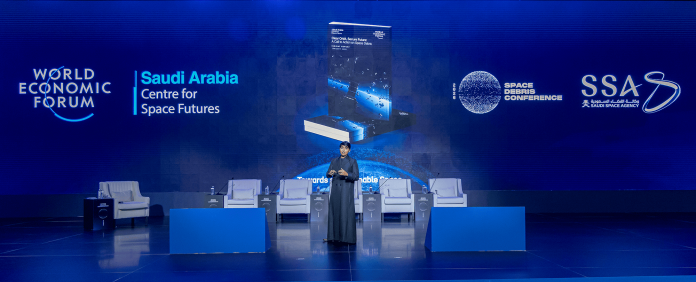
At the Space Debris Conference 2026, the Space Futures Centre announced the release of a new insights report titled “Clear Orbit, Secure Future: a Call to Action on Space Debris.”
In collaboration with the World Economic Forum and the Saudi Space Agency, the report calls for addressing the needs of the space community across its various stakeholders, including service users, providers, policymakers, and academia.
It warns that failure to effectively address the current space debris situation could cost the space industry between $25.8bn and $42.3bn over the next decade, underscoring the urgent need for a healthier space environment that benefits all.
The debris problem and its financial constraints
Space debris comprises millions of fragments – from defunct satellites to tiny paint flecks – orbiting Earth at speeds of up to 28,000 km/h.
At these speeds, even a marble-sized object carries the kinetic energy of a hand grenade, making the debris field a minefield for the modern space economy.
The financial burden on the industry is immense for several reasons:
Operational manoeuvring
Satellite operators must constantly monitor conjunction warnings. Performing avoidance manoeuvres consumes precious on-board fuel, directly shortening the operational lifespan of a satellite and reducing its lifetime revenue.
Shielding and design
To survive smaller, untrackable debris, manufacturers must add heavy Whipple shielding. This adds significant mass, potentially increasing launch costs by millions of dollars per mission.
Insurance risk
As the probability of collision rises, so do insurance premiums. For missions in high-density regions like Low Earth Orbit (LEO), debris-related costs can account for 5–10% of the total mission budget.
The Kessler Syndrome threat
The ultimate cost is the potential loss of entire orbital planes. If a chain reaction of collisions occurs, certain altitudes could become unusable, threatening the $190+ billion worth of global satellite infrastructure we rely on for GPS, telecommunications, and climate monitoring.
Economic costs of space debris underscore the urgent need for orbital sustainability
The report is the outcome of a series of community consultations aimed at assessing the risks and economic costs of space debris in the coming years.
It provides a quantitative assessment of the potential economic impact of space debris on the global space economy.
The release of these insights represents an important step in shaping future dialogue on orbital sustainability.
The report combines the mission-driven focus of the Space Futures Centre with the global network and influence of the World Economic Forum, with the objective of equipping the global space community with valuable guidance to address current and future challenges.
Developing collaborative solutions to improve the orbital environment
The report aligns with the missions of the contributing organisations, including the Saudi Space Agency, LeoLabs, and Novaspace.
The authors of the report invited the international space community to share their perspectives and feedback as part of ongoing collaborative efforts to develop collective solutions that ensure a safer, more sustainable orbital environment.
The call was endorsed by Space Futures Centre chief executive Mishaal Al Shemimri and World Economic Forum Centre for Technology and Innovation Frontiers head of planet solutions Helen Birt.