The European Union’s Destination Earth initiative is set to move into its third implementation phase following a new agreement between the European Commission and the European Centre for Medium-Range Weather Forecasts (ECMWF).
Beginning in June 2026 and running through to June 2028, Phase Three marks a critical step in advancing one of the world’s most sophisticated digital representations of the planet.
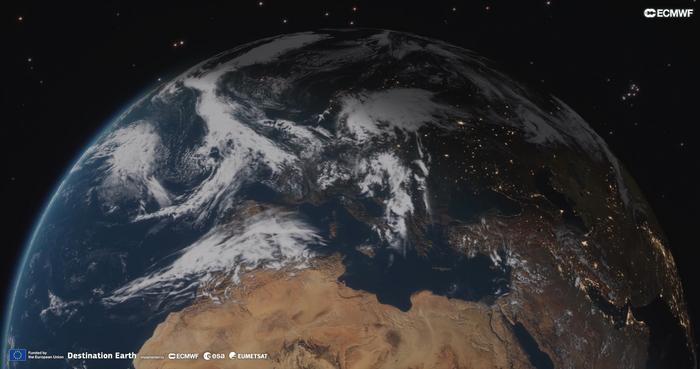
Designed to provide an ultra-high-resolution digital twin of Earth, Destination Earth aims to help policymakers, scientists, and public institutions better understand, anticipate and respond to climate change and extreme weather risks across Europe and beyond.
Irina Sandu, Director of Destination Earth at ECMWF, highlighted the significance of the project: “Destination Earth is, above all, a collaborative European effort. It brings together expertise in Earth system modelling, software engineering, high-performance computing, and artificial intelligence.
“By pooling resources and working closely with our partners, we are building capabilities that complement existing national and European services and help European institutions and Member States prepare for the challenges posed by climate change and extreme events.”
Digital twins for climate and extreme weather
At the heart of Destination Earth are advanced digital twins that simulate the Earth system in extraordinary detail.
These models allow users to analyse past and present conditions and explore plausible future scenarios, including extreme weather events under different warming pathways.
One key capability is the use of ‘what-if’ and storyline simulations, which enable researchers to replay historical events, such as floods or heatwaves, and examine how their impacts could change in a world that is 2 °C warmer.
These insights are increasingly vital for climate adaptation planning, disaster preparedness and long-term resilience strategies at both European and national levels.
Progress since launch and expanding partnerships
Since its launch in 2022, Destination Earth has evolved rapidly through close collaboration between ECMWF, the European Space Agency (ESA), EUMETSAT and more than 100 partner organisations, including many national meteorological services.
The Climate Change Adaptation Digital Twin and the Weather-Induced Extremes Digital Twin have progressed from early prototypes into operational modelling frameworks.
They now routinely generate high-resolution climate projections and detailed simulations of extreme events, supporting real-world decision-making across sectors.
A critical technical backbone of the initiative is the Digital Twin Engine. This system manages complex workflows and massive data streams across EuroHPC supercomputers and Destination Earth infrastructure, while also enabling tailored access to digital twin data for users across the ecosystem.
Artificial Intelligence takes centre stage
AI has become an increasingly central component of Destination Earth.
Since Phase Two began in 2024, machine-learning tools have been developed for multiple Earth-system domains, including land, oceans, sea ice, waves and hydrology. AI-driven solutions are also improving how users interact with vast volumes of climate data.
Phase Three will deepen this integration by further linking the Climate and Extremes Digital Twins with the Digital Twin Engine, while pushing toward an AI-enabled Earth-system model.
This approach combines physical climate science with advanced machine learning to improve prediction accuracy, speed and uncertainty analysis.
Building an AI Earth-system model
A major focus of the next phase is advancing and coupling machine-learning-based Earth-system components to complement traditional physics-based simulations. This hybrid modelling approach supports faster experimentation, rapid “what-if” testing and more robust risk assessments.
The programme will also produce high-quality, AI-ready datasets designed to feed Europe’s growing network of AI Factories.
By strengthening the links between supercomputing, AI, and Earth-system science, Destination Earth is laying the groundwork for a new generation of climate and weather applications.
Strengthening Europe’s climate leadership
By leveraging major investments in high-performance computing and AI, Destination Earth reinforces Europe’s leadership in trustworthy environmental intelligence.
The initiative supports national meteorological and hydrological services, public authorities and industry innovators, while complementing existing European and national climate services.
As Phase Three begins, Destination Earth is positioned not only as a scientific milestone, but as a strategic tool for preparedness, resilience and innovation in an era of accelerating climate change.