
BIOSAFIRE uses lignin and tannins to improve fire resistance following the Safe and Sustainable by Design (SSbD) approach.
BIOSAFIRE draws inspiration from nature to enhance lignins and tannins – natural flame-retardant compounds – making them suitable for industrial applications. Building on existing pilot plants, the project scales up production and broadens to a range of biobased feedstocks, delivering flame retardants for five specific use cases across four sectors: naval, railway, home appliances, and wood coatings. With 22 partners collaborating across Europe, BIOSAFIRE represents a major collective effort to transform natural additives into innovative, high-performance materials.
The project combines high performance with sustainability, achieving fire-retardancy levels comparable to conventional, toxic benchmarks while maintaining approximately 80% biobased content. Beyond demonstrating its effectiveness in multiple use cases, BIOSAFIRE is developing a comprehensive material portfolio and practical processing guidelines to help industry adopt safer, biobased flame retardants. This approach is set to unlock substantial market opportunity, estimated at €8bn by 2028, with Europe holding around a 25% share and the target sectors representing roughly 65% of the market.
The scope of the project
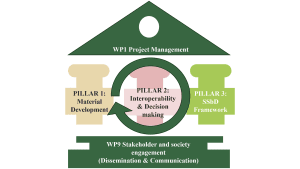
BIOSAFIRE is structured around three interconnected pillars that work together to ensure project success. Pillar 1 focuses on material development, creating and optimising flame-retardant formulations. Pillar 2 serves as the central hub, coordinating communication and collaboration between the technical and sustainability teams. Pillar 3 is dedicated to implementing the SSbD Framework, ensuring that safety, sustainability, and societal acceptance are integrated into every stage of development.
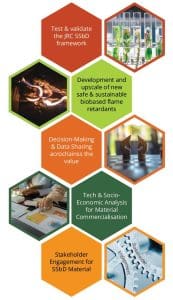
Furthermore, the project explores both thermosetting systems and thermoplastic systems, supporting applications ranging from composites and wood coatings to consumer-oriented home appliances. By bridging multiple industries, the project ensures that innovation can be widely applied and scaled effectively.
A central pillar of the project is the implementation of the SSbD Framework from the EU Joint Research Centre. Using an iterative, tiered approach, BIOSAFIRE integrates SSbD principles into early conceptual design. Alongside technical innovation, BISOAFIRE also incorporates social sciences and humanities (SSH) perspectives to enhance societal acceptance, while providing training materials to support industrial uptake of sustainable flame-retardant solutions.
The future of BIOSAFIRE
Looking ahead, BIOSAFIRE will design an industrial pilot plant to tackle value chain challenges and carry out a robust techno-economic assessment. These efforts aim to promote market adoption, giving stakeholders both the technical and economic evidence needed to implement biobased at scale.
By combining natural innovation, industrial expertise, and SSbD principles, BIOSAFIRE demonstrates that lignins and tannins can meet stringent fire safety standards while advancing sustainability, paving the way for greener materials across multiple sectors.

This project has received funding from the European Union’s Horizon Europe research and innovation programme under Grant Agreement No. 101178218.
Please note, this article will also appear in the 25th edition of our quarterly publication.