Recent research highlights the advantages of C-Lock’s GreenFeed system for measuring methane production in dairy farming, emphasising that mass flux measurements provide more reliable data for research and decision-making than traditional concentration-based sensors.
As the livestock industry moves toward more accurate methane measurement, one distinction is becoming increasingly important: the difference between methane concentration measurements and methane production measurements. While both can offer insights, they are not interchangeable – and new research shows why measuring methane as a mass flux provides a more reliable foundation for research, genetic selection, and on-farm decision making.
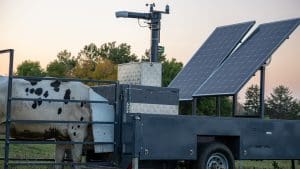
A recent five-month study conducted in Switzerland evaluated methane ‘sniffer’ sensors installed inside an automated milking system (AMS) and compared them with C-Lock’s GreenFeed Emission Monitoring System — a widely used on-farm tool that measures methane production in grams per day. The results reinforce a key message: concentration-based measurements are highly sensitive to sensor placement and animal behaviour, while GreenFeed’s mass-flux approach offers greater consistency and confidence.
Concentration vs production
Most AMS sniffers measure methane concentration (ppm) in the air near a cow’s muzzle while she eats during milking. These measurements are attractive because they can be collected frequently with minimal disruption. However, concentration readings are influenced by factors unrelated to how much methane a cow actually produces – such as the distance between the cow’s muzzle and the sensor, head movement during milking, and airflow within the stall.
GreenFeed takes a different approach. Rather than relying on concentration alone, it measures both methane concentration and airflow in a controlled sampling area around the cow’s head. This allows methane mass flux – the amount of methane emitted over time – to be calculated. In practical terms, GreenFeed measures what matters most: how much methane a cow actually produces, not just how concentrated methane happens to be at a single point in space.
Putting sensor placement to the test
To understand how much sensor placement matters, researchers installed nine sniffer nozzles in a 3×3 grid above the feed bin inside a DeLaval AMS. At the same time, a GreenFeed unit was installed in the same barn so methane production could be measured from the same cows.
Over 154 days, data were collected from 107 lactating dairy cows across three breeds. The study showed that methane concentration readings varied substantially depending on which sniffer nozzle was used. Positions closer to where cows typically exhaled while feeding recorded higher and more consistent values, while sensors further away – or near walls – recorded lower concentrations and showed greater variability.
This variability is not trivial. It means that two sniffers measuring the same cow at the same time can produce very different results, depending purely on where the sensor is located.
GreenFeed as a stable benchmark
When researchers compared sniffer measurements with GreenFeed methane production, correlations were generally moderate and strongly dependent on nozzle position. Central sniffer locations aligned best with GreenFeed, but even then, agreement was far from perfect.
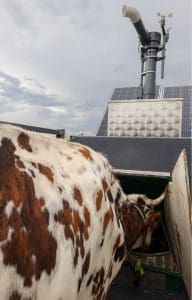
Repeatability – the ability to get consistent results from the same cow over time – improved for both systems when measurements were averaged across longer periods. However, GreenFeed showed strong stability with fewer assumptions about animal position or airflow, while sniffers required careful placement and extended averaging to achieve comparable consistency.
For applications such as diet evaluation, feed additive testing, or benchmarking emissions across herds, this distinction matters. A system that directly measures methane production reduces uncertainty and simplifies interpretation.
Ranking cows: Where accuracy really counts
One of the most valuable uses of methane data is ranking cows by emissions intensity for research or genetic selection. The study found that cow rankings varied depending on which sniffer position was used, and agreement with GreenFeed rankings was only low to moderate.
This highlights a practical risk: if rankings depend on sensor placement, they may reflect barn geometry or animal behaviour rather than true biological differences. GreenFeed’s mass-flux approach avoids this issue by capturing total methane output during each visit, making it a more reliable reference when ranking animals or validating low-emissions strategies.
What this means for the industry
Sniffer systems can play a role in high-throughput data collection, particularly when installed and standardised carefully. But this study makes it clear that concentration-only measurements introduce additional uncertainty, especially in dynamic environments like automated milking systems.
GreenFeed’s ability to measure methane production directly – rather than inferring emissions from concentration alone – is why it continues to be used globally as a benchmark for enteric methane measurement. As the industry moves toward data-driven emissions reduction, tools that deliver repeatable, comparable, and biologically meaningful data will be essential.
The takeaway
Not all methane measurements tell the same story. Concentration data can be informative, but when decisions depend on accuracy – whether in research, breeding, or sustainability programmes – measuring methane production via mass flux provides a clearer and more dependable picture. This study reinforces what many researchers already recognise: how you measure methane matters as much as how often you measure it.