From costly disposal to on-site PFAS destruction: PFASuiki’s technology offers a new way to solve your PFAS wastewater challenge.
Per- and Polyfluoroalkyl substances (PFAS) are among the most pressing environmental challenges of our time. Known as ‘forever chemicals’ due to their extreme persistence, PFAS accumulate in soil, water, and living organisms, creating risks to human health and ecosystems. While industries have long relied on PFAS for their unique chemical stability and performance, the environmental and regulatory pressures around their use are growing rapidly.
At PFASuiki, we are on a mission to eliminate PFAS from the environment permanently. Our breakthrough electrochemical oxidation (EO) systems are designed not to capture or concentrate PFAS, but to destroy them at the molecular level. With our proprietary electrodes, scalable system design, and deep material science expertise, we deliver a reliable and economical end-of-pipe solution that enables industries, municipalities, and landfill operators to move from PFAS management to true PFAS elimination.
Standing out in the PFAS destruction landscape
PFAS treatment today is dominated by separation-based methods such as activated carbon adsorption, ion exchange, or reverse osmosis. These approaches are effective in removing PFAS from contaminated water but do not destroy them. Instead, they shift PFAS into secondary waste streams that must be incinerated or landfilled – costly, inefficient, and increasingly restricted in Europe and beyond.
Destructive methods exist but remain impractical. Traditional methods like incineration are costly, inefficient, and create new regulatory headaches. Our solution eliminates the need for expensive hazardous waste transport and reduces your long-term liability, offering a complete and final resolution.
PFASUIKI changes this paradigm
Born from TDK, a globally recognised Japanese electronics company, and now operating as an agile independent startup, PFASuiki combines the best of two worlds: the financial strength and technological depth of an industry leader with the flexibility and bold innovation of a start-up. Leveraging decades of expertise in advanced materials and precision engineering, we have developed a disruptive PFAS destruction platform based on three pillars:
- Novel materials – engineered for high catalytic activity, selectivity, and durability.
- Advanced electrode design – tailored for PFAS destruction efficiency, energy reduction, and long system life.
- Smart process engineering – adaptable to multiple streams and scalable from pilot to full-scale operation.
How our technology works: Precision PFAS destruction
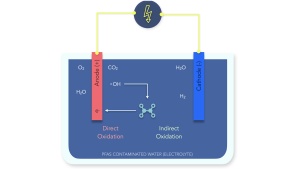
Electrochemical oxidation is a well-established process in water treatment, but its effectiveness depends entirely on the electrode material and system configuration. PFASuiki’s proprietary electrodes enable both:
- Direct electron transfer (DET): PFAS molecules interact directly with the electrode surface, enabling targeted bond cleavage.
- Indirect radical oxidation: Generated active species degrade PFAS and other organic contaminants, maximising destruction efficiency.
This dual mechanism ensures efficient PFAS destruction while minimising energy input. Our modular systems are designed to:
- Achieve high destruction rates (>95%) even in complex matrices like landfill leachate.
- Operate at competitive energy consumption
- Scale flexibly from pilot deployment to full industrial roll-out.
- Deliver eco-friendly performance with no chemical additives and fully recyclable electrode materials.
From prototype to real-world impact
Landfill leachate case study
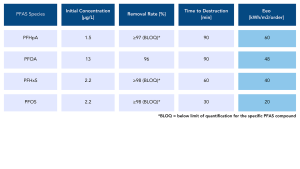
Municipal landfill leachates represent one of the most challenging PFAS matrices due to high organic loads, salts, and co-contaminants. PFASuiki’s prototype, developed with TDK’s material science expertise, has already demonstrated success:
- Rapid degradation of >= 6C PFAS (PFHpA, PFOA, PFHxS, PFOS) within 30-90 minutes.
- 95% destruction rates despite high total carbon
(>4.5 g/L). - Potential for shorter-chain PFAS removal in ongoing optimisation.
- Energy efficiency enabling cost-effective integration into treatment trains or as a stand-alone solution.
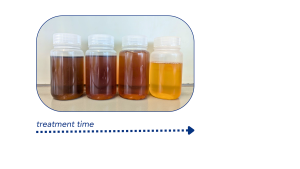
As treatment progresses, a change in sample colour occurs, indicating removal of DOM (Dissolved Organic Matter) in addition to PFAS destruction in the sample.
These results showcase not only technical feasibility but also the economic and environmental viability of our approach.
Why industries and municipalities choose PFASuiki
Our EO systems are designed for versatility, scalability, and ease of use. They can be deployed as stand-alone PFAS destruction units or seamlessly integrated into existing treatment trains. Key advantages include:
- Versatile applications – from landfill leachate and industrial effluents to firefighting foam residues and ion exchange regenerates.
- Reduced Cost – low energy consumption and long-lasting, recyclable electrodes dramatically lower operational expenses.
- Ease of operation – plug-and-play integration, rapid electrode change-outs, minimal maintenance.
- Environmental responsibility – no chemical additives, fully recyclable electrodes, supporting circular economy principles.
The bigger picture: Industry, regulation, and ESG
PFAS are not going away any time soon. They remain critical to multiple industries, from healthcare to semiconductors or defence. Eliminating their use entirely would mean compromising on product safety and performance. However, preventing PFAS from reaching the environment is both feasible and urgent.
- Regulatory pressures are intensifying, with Europe tightening incineration and disposal options.
- Compliance costs are soaring, with hazardous PFAS waste disposal often exceeding €2,000–3,000 per tonne.
- Public scrutiny is increasing, as municipalities, landfills, and industries face lawsuits, reputational risks, and ESG obligations.
By enabling on-site PFAS destruction, PFASuiki helps clients:
- Minimise hazardous waste transport.
- Reduce liability risks under EU Waste Shipment Regulations.
- Demonstrate proactive ESG leadership and public responsibility.
Collaboration and partnerships: Co-creating the future
The complexity of PFAS challenges requires collective action. At PFASuiki, we actively engage with partners across industry, academia, and government to accelerate PFAS destruction at scale.
Opportunities for collaboration:
• Pilot deployment – tailored system trials with full data collaboration.
- Scale-up support – bridging the gap between prototype and commercial roll-out.
- Research partnerships – co-developing novel materials, analytics, and system integrations.
- Regulatory and market access – navigating compliance frameworks together.
- Consulting and analytics – PFAS product testing, regulation advisory, and stream characterisation.
We see ourselves not just as a technology provider but as a PFAS competence partner, offering solutions from diagnostics to destruction.
A startup vision: Eliminating PFAS, empowering industries
Startups like PFASuiki play a unique role in addressing environmental challenges. We combine agility, innovation, and focus with the resources of our parent company, TDK. Our vision extends beyond PFAS destruction towards becoming a global competence hub for PFAS management – from analysis and regulation consulting to end-of-pipe destruction systems.

The path forward is clear: capture and destroy PFAS before they enter the environment. By working hand in hand with industries, regulators, and investors, we aim to pioneer sustainable, scalable, and cost-effective PFAS destruction solutions that will shape a cleaner future.
Ready to solve your PFAS challenge?
Contact us today for a consultation. Our team is ready to discuss your specific needs and outline a path to a permanent, compliant, and cost-effective solution.
Suggested keywords for SEO: PFAS destruction, electrochemical oxidation, PFAS removal, forever chemicals, landfill leachate treatment, industrial wastewater PFAS, sustainable water treatment.
Please note, this article will also appear in the 23rd edition of our quarterly publication.