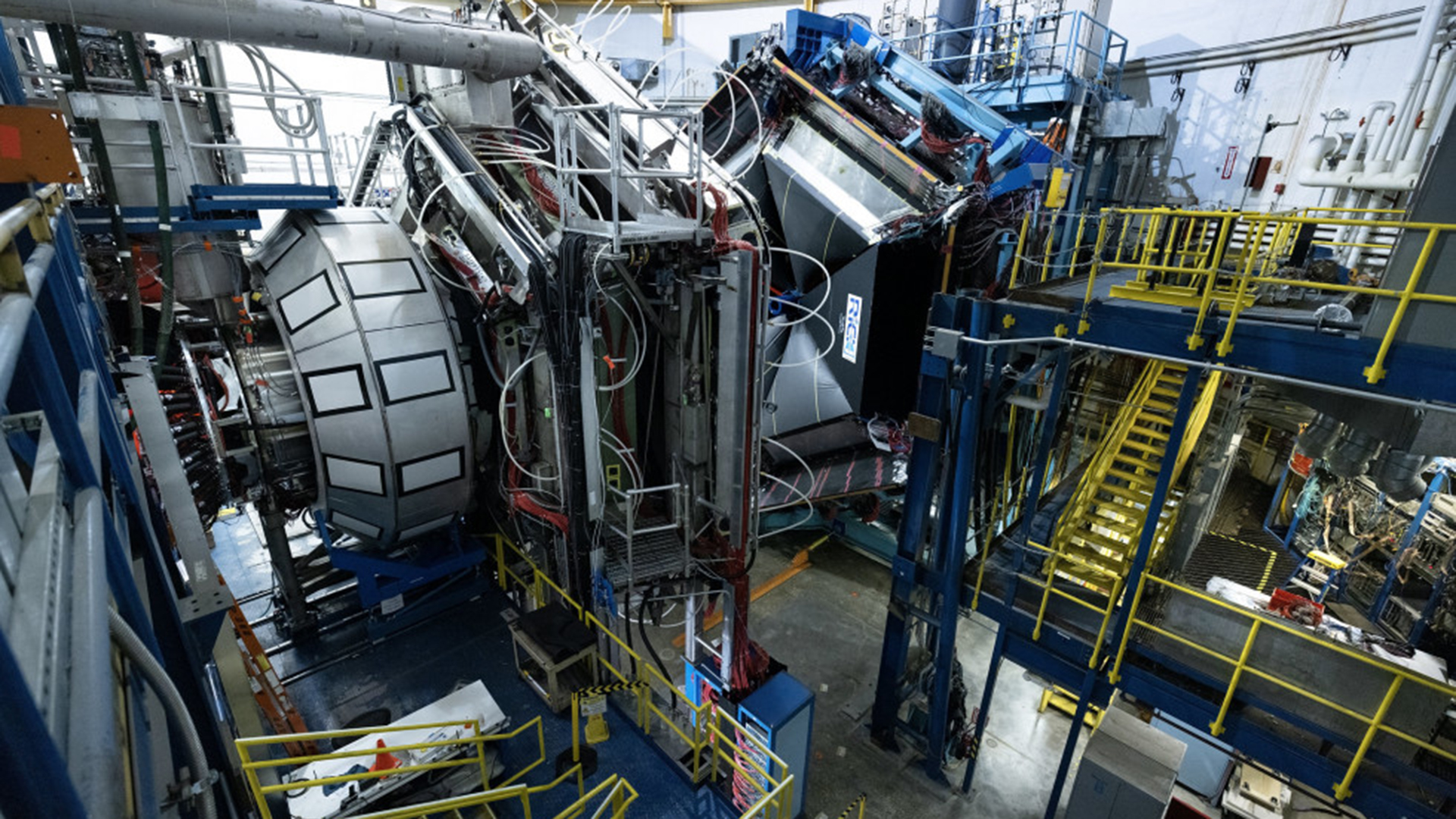
Professor Fatiha Benmokhtar is conducting advanced experiments at Jefferson Lab using hybrid Ring Imaging Cherenkov detectors to investigate the proton’s structure.
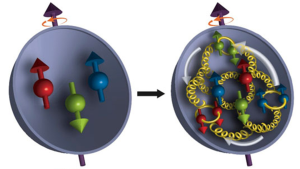
Understanding the quark and gluon structure of the proton, the fundamental constituent of visible matter, is a central goal in modern nuclear physics and a top priority in the US DOE/NSF Nuclear Science Advisory Committee (NSAC) Long Range Plan. Within Quantum Chromodynamics (QCD), the theory of strong interactions, the proton emerges as a relativistic, strongly bound state of nearly massless quarks and gluons (collectively referred to as partons). While decades of experimental and theoretical work have provided profound insights into parton dynamics, critical questions remain unresolved. Among these, the origin of the proton’s spin stands out as one of the most compelling challenges. Spin is a fundamental quantum property and an essential probe of nucleon structure. Measurements indicate that quark spin accounts for only about one-third of the proton’s total spin, and gluon spin alone cannot explain the remaining contribution. This raises a key question: does the missing component originate from the orbital angular momentum of partons? Addressing this question requires precision measurements and advanced theoretical frameworks.
Understanding proton spin structure through SIDIS experiments
Inclusive and semi-inclusive polarised deep-inelastic scattering (SIDIS) experiments at facilities such as CERN, SLAC, DESY, and Jefferson Lab have significantly advanced our understanding of proton spin structure. However, the strange quark contribution remains poorly determined due to its small magnitude and the experimental challenges in isolating strange quark signals, which rely on kaon tagging and suffer from fragmentation uncertainties. Accurate determination of the strange quark distribution requires semi-inclusive measurements with identified hadrons. Due to quark confinement, individual quarks cannot be observed in isolation. The most suitable hadron species for assessing the presence of strange and/or anti-strange quarks to the proton are particles called kaons. For example, a kaon-plus (composed of an up quark and a strange anti-quark) and the kaon-minus (composed of an up anti-quark and a strange quark).
With continuous support from the National Science Foundation, Professor Benmokhtar undertakes electron-proton scattering experiments at the Thomas Jefferson National Laboratory. Since she joined Duquesne University, she has mentored and trained more than 50 undergraduate students in this project. Her contribution to the strange sea began with the G0 experiment in Hall C, which measured the contribution of the strange quark sea to the electromagnetic properties of the proton.¹ Since 2018, with the upgrade of Jefferson Lab’s continuous electron beam accelerator to 12 GeV, Professor Benmokhtar has been conducting SIDIS experiments in Hall B using the CLAS12 detector. Two Ring-Imaging Cherenkov (RICH) detectors were added to the baseline equipment to identify kaons in the 3 to 8 GeV/c momentum range.
What is a RICH detector?
A RICH detector is a device that allows the identification of electrically charged subatomic particles through the detection of the Cherenkov radiation emitted (as photons) by the particle in traversing a medium with refractive index n. The identification is achieved by measurement of the angle of emission, θc, of the Cherenkov radiation, which is related to the charged particle’s velocity v by cos θc = c/(nv), where c is the speed of light. Particles of different masses but the same momentum can be distinguished by the distinct contours of their emitted photons. CLAS12, in Hall B at Jefferson Lab, is a magnetic spectrometer based on a toroidal field produced by six coils that naturally divide the spectrometer into six independent sectors. The CLAS12 baseline equipment comprises a time-of-flight system (TOF), able to efficiently identify hadrons up to a momentum of about 3 GeV/c, and two Cherenkov gas counters of high (HTCC) and low (LTCC) threshold, reaching the needed pion rejection power only close to the upper limit of hadron momenta (around 7 GeV/c) and are not able to distinguish kaons from protons. A Hybrid RICH detector has been designed and built by Professor Benmokhtar from Duquesne University and her collaborators: the Italian INFN groups (Dr M. Contalbrigo and Dr M. Mirazita), together with the US Jefferson Lab (Dr V. Kubarovsky and Dr P. Rossi, and Dr Avakian), Argonne National Lab (Dr K. Hafidi) and the University of Connecticut (Professor K. Joo, Dr Kim, and Dr T. Hayward). Two full RICH detectors were built and installed in CLAS12 in Fall 2018 and May 2022, respectively, as shown in Fig. 3. The components of the hybrid RICH are shown to the right.
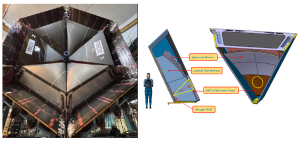
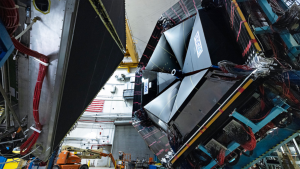
The Ring Imaging Cherenkov (RICH) detector is designed to enhance particle identification in CLAS12 for momenta between 3 and 8 GeV/c, replacing two sectors of the existing LTCC detector. Its design integrates aerogel radiators, visible-light photon detectors, and a focusing mirror system to reduce the photon detector coverage area to about 1 m². Multi-anode photomultiplier tubes (MA-PMTs) provide the required spatial resolution and are optimised for the aerogel Cherenkov light spectrum in the visible and near-ultraviolet range. For forward-scattered particles (θ < 13°) with momenta of 3–8 GeV/c, a proximity imaging technique using a thin (2 cm) aerogel and direct Cherenkov light detection will be employed. For particles with larger incident angles (13° < θ < 25°) and momenta of 3–6 GeV/c, Cherenkov light will be generated in a thicker aerogel (6 cm), focused by a spherical mirror, then pass twice through the thin radiator and reflect off planar mirrors before detection. An example of Cherenkov rings for direct and reflected light is illustrated in the figure above.
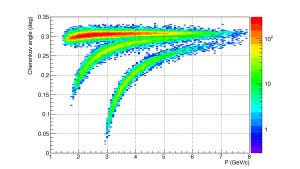
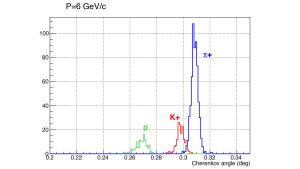
Many publications resulted from the development and the characterisation of this detector, and it is now used in the extraction of physics, including single and di-hadron production in SIDIS. Preliminary exciting physics results are obtained from this work and final results will be released in the next few years.
Acknowledgement: Professor Benmokhtar’s research is supported by the National Science foundation grant No. Benmokhtar-2310067. Italian INFN groups are supported by the European Union’s Horizon 2020 Research and Innovation programme under Grant Agreement No. 824093 (STRONG2020). We thank Jefferson Lab scientists and engineers for their contribution to the RICH project.
References
- Strange Quark Contributions to the Parity Violating Asymmetries in the Backward Angle G0 Electron Scattering experiment,
https://journals.aps.org/prl/abstract/10.1103/PhysRevLett.104.012001 - CLAS12 at Jefferson Lab: https://www.jlab.org/physics/hall-b/clas12
- RICH detector: https://www.jlab.org/Hall-B/clas12-web/specs/rich.pdf
- The large-area hybrid-optics CLAS12 RICH: First years of data-taking 10.1016/j.nima.2023.168758, https://www.sciencedirect.com/science/article/pii/S0168900223007490
Please note, this article will also appear in the 24th edition of our quarterly publication.