The research and teaching programmes at the University of Guelph’s Department of Animal Biosciences underpin the ethical and sustainable production of food and animal products and care of companion animals that enhance human and animal health and wellbeing.
The Department of Animal Biosciences (ABSc) – a globally recognised leader in animal health, welfare and sustainable production, within the Ontario Agricultural College (OAC) at the University of Guelph – is a leader in innovation and research, driving the agricultural and aquaculture sectors forward.
Being the only department of its kind in Ontario and sitting amongst the top animal science departments globally, ABSc plays a vital role in advancing food animal production in Canada and beyond. Home to more than 24 faculty members, over 150 graduate students, and 1,500 undergraduate students, the department is deeply committed to understanding the biology of animals and applying that knowledge to create real-world impact. Through cutting-edge research, strong industry partnerships, and the development of highly skilled graduates, ABSc supplies Ontario’s agriculture and food industries with the knowledge, talent, and innovations needed to thrive. This partnership between ABSc, government, and industry funding sources has led to over CAD$6m in annual research grants.
With roots tracing back to the founding of the Ontario Agricultural College in 1874, ABSc continues to build on a proud legacy, powering progress, sustainability, and leadership in Canada’s agri-food sector. A key component of ABSc’s success is the longstanding partnership between the Ontario Government and the University of Guelph through the Ontario Agri-Food Innovation Alliance – a collaboration that fuels research, innovation, and knowledge transfer across the province. This partnership provides ABSc researchers with access to world-class research stations and facilities owned by Agricultural Research and Innovation Ontario, an agency of the Government of Ontario.
On the academic side, ABSc offers dynamic and world-class programmes. For undergraduate students, the Bachelor of Science in Animal Biology programme caters to students wishing to pursue graduate studies or veterinary sciences while the Bachelor of Science in Agriculture major in Animal Science programme caters to students interested in pursuing careers in animal agriculture, and the Bachelor of Bio-Resource Management major in Equine Management focuses on students interested in working in the equine industry. At the graduate level, ABSc offers a variety of options ranging from M.Sc. by thesis, M.Sc. by coursework and Ph.D. degrees, all supported by a dynamic well-funded research programme.
The Campbell Centre for the Study of Animal Welfare (CCSAW) – research impacting global policy in animal care and welfare
As one of the first and largest groups of animal welfare centres in the world, CCSAW, at the University of Guelph, has a longstanding international reputation for improving the lives of animals. Our award-winning faculty members in ABSc specialise in basic and applied research on farm animals and horses that result in real-world impact.
An expert team
Dr Alexandra Harlander is one of the world’s leading experts on feather pecking behaviour in poultry – a behaviour problem affecting the health and wellbeing of the billions of laying hens around the world. Her pioneering fundamental work on the gut-brain-axis in the laying hen aims to disentangle the relationships between gut microbes and behaviour.
Dr Katrina Merkies specialises in equine welfare, with a focus on human-horse relationships and welfare implications of animal-assisted therapies that are used for enhancing human health.
Dr Tina Widowski, who has held the Egg Farmers of Canada chair in poultry welfare research for over ten years, works closely with egg farmers to develop housing and management that enhances health and welfare of laying hens. She focuses much of her research on early life, and the profound lifelong effects that rearing environment has on shaping young birds’ musculoskeletal and behavioural development.
Our faculty conducting animal welfare research play important roles in policy development by transferring their research findings into practice while serving on scientific advisory committees that develop animal welfare guidelines and policy in Canada and beyond.
The Centre for Genetic Improvement of Livestock (CGIL) – a breeding powerhouse for improving animal health, production, and sustainability
The Centre for Genetic Improvement of Livestock (CGIL) at the University of Guelph leads a comprehensive research programme focused on improving the health, welfare, and environmental sustainability of livestock through genetics, genomics, and multi-omics approaches funded by industry partners and public agencies totalling $3.5m/year.
With six faculty members, ten post-doctoral fellows and many graduate students, CGIL’s work integrates quantitative genetics, functional genomics, advanced genomic prediction, and large-scale phenotyping to identify genetic variation underlying disease resistance, animal resilience, feed efficiency, and methane emissions.
In recent years, the CGIL’s research has expanded further to include resilience and welfare traits, exploring how animals respond to stress and disease challenges. This holistic approach, linking animal health, efficiency, and environmental sustainability, has positioned CGIL as an international leader in developing genomic tools to improve food animal production and sustainability.
The Aquaculture Centre – a hub of information about aquaculture in Ontario
The Aquaculture Centre was established in 1988 as a collaborative venture between the University of Guelph and the Ontario Ministry of Agriculture, Food and Agribusiness. It provides Ontario aquaculture information to industry participants and frequently to the public.
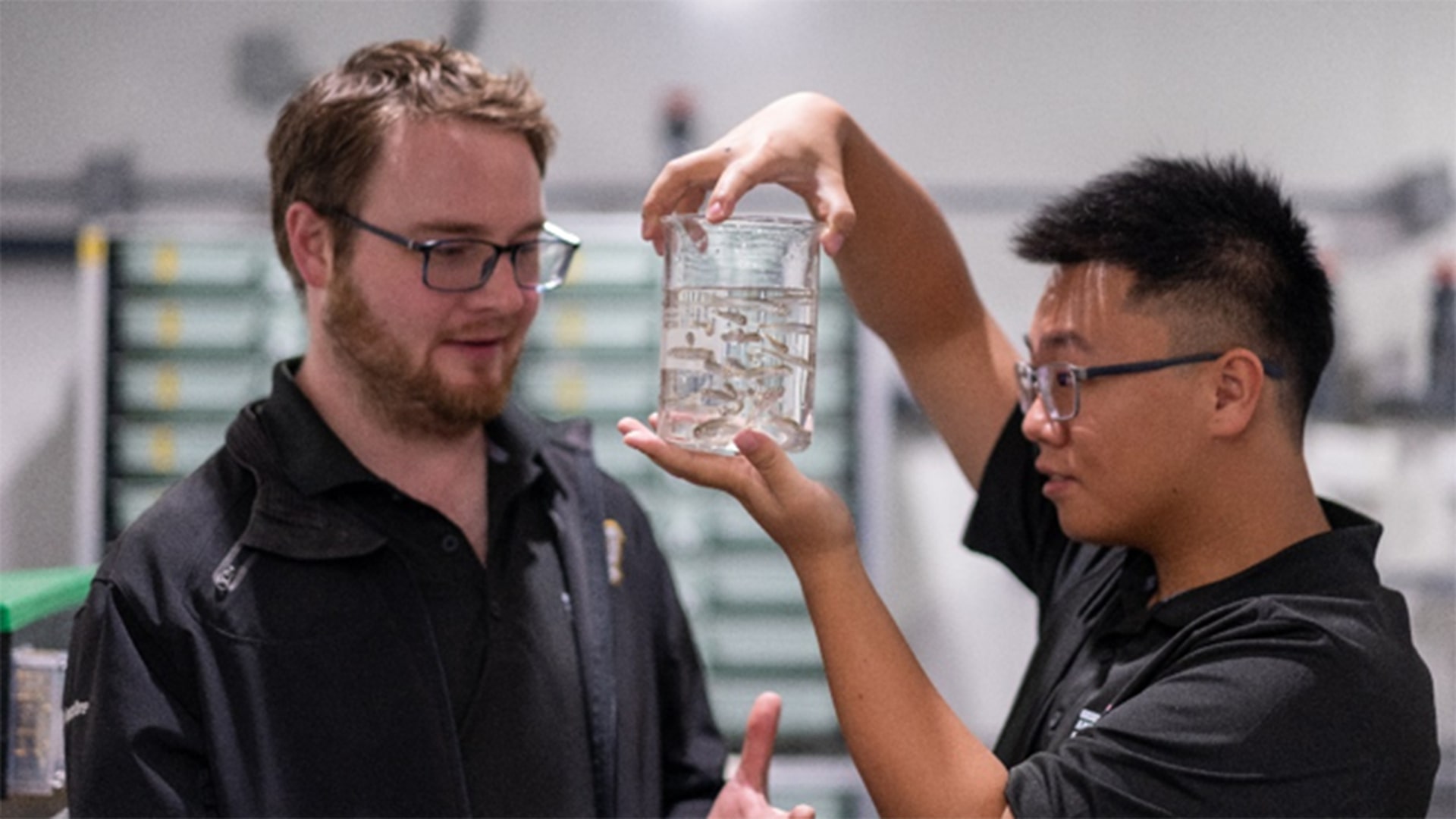
The Aquaculture Centre consists of over 17 professors that work at least in part on aquaculture research on topics that include fish genetics, health, nutrition, physiology, and ecology. Dr David Huyben’s research focuses on optimising nutrition and gut microbiota to support the health of farmed salmonid fishes, while Dr Dominique Bureau’s internationally recognised research focuses on improving our understanding of nutrients utilisation and deposition. Professor Rich Moccia’s research focuses on aquatic animal food production with an emphasis on the ecosystem impacts and animal welfare, and he was instrumental in developing industry code of practice standards.
Making sense of data – the Centre for Nutrition Modelling (CNM) at the University of Guelph
The CNM translates One Health principles into practice by developing advanced biomathematical and computational models that link animal nutrition, physiology, production systems and environmental outcomes, enabling interventions that benefit animal health and reduce emissions, thus providing tools for system optimisation.
Through a diverse array of backgrounds, the CNM’s leadership and researchers bring complementary strengths. Dr Jennifer Ellis applies cross-species mechanistic, empirical and machine learning animal models to improve nutrient efficiency, optimise systems, and sustainability and animal welfare outcomes. Dr John Cant leads a research programme on systems-level physiology and whole-animal modelling that connect biochemical mechanisms to production outcomes, while Dr Dan Tulpan contributes advanced computational and machine-learning approaches for large-scale biological data. Together, the CNM group enables evidence-based decisions that advance One Health goals.
In addition to innovative research streams, this team has developed a suite of undergraduate and graduate courses to train the next generation of animal scientists to utilise emerging data streams and computational methodologies to advance the sustainability, health, and welfare goals of the department.
ABSc – a leader in advancing dairy cattle health through innovative, multidisciplinary research (partner of the University of Guelph Dairy at Guelph)
Within the department, we are united by a shared goal: improving the health, welfare, and productivity of dairy cattle, while promoting the sustainability of the dairy industry. Our work spans the full spectrum of animal biosciences, from genetics and physiology to nutrition and behaviour, and is transforming how dairy health is understood, managed, and optimised.
Fundamental to this mission is the groundbreaking work in dairy genomics led by Drs Christine Baes and Flavio Schenkel, whose research is redefining how genetics can be harnessed to enhance animal health and resilience. Through projects such as the Efficient Dairy Genome Project, they identified genomic markers linked to disease resistance, fertility, and metabolic stability, allowing for earlier and more accurate selection of cows less prone to illness. Their research not only strengthens the genetic foundation of herd health but also aligns with environmental goals by targeting traits like feed efficiency and methane reduction, demonstrating that healthier cows can also be more sustainable.
In terms of nutrition and metabolic health, Dr John Cant’s work on nutrient utilisation, energy metabolism, and mammary gland physiology provides critical insight into how dietary inputs are converted into milk components and how metabolic processes regulate production efficiency and immune function, ultimately informing feeding and management practices. Additionally, Dr Michael Steele’s internationally recognised work on calf nutrition and rumen development reveals how early-life feeding strategies can shape long-term immunity and metabolic health, thus preventing digestive disorders and promoting stronger, more resilient animals from the start of life. Similarly, Dr Trevor DeVries’ research integrates animal behaviour, nutrition, welfare, and precision technology to support better health outcomes in mature cows. This proactive health management and reducing the need for therapeutic interventions.
Complementing these efforts, Dr Eduardo Ribeiro’s research in reproductive physiology focuses on the intricate links between disease, metabolism, and fertility. His discoveries on how postpartum disorders affect conception and embryo development are driving new strategies to reduce reproductive losses and improve overall herd health and longevity. Together, the dairy faculty in ABSc form a cohesive and dynamic research community that approaches dairy health from every angle.
ABSc – a leader in swine/pork health, nutrition, and welfare
Male piglets are routinely castrated to prevent off-odour and off-flavour in the meat known as boar taint. However, this practice has serious animal welfare concerns and reduces the efficiency and sustainability of pork production systems. Boar taint is a complex, multifactorial issue influenced by the metabolism of androstenone and skatole, and a high variability between breeds and individuals within breeds. As a solution, the work of Dr E James Squires and his team aims at developing methods to identify individuals with a low potential for boar taint, and develop nutritional strategies for pigs with high potential for boar taint, thus addressing animal welfare concerns while improving efficiency.
In fact, nutritional interventions have become a key mean of improving animal health and productivity. Dr Ming Fan’s group is conducting research using enzyme biotechnology strategies to enhance nutrient utilisation via modulation of the gut microbiome, thus reducing our reliance on the use of antimicrobials. As for all agricultural species, reproductive efficiency is key to the profitability of the pork industry.
One of the biggest challenges is accurately selecting young pigs that will become productive breeding sows. Looking beyond traditional approaches, Dr Julang Li found that the vaginal microbiome, combined with a machine-learning model, can predict a gilt’s fertility with close to 85% accuracy. On-farm validation is currently underway. Dr Lee-Anne Huber focuses on precision feeding strategies to improve sow productivity, health, and sustainability. Using the new, state-of-the-art swine research centre and environmental rooms capable of measuring greenhouse gas emissions from pigs and manure, Dr Huber conducts research examining the underlying biology that drives nutrient and energy requirements in order to update requirement models.
ABSc – working together for better health and welfare in poultry
Collectively, Drs Bédécarrats, Kiarie, Widowski and Harlander’s research aims to improve the health and welfare of birds while maintaining the economic sustainability of the industry. To that end, their approach is multidisciplinary, involving nutrition, metabolism, physiology, and behaviour, and addresses priorities of all sectors of the industry (laying hens for table eggs, broilers and broiler breeders for meat, and turkeys).
On the egg-laying side, Egg Farmers of Canada is committed to transitioning away from conventional cages to enriched and non-cage housing. Although welfare friendly, these systems also come with specific challenges associated with the increased level of bird activity and increased health risks, while shifting the need for and utilisation of nutrients, thus influencing growth trajectories and body composition of pullets.
Dr Bédécarrats’ research currently focuses on identifying the impact of body composition and metabolic status on the initiation of lay and the subsequent impacts on skeletal health, while Dr Kiarie focuses on early-life nutrition strategies to bolster gastrointestinal and skeletal development. Furthermore, Dr Kiarie’s studies evaluating novel feed ingredients, feedstuffs processing technologies, and innovative feed additives will help mitigate feed cost and environmental impact of animal protein production. Dr Harlander’s research focuses on the biomechanics and physiology of locomotion, and how muscle use affects skeletal health.
Improving the beef industry from bench to field to fork
Beef cattle research in ABSc is dedicated to advancing sustainability, efficiency, health and welfare, across all sectors of the beef industry. Faculty work to foster interdisciplinary collaboration among researchers across nutrition, genetics, welfare, and meat science, along with across department collaborations focusing on pastures, soils, and grazing and more.
Dr Katie Wood works on improving feed efficiency in beef production, which includes approaches using nutrition and management, developmental programming, improving gut health, and mitigation of enteric methane emissions in the barn and on pasture.
Dr Angela Canovas employs genetics, genomics, and the integration of multi-omics technologies within a systems biology framework to better understand animal function at the molecular level and identify genetically superior individuals. Her research aims to simultaneously improve key economically important traits by breeding healthier, more efficient animals that produce high-quality products in a sustainable manner.
Beyond agricultural species, ABSc is also a leader in companion animal health and wellness research
Dr Kate Shoveller leads an internationally recognised research and training programme in Companion Animal Nutrition, Physiology, and Metabolism at the University of Guelph. Her group integrates fundamental and applied approaches to understand how nutrition regulates protein, amino acid, and energy metabolism in dogs and cats, and how these metabolic processes influence health, physiology, and behaviour. Equally central to her programme is the training of highly qualified personnel, students and postdoctoral fellows who develop strong technical, analytical, and leadership skills through multidisciplinary projects and collaborative partnerships with academia and the global pet food industry.
Dr Wendy Pearson leads an equine physiology research programme focused on understanding the roles of inflammation in health and disease, and the influence of clinical nutrition. A key research area involves developing models to study the role of nutraceutical feed supplements in cartilage responses to inflammatory challenges. Another focus area seeks to understand the role of inflammation on adaptation of horses to exercise stress. This area of research seeks to characterise the transient oxidative/inflammatory effects of high-intensity exercise, with particular focus on cartilage metabolism and resistance to arthritis. In addition, Dr Pearson is also actively involved in elucidating the cause of leaky gut syndrome in horses by identifying risk factors, and developing nutritional and management interventions for its treatment.
In summary, through strong industry and government partnerships, ABSc translates cutting-edge science into real-world impact, shaping policy and practice in Canada and beyond. Its One Health approach ensures holistic progress in animal and human wellbeing.
Partners:
Please note, this article will also appear in the 24th edition of our quarterly publication.