ELEXIA develops and demonstrates tools for planning and managing integrated energy systems across vectors and sectors towards a cost-optimised, flexible and resilient energy system of systems.
Europe’s transition toward a carbon-neutral energy future requires smarter, more connected, and more resilient energy systems, and this is precisely what the ELEXIA project aims to achieve. Co-funded by the European Union under the Horizon Europe programme, ELEXIA ‘Demonstration of a digitised energy system integration across sectors, enhancing flexibility and resilience towards an efficient, sustainable, cost-optimised, affordable, secure, and stable energy supply’ intends to demonstrate how integrated planning and operation of systems with multiple energy carriers can be achieved. By linking electricity, heat, transport, and gas systems, and systems and components digitalisation, ELEXIA seeks to optimise the energy system as a whole, enhance flexibility and resilience, and contribute to Europe’s commitments under the Paris Agreement and the UN’s 2030 Agenda for Sustainable Development.
The ELEXIA project
The ELEXIA project aims to coordinate the planning and operation of the energy system ‘as a whole’, across multiple energy carriers, infrastructures, and consumption sectors as a pathway towards an effective, affordable, and deep decarbonisation of the European economy in line with the Paris Agreement and the UN’s 2030 Agenda for Sustainable Development. Linking of energy vectors and sectors will allow optimisation of the energy system as a whole, rather than decarbonising and making separate efficiency gains in each sector independently, which leads to sub-optimal outcomes in terms of efficiency and cost. Sector coupling creates flexibility for the power system where variable power generation is increasing rapidly and therefore benefits from a more controllable electricity demand, while the consideration of energy storage (heat, electricity and gas) and demand response results in substantial cost savings.¹
The project has a strong interdisciplinary character as it addresses not only technical boundary conditions, but also economic, regulatory and societal ones.
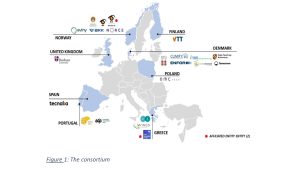
Kicked off in October 2022, and with a targeted duration of 48 months, there are in total 22 partners from different European countries (Fig. 1) involved in making the project a success.
The project aims at:
- Developing and deploying a System Planning Toolbox to support effective sector coupling at local sites, considering different scenarios, operational details, conflicting interests of multiple actors, and security of supply.
- To build and deploy Energy Management Systems for flexible, cost-optimised, and resilient operation of sector-coupled local sites, including forecasting, data-driven digital twins, optimisation, control, monitoring, assessing operating conditions and predicting anomalous operation.
- To provide a Digital Services Platform to host the energy management and planning services and to foster flexibility and sector coupling, consisting of the whole digitalisation hierarchy from smart edge devices to cloud services for guaranteeing interoperability, privacy and cybersecurity, increased observability, and controllability at more disaggregated levels and close to real time.
- To demonstrate the benefits of sector integration and flexibility at local and national level in three different geographical, climate and economic conditions throughout Europe and to train local stakeholders: in an industrial port environment in (Portugal), in an urban-city & hub environment in the Danish Pilot (Denmark), in an industrial-urban-residential environment in Bergen (Norway) and an additional industrial site in Gaj Olawski (Poland), which was previously considered as a location to replicate the ELEXIA concept.
- Furthermore, environmental sustainability using LCA will be demonstrated, alongside the economic feasibility.
In addition to the technical developments of the project, stakeholder engagement, societal impact assessment, stakeholder community building, and providing policy and governance recommendations are essential elements of the successful implementation of the ELEXIA concept. To ensure the success beyond the duration of the project, cooperation with other and similar projects and initiatives is followed, such as the BRIDGE initiative, the Energy Nexus Cluster or the EERA Joint Program Energy Systems Integration. Initiating the replication of the ELEXIA concept is another important activity within the project.
Given the wide spectrum of topics to be covered, the project work is highly interdisciplinary, bringing together specialists with various backgrounds, ranging from data science, via programming, engineering, economics, architecture, to social science. Furthermore, the cooperation across ‘traditional’ boundaries and single businesses and interests is an essential need for the success of the project and therefore the ELEXIA concept.
The first three years of the project were dominated by activities in developing the core tools of the concept, which are the Energy Systems Planning Toolbox (SPT), the Energy Management System (EMS) and the Digital Service Platform (DSP), as well as preparing the pilot sites.
Technical
The DSP is in the centre of the ELEXIA system, using the infrastructure of the partner Centre Denmark,² managing the data flow, storage and interfacing with all modules of the EMS, DSP and the energy systems components at the pilot sites. The digitalisation of the energy system is a relevant and essential element, following the concept of Minimal Interoperability Mechanisms (MIMs).³ The data structure and the required dataflow were defined and implemented during the first phase of the project, in close cooperation with data specialists, tool developers and pilot owners and operators. The required data flow and storage differ between the EMS and SPT tools and modules.
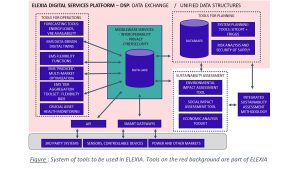
The EMS tools require a continuous or quasi-continuous flow of data from the integrated energy systems and their components via the DSP, also including the available historical data. They are therefore tightly connected to the DSP, and they are operating close to real time, providing system operational parameters for at least the next day up and expected operation for the next two to five days. The tools and modules in the ELEXIA concept include tools for forecasting of expected energy loads and variable renewable energy (VRE) availability, data-driven digital twins, flexibility functions, tools for multi-market optimisation and an aggregation toolset for flexibility bids and health monitoring of critical assets.
The connection of the SPT tools to the DSP is less tight, given the purpose of the tools, targeting longer-term planning. These tools allow for covering both cases, the planning and development of new energy systems as well as the planning of integrating new consumers or other energy system-relevant assets into existing systems. In case the latter needs to be evaluated, historical data from the DSP is retrieved. The DSP furthermore serves as a repository for saving different scenarios and/or versions of the energy system in planning.
It might not need to be noted that all aspects of cyber and data security are considered and that access to case-relevant data is controlled and restricted.
The ELEXIA system is to be demonstrated at four different locations, which are complementary to each other, allowing it to cover the entire spectrum of ELEXIA. These plot sites are:
- The port of Sinès (Portugal), where energy management of buildings and transport is in focus. Its weight is towards the EMS, but also the SPT will be relevant for planning the transition of the energy system of the harbour to include large shares of VRE, namely solar and wind-based energy.
- The area of Høje Taastrup (Denmark) with several municipal buildings, and a recently installed large pit thermal energy storage (PTES), is connected to the thermal distribution grid and the district heating grid of Høje Taastrup. The municipal buildings are also equipped with an occupant feedback tool providing input to the building management system.
- The area of Dokken, being a part of the city of Bergen (Norway), is the third pilot. As Dokken is in the process of being converted from an industrial harbour area into a zero-emission and sustainable area with a mixture of residential, business and public buildings (education and maritime research), but still keeping a quay for passenger ships (Hurtigruten) and shore power. SPT is key for this pilot, strongly supported by LCA and risk evaluation. The interaction with the already existing energy systems of the Bergen municipality needs to be considered. The advanced waste collection system is, in addition to the interaction with transport and local energy storage, a flexibility asset as the collection can be, within some limits, scheduled for an improved matching of energy demand and generation.
- An industrial site in Poland, which was first targeted as a replication site, is also going to act as a demonstrator for the ELEXIA system. The site of Promet Plast in Gaj Olawski comprises offices and a manufacturing site for products for hospitals and doctors. Local energy generation based on wind (21MW), AgroHydroEnergy (PV-fields of 10MW), battery storage (12MWh), hydrogen generation (5MW electrolyser) and storage, as well as a trigeneration unit as back-up (Hydrogen-based 1MW/1.2MWe and Methane-based 1MW/1.2MWe). Flexible loads are represented by batteries, H2 generation, thermal loads, and EV charging and load shifting between separate manufacturing lines is an additional possibility. A large PV field is connected to an agricultural operation (growing food) and protecting the plants against frost via artificial snow using water collected for the PV panels and RES.
Interdisciplinary
On the practical side, cooperation across energy vectors, sectors, and disciplines requires close interaction between tool developers and stakeholders at the pilot sites. Ongoing communication is essential to bridge the diverse professional backgrounds of the participants and to identify and address potential gaps. The involvement of external stakeholders and the collection of information and data from them turned out to be challenging. Most of them prioritise their own planning, activities and resources over contributing to ELEXIA. A key reason may be that, at this stage, only estimated benefits can be presented, as the on-site demonstrations have not yet begun. It also became apparent that besides the economic and technical parameters, other, less data-based parameters impact the willingness of stakeholders to join and get involved. Overall, these differ depending on local conditions like the level of energy prices relative to the level of income, as well as personal preferences and prejudices. The estimation of the extent to which local stakeholders are willing to join, willing to use technical possibilities (smart appliances, utilising potential flexibility, etc.) is therefore quite uncertain, especially in the context of planning activities. The consideration of societal situation, local economy and perception is therefore important to estimate the impact of the ELEXIA concept and to what extent the full potential of the implemented solutions can be harvested.
Current status
Currently ongoing is the first phase of demonstrating the tools at the pilot locations. Even though a relatively high level of digitalisation at the pilots was achieved, a lot of effort was spent on mapping the existing level of digitalisation, the availability of data relevant to the tools, and preparing the sites. Together with the installation of ELEXIA is a training of users ongoing, providing important feedback for the developers to further improve interfaces, dashboards, etc., thus ensuring the use of the tools. Requirement of different user groups is considered depending on their role in the energy environment. These might range from those mainly interested in the result of the tools as a base for decisions, via those who need to configure and run various scenarios, to those who need to add additional modules (e.g. components, characteristics) to the ELEXIA system.
The interactive installation and operation of the ELEXIA system at the pilot location is still proceeding and expected to be completed by the first quarter of 2026, followed by the operational phase, which will be covered in follow-up publications.
For existing ELEXIA publications, most of which are scientific, please visit the project’s website.
References
- Schledorn, A. (2023). Modelling of flexibility-centric energy systems: Operation, planning and policy-making. Technical University of Denmark.
- https://www.centerdenmark.com/en/
- See also https://data.europa.eu/en/news-events/news/minimal-interoperability-mechanisms-advancing-europes-digital-future
Please note, this article will also appear in the 24th edition of our quarterly publication.