The protein bioeconomy is shifting beneath our feet.
In the face of unpredictable global market pressures, broad product pipelines, expectations for rapid profits, and the need for low-cost protein products, a rapid shift is taking place in the biotechnology industry from large-scale, single-product facilities to agile, distributed, and flexible manufacturing strategies.
Biomanufacturing capacity must grow 20-fold by 2040 to support market growth predictions, reduce manufacturing costs, and prevent production bottlenecks – and Europe finds itself uniquely positioned to lead a biomanufacturing revolution. To meet this accelerating demand for bioproducts, biotechnology innovators need high-quality, cost-effective approaches to production and innovations that enable flexible manufacturing capacity.
While other regions grapple with policy uncertainties and retreat from global co-operation, European nations are advancing toward a more evolved approach to innovation and regulation through initiatives like the EU Biotech Act, which simplifies and standardises the drug approval process, and the Critical Medicines Act, which enables agile vaccine manufacturing and strengthens the availability and supply of critical medicines.
Yet the protein bioeconomy knows no borders: supply disruptions, food security challenges, or shifts in agricultural and materials demand can emerge anywhere at any time, making it essential to keep global policy shifts in view and be ready to respond accordingly. Regardless of the country or continent, the future of bioindustrial sovereignty lies in the ability to produce what you need, when you need it, and where you need it.
Why continuous manufacturing matters now
Traditional biomanufacturing is capital-intensive, slow to adapt, and concentrated in certain geographies. It typically takes three to five years and over $200m to build conventional stainless steel biomanufacturing facilities. These types of facilities are often built for a single product type and cannot rapidly adapt to changes in demand. In the face of unpredictable global market pressures, broad product pipelines, the expectation for rapid profits, and the need for low-cost protein products, shifting away from ultra-large-scale, single-product facilities to agile and flexible manufacturing strategies is paramount.
Continuous methods for protein manufacturing, such as perfusion, have transformed protein production. Perfusion fermentation requires less physical space, allowing for a smaller process footprint while still ensuring consistent product quality. At this scale, single-use technologies become viable – reducing fluid usage, eliminating cleaning chemicals, shortening turnover times, and enabling flexible multi-product facilities. Together, this integrated, distributable, and lower-cost manufacturing approach empowers manufacturers to produce proteins without the need for large, upfront capital investments.
The dual advantage of continuous manufacturing (CM) speaks directly to European priorities: productivity and sustainability.
For productivity, continuous processes dramatically reduce manufacturing footprints while increasing output flexibility. A single CM line can produce what traditionally required multiple batch reactors, reducing capital investment and operational complexity. This ‘right-sized’ approach allows many micro facilities to be deployed in diverse regions, enabling more localities to participate in and benefit from the expanding protein bioeconomy.
For the planet, CM aligns perfectly with Europe’s environmental leadership. It’s a more efficient and eco-friendlier alternative to traditional batch manufacturing, reducing water consumption alongside the need for smaller and often fewer unit operations. Ultimately, this approach enhances product consistency, protein yield, and throughput. By maintaining stable, optimal conditions, CM also supports accelerated production, reduces product variability, and ultimately lowers energy consumption due to smaller facility footprints with similar or greater product yields, making it an attractive option from a sustainability perspective.
With this technology, each European nation, or the EU as a whole, can tailor its biomanufacturing infrastructure to meet its specific protein production priorities while maintaining the flexibility to collaborate when needed. As CM advances, it will make high-quality bioproducts more affordable, accessible, and faster to produce, ultimately revolutionising bioeconomy development worldwide.
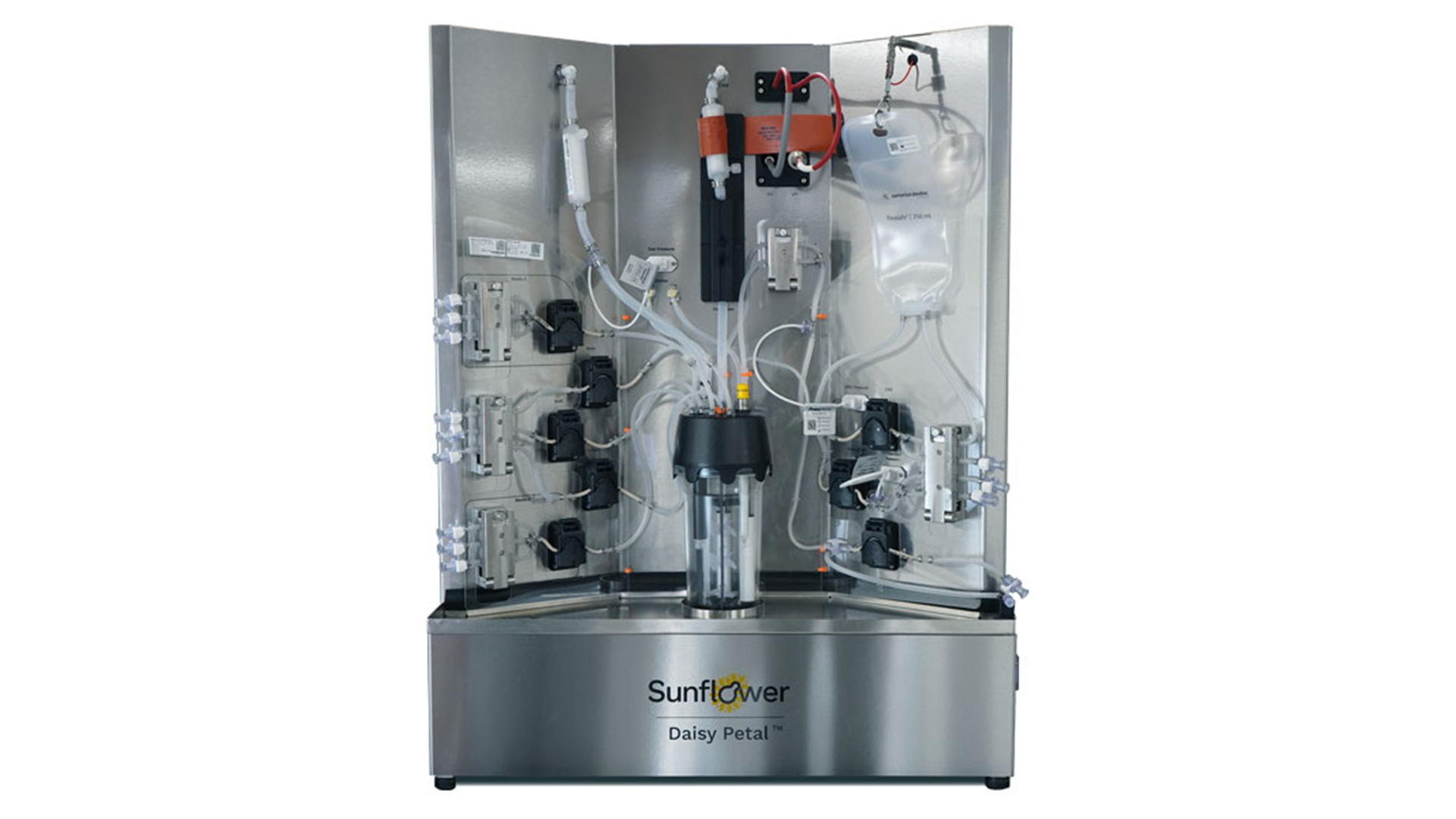
Solutions like the Daisy Petal™ Perfusion Bioreactor System can set Europe on this path to bioeconomic development today. The Daisy Petal™, developed by Sunflower Therapeutics, is a cutting-edge, fully automated benchtop bioreactor system designed for continuous protein production. Unlike legacy processes and technology, the Daisy Petal™ is a fermentation platform that operates in a completely unique way – through perfusion. It is designed to help achieve R&D goals in drug development, synthetic biology, or reagent production without the need for bioprocessing expertise.
The system, which is designed with an intuitive, single-use assembly, makes high-yield, sustainable biomanufacturing more attainable than legacy technologies. It leverages a novel in-vessel cell retention device that allows for continuous nutrient feeding, waste removal, and biomass retention without ever removing the cells from the controlled environment. This approach enables consistent, high-quality protein production with a smaller footprint and lower operational costs.
By combining automation, in-vessel perfusion, and single-use components, the Daisy Petal™ supports scalable recombinant protein manufacturing and enables a seamless transition to the pilot-scale Dahlia Petal™ or even larger systems, allowing efficient scale-up from research and development to commercial production while reducing environmental impact, lowering costs, and broadening access.
Looking ahead
As demand for bio-based solutions grows, regions will increasingly shape their own approaches to alternative proteins, probiotics, agricultural products, and sustainable materials. In the industrial biotechnology sector, ensuring resilient supply chains is essential. For Europe, the opportunity lies in accelerating infrastructure to keep pace with growing demand. The opportunity is to lead in sustainable, flexible biomanufacturing and set standards for others to follow.
CM is not just about resilience in a fragmented world. It is about thriving in it. This means producing bio-inspired products within European borders, under European control, and aligned with European values.
Europe must look to the future of biomanufacturing, where continuous technologies provide a path to greater independence, productivity, and sustainability. The need for bioindustrial sovereignty is already clear. The real question is whether Europe will act now to build the infrastructure that makes it possible.
This future isn’t about isolation, but intelligent independence — collaborating from a position of strength rather than reliance. With CM as its foundation, Europe can begin building that future today.
Please note, this article will also appear in the 24th edition of our quarterly publication.