
Spectrum Blue AS considers the harmful effects of nitrogen oxides on health and the environment, outlining current strategies for managing emissions and the potential for emerging solutions like photocatalytic coatings to reduce NOx levels in urban areas.
Nitrogen oxides, collectively referred to as NOx, are a group of highly reactive gases primarily composed of nitric oxide (NO) and nitrogen dioxide (NO₂), which are significant contributors to air pollution and environmental harm.1,2,3 NOx gases are mainly formed during high-temperature combustion processes, such as those occurring in vehicle engines, power plants, industrial boilers, and shipping. In Norway, the largest sources of NOx emissions are transportation (especially road traffic and shipping), oil and gas activities, and land-based industry.¹ Natural sources also exist, including lightning and forest fires, but human activities overwhelmingly dominate total emissions in most populated and industrialised regions.4,5,2
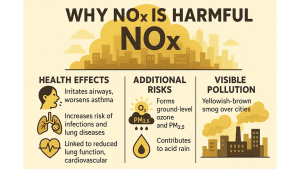
NOx is harmful for several reasons. When inhaled, nitrogen dioxide can irritate and inflame the airways, worsen asthma, and increase susceptibility to respiratory infections and chronic lung diseases.6,7,8,3 Long-term exposure is linked to reduced lung function, cardiovascular problems, and even premature death. Beyond direct health effects, NOx plays a central role in the formation of ground-level ozone and fine particulate matter (PM2.5), both of which are associated with further respiratory and cardiovascular risks.6,1,8 NOx also contributes to acid rain, which damages ecosystems, buildings, and crops.7,2,8 The visible manifestation of NOx pollution is often seen as yellowish-brown smog over cities, especially where vehicle emissions are high.8,3
The problem is most severe in densely populated urban areas and industrial clusters, where traffic and industrial activity are concentrated. Satellite data and air quality monitoring consistently show that large cities, such as Delhi, London, and other major metropolitan regions, are NOx hotspots, with the highest levels typically found near busy roads, ports, and industrial zones.9,1,2 In these areas, residents face the greatest health risks and environmental impacts from NOx pollution. While regulations and technology have reduced emissions in some regions, NOx remains a persistent challenge for air quality in urban and industrialised parts of the world.
How we deal with NOX today
Current strategies to manage NOx include:
- Prevention: Transitioning to electric vehicles and cleaner combustion technologies.
- Regulation: Implementing emissions standards and low-emission zones (LEZs).
- Monitoring: Tracking pollution levels, with mitigations only existing for inside air filtration, such as potassium permanganate-based air filters.
However, very few methods exist to remove NOx after it has already been emitted into the atmosphere that the pedestrian is exposed to.
A solution that reduces NOx levels in a city centre by 20% is considered significant. Evidence from real-world interventions, such as the implementation of low-emission zones (LEZs), shows that a 20% reduction in nitrogen dioxide (NO₂, a major component of NOx) is a typical and impactful outcome, leading to measurable improvements in urban air quality.¹ Such reductions are associated with public health benefits, including lower risks of respiratory and cardiovascular diseases, as well as a decrease in premature deaths linked to air pollution exposure.2,3
For context, studies have shown that even reductions in the range of 14–28% (as seen in Madrid’s traffic-restricted zones) are notable and often cited as evidence of successful air quality policy.⁴ Over the past decades, sustained NOx reductions in cities have contributed to dramatic improvements in air quality and public health outcomes.² Therefore, achieving a 20% NOx reduction in a city centre would represent a meaningful and positive environmental and health impact.1,2
Surface reduction of NOx
An emerging approach to directly remove NOx in ambient air is through photocatalytic coatings11 applied to surfaces in urban areas that convert it into nitrates with UV light as an energy source.
Traditionally, these coatings rely on UV light to activate the catalytic process. However, UV levels are highly variable due to cloud cover, seasons or time of day and are completely absent in tunnels and shaded areas.
And UV levels are also much weaker north of the 37th parallel – encompassing some of the most logistically intensive places in the world.
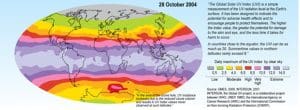
This means that they are not usable in shaded urban canyons or tunnels and other undergrown infrastructure where artificial light is the only source of illumination. So, in this case, UV is the elephant outside the room, and having a visible light photocatalytic coating could make this additional and complementary avenue of improving air quality a success.
In search for a visible light solution that can work even with artificial light, SPECTRUM BLUE AS was funded through the EEA and Norway Grants programme and teamed up with BEIA Consult International and HEY’DI AS to test its patented visible light photocatalytic pigment (PCT/RO2022/050005) in various types of cement and coatings.
Making it work without UV: Introducing the Q-field technology
Unlike traditional coatings, Q-coating is effective without needing UV light, making it functional:
• Indoors
• In tunnels
• Under overpasses
• On shaded urban surfaces
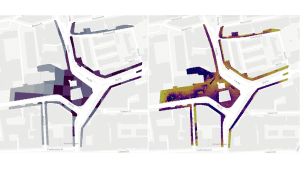
The Q-field cement project showed that Q-coated surfaces can reduce NOx even in low-light shaded conditions when applied on pedestrian pavements. Q-field coating offers a passive, scalable method for reducing airborne NOx. Modelled deployment scenarios suggest that it can achieve daily reductions of 19% in localised NOx concentrations, comparable to the impact of low-emission zones or traffic restrictions.
Based on lab results, just 100 m² of coated pavement could remove up to 6.12 tons of NOx per year in a scenario from a London intersection. Coating the pavement of an intersection, such as Old Street in London, can be the difference between a healthy and an unhealthy commute. This represents a scalable, cost-effective solution to target NOx pollution in otherwise unreachable places.
A toolkit for cities: Mapping the Q-no-NOx potential
Q-coating offers a way for municipalities to proactively reduce pollution – not just regulate or avoid it.
Key applications include:
- Coating tunnel interiors, concrete barriers, and public infrastructure
- Creating NOx traps along highways and industrial zones
- Painting school walls, playgrounds and hospitals to improve micro-environment air quality
Planning and impact estimation
Companies such as Optimal Cities Ltd, a UK-based digital planning company, have built models for city simulations that can:
- Estimate the total NOx reduction potential by surface area
- Prioritise high-exposure zones
- Integrate the technology into sustainability and health planning
Cities, infrastructure operators, and construction companies can now:
- Schedule pilot installations
- Integrate Q-field into their construction projects
- Monitor air quality changes via recommended third-party partners
With the invention of Q-field, we can move past just measuring NOX pollution; it’s possible to start cleaning it!
References
- https://cleancitiescampaign.org/research-list/quantifying-the-impact-of-low-and-zero-emission-zones/
- https://www.epa.gov/clean-air-act-overview/progress-cleaning-air-and-improving-peoples-health
- https://wjarr.com/sites/default/files/WJARR-2023-1779.pdf
- https://itdp.org/2020/03/04/transit-solutions-for-the-air-quality-crisis/
- https://www.sciencedirect.com/science/article/abs/pii/S1352231017308695
- https://www.sciencedirect.com/science/article/abs/pii/0048969796052382
- https://aiche.onlinelibrary.wiley.com/doi/10.1002/ep.13484
- https://stillwaterassociates.com/food-for-thought-overly-aggressive-nox-reduction-has-delayed-californias-ozone-attainment-by-15-years/
- https://www3.epa.gov/ttncatc1/dir1/fnoxdoc.pdf
- https://davidsuzuki.org/wp-content/uploads/2017/09/impact-green-space-heat-air-pollution-urban-communities.pdf
- https://www.mdpi.com/2071-1050/15/11/9098
- https://www.noxfondet.no/en/articles/what-is-nox/
- https://en.wikipedia.org/wiki/NOx
- https://learn.kaiterra.com/en/air-academy/oxides-of-nitrogen-nox
- https://www.aeroqual.com/blog/meet-the-nitrogen-oxide-family
- https://www.ncbi.nlm.nih.gov/books/NBK138707/
- http://azdeq.gov/nitrogen-oxide-nox-pollution
- https://phys.org/news/2015-09-nox-gases-diesel-car-fumes.html
- https://www.qld.gov.au/environment/management/monitoring/air/air-pollution/pollutants/nitrogen-oxides
- https://www.greenpeace.org/india/en/press/3715/new-satellite-data-shows-top-polluting-nox-hotspots-in-india-range-from-cities-to-industrial-clusters/
- https://www.youtube.com/watch?v=PRKweQsz-g8
Please note, this article will also appear in the 25th edition of our quarterly publication.