ZeroF’s final event showcased PFAS-free coatings for food packaging and upholstery textiles, exploring technical feasibility, regulatory alignment, consumer acceptance, and future market potential.
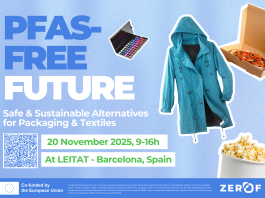
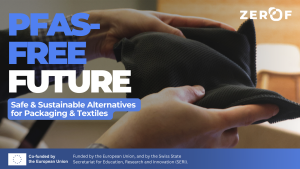
The European research project ZeroF marked a key milestone with its final stakeholder event, ‘PFAS FREE FUTURE – Safe & Sustainable Alternatives for Packaging & Textile’ last November in Barcelona. After three years of EU- and Swiss-funded research, the project presented PFAS-free coating solutions for food packaging and upholstery textiles, showing promising progress in performance, safety and sustainability assessments, and alignment with emerging EU rules by 2030 and rising consumer awareness.
Why PFAS-Free Matters Now: Insights from ZeroF
Per- and polyfluoroalkyl substances (PFAS) are widely used to make products water-, grease-, and stain-repellent. Due to their persistence, bioaccumulation, and health risks, the EU plans to phase out non-essential PFAS uses by 2030 under the Chemicals Strategy for Sustainability, the Zero Pollution Action Plan, national measures, and the proposed REACH restriction. At the project’s final event, the 12 ZeroF partners shared insights on the evolving regulatory landscape driving the shift to PFAS-free solutions. Discussions covered the technical, safety, and market factors needed for wider adoption, focusing on three questions: Are viable PFAS-free alternatives available? How will EU regulations change? And what does this mean for research, industry, and consumers?
ZeroF partner TEMAS Solutions highlighted that Europe is entering a dense regulatory decade. The Green Deal is reshaping chemicals, packaging, and textile policies, introducing stricter rules on Food Contact Materials, packaging waste, and eco-design, along with emerging expectations regarding recyclability, microfibre release, and non-intentionally added substances (NIAS). These changes are raising standards for PFAS use as well as overall material safety and circularity. Packaging or textiles that hinder recycling or contain PFAS may already fall short of evolving rules, even before full bans take effect. Clear timelines and consistent criteria for recyclability and PFAS-free claims are essential to support early adopters and avoid fragmented national approaches. Against this backdrop, the ZeroF final event demonstrated the shift from regulatory awareness to practical action, presenting some of the first PFAS-free solutions ready for real-world use.
ZeroF’s solutions for upholstery textiles
ZeroF’s upholstery textiles were based on advanced ORMOCER® hybrid coatings developed by Fraunhofer ISC, which integrate inorganic and organic materials to create a durable, water- and oil-repellent, easy-clean layer. The coatings were applied and validated by Leitat, in collaboration with E.Cima and Textiles.CAT, focusing on performance optimisation, production scale-up, and compatibility with conventional textile machinery for prototype upholstery textiles.
Tests on ZeroF’s coated upholstery fabrics showed excellent water repellency and good oil repellency for cooking oils and more challenging oils, suitable for most indoor uses, though not yet as strong as traditional PFAS-based coatings. Semi-industrial trials showed they can be applied with standard textile machinery using padding or exhaustion. Next steps include improving stability, wear resistance, and durability through repeated washing, showing that practical PFAS-free coatings are achievable. ZeroF experts noted that current standards often do not fit PFAS-free materials, especially for oil repellency and stain resistance. Updated benchmarks are needed to define adequate performance criteria, giving policymakers a chance to better align chemicals policy, product standards, and circular economy goals.
What ZeroF delivered for packaging
For food packaging, VTT, together with partners Kemira and Yangi, developed new coatings based on modified polysaccharides (such as cellulose and starch) reacted with long-chain fatty acids, mostly referred to as CeFAE materials. These bio-based coatings, applied as water-based dispersions or powders, provided strong water and grease barriers on boards and 3D-shaped fibre products, meeting performance expectations in laboratory and pilot-scale evaluations.
The project also demonstrated pilot-scale production (tens of kilograms) in standard reactors, indicating that upscaling from lab chemistry to industrially relevant quantities is feasible. Tests on coated trays showed encouraging performance under use conditions and partial compostability, although further work is needed on recyclability, migration into food, and the behaviour of residues at the end of life to meet future EU packaging and Food Contact Materials requirements.
Safe and sustainable by design in practice
A central pillar of ZeroF was applying the EU’s Safe and Sustainable by Design (SSbD) approach as a continuous guide throughout material design, testing, and scaling. The Luxembourg Institute of Science and Technology (LIST), together with partners TEMAS Solutions, IDEAconsult Universita di Bologna, and LGI Sustainable Innovation, combined hazard screening and assessment, computational modelling, life-cycle assessment, and cost analysis to improve the safety and sustainability of ZeroF formulations and processes. This led to the substitution of around 20 hazardous substances, enhancing safety and optimising energy use and overall impact. PFAS-free packaging prototypes generally outperform PFAS-coated references, while textile prototypes reduce PFAS emissions but show mixed results in other impact areas, highlighting trade-offs for policymakers.
Bringing new materials to the EU market requires thorough documentation of safety, chemical migration, NIAS, and performance, supported by EFSA-style data for Food Contact Materials or robust internal testing for textiles. ZeroF shows that SSbD methods and digital tools help guide design and structure this process, but they cannot replace actual testing or fill gaps in polymer-specific hazard data, underscoring the need for both rigorous testing and regulatory alignment.
What consumers think and how to engage them with new solutions
VTT, with support from Leitat, surveyed 1,500 citizens in Finland, France, Spain, and Luxembourg about PFAS-free products. While around 62% had never heard of PFAS, most showed a strong preference for PFAS-free options once they knew everyday use, performance, and price would stay the same. Food packaging is the top priority, followed by textiles, and about a third are already seeking alternatives. Acceptance depends on clear proof, convenience, and cost, highlighting the role of regulation, standards, and public procurement in making PFAS-free the norm.
Collaboration as a condition for success
ZeroF’s final event in Barcelona showed that a PFAS-free future is not just a technical challenge. It highlighted the need for cross-sector collaboration, especially for demanding applications and new standards. The project leaves a twofold legacy for the EU: it provides tested PFAS-free options for packaging and upholstery textiles, and demonstrates how SSbD can bridge innovation and regulation. The next phase now rests with regulators, standardisers, brands, and manufacturers to make PFAS-free materials the default in Europe’s green transition.