Conducting integral research on antimicrobial resistance in wastewater, Dr Amy Pruden and her team emphasise a One Health approach and using wastewater surveillance to link antibiotic prescriptions to resistance genes.
Dr Amy Pruden, University Distinguished Professor in Civil & Environmental Engineering at Virginia Tech University, USA, and her collaborators have advanced key research fronts over the past year towards further illuminating environmental dimensions of antimicrobial resistance (AMR). As underscored in the World Health Organization (WHO) Global Action Plan and the United Nations Environment Programme Bracing for Superbugs reports, a One Health approach considering the interconnected health of people, animals, and the environment is essential towards combating the spread of AMR, but environmental aspects are relatively poorly defined. On the 14th October, Pruden was invited to address this issue as a keynote at the International One Health Symposium, held in Berlin, Germany.
Pruden highlighted her team’s study that was published last month in NPJ Antimicrobials and Resistance.¹ By partnering with medical researchers, Dr Lauren McDaniel, Dr Jayasimha Rao, Dr Elizabeth Nowak and Dr Anthony Baffoe-Bonnie at the Carilion Clinic serving Southwest Virginia, US, they were able to obtain antibiotic prescription data for the region and map the inpatient and outpatient rates of prescriptions per patient encounter in two neighbouring sewersheds.
They found that while outpatient prescription rates dropped precipitously during the early phases of the COVID-19 pandemic, one community had significantly higher outpatient prescription rates over the 2017-2022 period examined in the study. They compared this data against longitudinal shotgun metagenomic sequencing data for the sewage entering the two corresponding wastewater treatment plants (WWTPs) and found that the numbers and diversity of unique antibiotic resistance genes (ARGs) were higher for the WWTP serving the community with historically higher antibiotic prescription rates.
This work has important implications for the benefits of improved antimicrobial stewardship practices and provides an exemplar of the value of wastewater-based surveillance for AMR monitoring at the community scale.
Sampling campaign of antibiotic-resistant bacteria in water
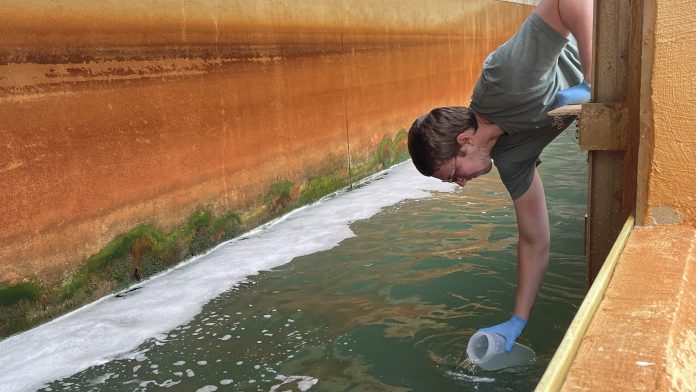
Over the last six months, Pruden’s team launched a longitudinal sampling campaign of antibiotic-resistant bacteria (ARB) and ARGs in rivers and streams across the Eastern USA. Dr Valerie J. Harwood’s team has led sampling in Florida, Dr Walid Alali has led sampling in Tennessee, Dr Latania Logan has led sampling in Atlanta and Chicago, Dr Emily Garner has led sampling in West Virginia, and Dr Peter Vikesland has partnered with Pruden to conduct sampling across Virginia. The target ARBs are cefotaxime-resistant Escherichia coli, vancomycin and erythromycin-resistant Enterococcus spp., and ceftazidime and imipenem-resistant Pseudomonas aeruginosa.
Analysis of results is underway and will help to identify sources of these representative ESKAPEE pathogens to the environment, including the relative contributions of a spectrum of small to large WWTPs. The study will also provide the opportunity to compare with clinical ARB strains and help address epidemiological knowledge gaps regarding the contribution of environmental exposures to AMR infections in humans.

Shotgun metagenomic sequencing and whole-genome sequencing will additionally be conducted to shed light on the origin and evolution of resistance in these aquatic environments. This effort is also vital in taking steps towards standardising culture-based methods for environmental monitoring of ESKAPEE pathogens, which is often challenging due to contamination by non-specific organisms.
Upcoming metagenomic sequencing study
In the coming months, Pruden, Vikesland, Dr Matthew Blair at the University of Alabama and their team will additionally be analysing metagenomic sequencing data gathered from the influent and effluent of WWTPs located in India, the Philippines, Botswana, Switzerland, Portugal, Sweden, and the USA. This study will build on recent studies2,3 that have revealed striking patterns in the relative abundance and clinical relevance of ARGs in sewage as a function of geography. This more in-depth study provides the opportunity to examine drivers of these patterns, including socioeconomic factors and the level of local and national policy and stewardship efforts.
Enhancing accessibility
Finally, Pruden’s team, in partnership with Dr Liqing Zhang, has taken strides in developing web-based tools to help make metagenomic-based tools more accessible for monitoring of ARGs in the environment. In August, her team launched CIWARS (Cyberinfrastructure for Waterborne Antimicrobial Resistance Surveillance) as a web server configured for longitudinal metagenomic data. Additionally, they have made advances towards the use of large language models in ARG identification through ProtAlignARG and the implementation of assembly graphs to map the local context of ARGs on mobile genetic elements and pathogens through ARGContextProfiler.
Overcoming challenges
One major stumbling block to the progress of the research conducted by Pruden and her collaborators has been the loss of U.S. Environmental Protection Agency (U.S. EPA) funding that was reported previously by INN. This was due to the recent unfortunate decision of the U.S. EPA to close its Office of Research and Development and terminate all funded research projects. This funding was vital to support national-level surveillance of ARB and ARGs in rivers and streams as a means of gaining insight into the ecology and evolution of AMR and the contribution of environmental exposures to resistant infections encountered in the clinic.
Her team has been able to move forward at a more modest scale through support from the US National Science Foundation Research Traineeship (NRT) PhD training grant on Combating Antimicrobial Resistance, the Virginia Tech Fralin Life Sciences Institute, the Virginia Tech College of Engineering, and other internal sources of support. Pruden emphasises that investment in AMR research in the environment is more critical than ever, particularly at the international scale, in order to better understand the root sources of the problem and identify effective strategies that keep antimicrobials working as life-saving drugs for future generations.
References
- Maile-Moskowitz, A; Brown, CL, Afrin Rumi, M; Moumi, N; Majeed, H; Finkielstein, C; Ceci, A; Gonzalez, R; Xia, K, McDaniel, L; Baffoe-Bonnie, A; Rao, J; Zhang, L; Pruden, A; Vikesland, PJ. Relating antimicrobial use to wastewater resistance gene patterns via metagenomic analysis of two neighboring treatment plants circa the COVID-19 pandemic. NPJ Antimicrobials and Resistance. 2025 September 30. https://doi.org/10.1038/s44259-025-00153-9
- https://pmc.ncbi.nlm.nih.gov/articles/PMC6408512/
- https://pubs.acs.org/doi/10.1021/acs.est.1c08673
Please note, this article will also appear in the 24th edition of our quarterly publication.