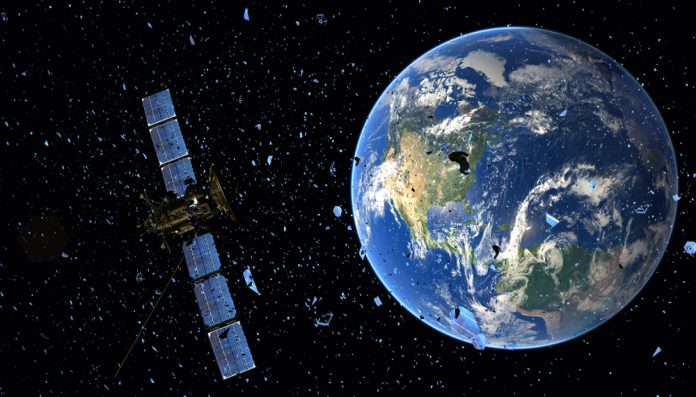
Japan has initiated the development of international regulations for space debris removal, as space junk poses a threat to satellites, the International Space Station (ISS), and other orbital objects.
By March 2026, the Japanese Government will work with experts to develop legal and procedural frameworks for space debris removal, such as rocket fragments, defunct satellites, and other objects.
This initiative aims to create global standards that will help minimise the risk of orbital collisions and ensure the sustainable use of space.
The growing problem of space debris
There are an estimated 140 million pieces of space debris smaller than 1cm, and over 54,000 tracked objects larger than 10cm currently orbiting Earth. Even tiny fragments can cause catastrophic damage to satellites.
Active satellites that provide vital services on Earth are at risk of collision with other satellites and the huge quantity of human-made debris in orbit around our planet.
The increase in launches, especially by private companies such as SpaceX, worsens the problem. The Starlink satellite constellation alone has more than 6,000 satellites, some of which may eventually become debris.
Without regulation, this situation threatens the future of space exploration, increasing the likelihood of a cascade effect (Kessler Syndrome), where collisions create more fragments, rendering orbit unusable.
Therefore, it is crucial to promote the responsible use of space through a combination of regulation, development of sustainability standards, technological advancements, missions like space debris removal, and robust surveillance and tracking services.
Japan’s space debris removal strategy
The newly-launched Japanese strategy focuses on the following areas to aid active space debris removal:
- Object identification: Establishing procedures for obtaining debris data from its owners – both governmental and private organisations
- Safe disposal: Developing mechanisms for removing objects from orbit, including possible capture and deorbiting technologies
- International cooperation: Preparing proposals for discussion at the UN Committee on the Peaceful Uses of Outer Space (COPUOS), scheduled for 2026
Japan’s initiative aims to establish unified international standards that will be mandatory for all space activity participants, including private companies. This is especially relevant in light of the growth of commercial spaceflight, where players such as SpaceX, Blue Origin, and Rocket Lab launch hundreds of satellites annually.
Japan plans to present its proposed rules for discussion at the UN to lay the groundwork for global cooperation on space debris removal. This may include requiring satellite operators to incorporate deorbit mechanisms (e.g., sails or tethers) at the design stage.
Other international efforts
The new initiative is part of Japan’s ongoing space debris removal plans. In 2020, the Japan Aerospace Exploration Agency (JAXA) launched the Kounotori mission, which tested electrodynamic tether technology for satellite deorbiting.
In addition, the Japanese startup Astroscale conducted a successful 2021 demonstration using the ELSA-d satellite equipped with a magnetic system to capture a simulated debris target.
Solutions in other countries include:
- USA: Scientists at Sandia National Laboratories in Albuquerque proposed using infrasound sensors to track space debris and meteoroids, potentially improving trajectory predictions.
- Europe: ESA is developing the ClearSpace-1 mission, scheduled for 2026, which will test the capture of a large fragment (a Vega rocket remnant) using a robotic arm.
- China: In 2022, China tested a satellite with a robotic arm for debris capture and is also developing laser systems to deflect small fragments.