McGill University’s Antimicrobial Resistance (AMR) Centre unites diagnostics, surveillance and prevention, and therapeutics research to deliver real-world solutions against AMR.
Antimicrobial resistance occurs when microbes such as bacteria, fungi, and parasites no longer respond to medicines designed to eliminate them, leading to infections that are increasingly difficult to prevent and treat. According to the World Health Organization, in 2023, nearly one in six laboratory-confirmed bacterial infections worldwide were resistant to antibiotic treatment. This growing resistance increases the risk of disease transmission, prolonged illness, and death while undermining decades of medical progress. Beyond healthcare, AMR threatens food security, agriculture, and environmental stability, making it a widespread challenge.
AMR remains one of the most urgent public health challenges of the 21st century, threatening advances in medicine, food production and environmental protection. Addressing such a complex problem demands more than scientific discovery alone; it requires collaboration, innovation, and real-world application. Since AMR spans many interconnected systems, traditional, single-discipline research approaches cannot fully address it. A co-ordinated ‘One Health’ approach that brings together diverse areas of expertise is essential to develop lasting solutions.
Translating research into innovations and impact: The McGill AMR Centre approach
At McGill University in Canada, researchers in the McGill AMR Centre are bridging the critical ‘lab-to-field’ gap by transforming fundamental discoveries into deployable solutions. Through cross-disciplinary integration spanning diagnostics, surveillance and prevention, and therapeutics, the Centre strives to redefine how academic research can generate impactful discoveries and drive innovation to mitigate the risks posed by AMR.
The McGill AMR Centre serves as a hub for collaborative research and innovation. It brings together over 60 investigators from across McGill and partner institutions, spanning the Faculties of Medicine and Health Sciences, Dentistry, Agricultural and Environmental Sciences, Law, and Engineering. This diversity of expertise creates a dynamic environment to address AMR from multiple perspectives. Its mission is to move discoveries from the laboratory into real-world solutions that combat AMR. The Centre supports shared resources such as the Intensive Care Unit (ICU) research platform for severe infections and AMR, which enables studies in critically ill patients, and the Microbial library, a large collection of pathogenic bacteria used to develop new treatments and diagnostics. Additionally, a year-round programme of seminars, symposia, outreach and training keeps the research community informed and connected. Together, these efforts enable McGill’s AMR Centre to drive innovation and curb the spread of AMR.
Diagnostics: Empowering early detection across environments
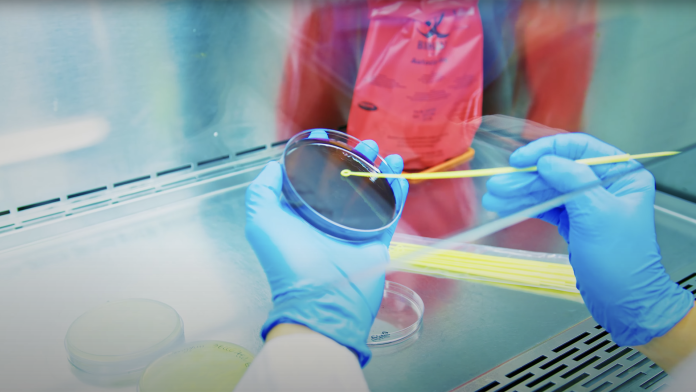
Rapid and reliable diagnostics are critical for identifying resistant pathogens before they spread. At McGill’s AMR Centre, researchers are developing next-generation diagnostic platforms that are fast, affordable, and adaptable. These include nanosensor-based technologies, CRISPR-driven molecular assays, and microfluidic biosensors capable of detecting resistance markers directly from clinical or environmental samples.

These tools are also being adapted for agricultural and ecological settings, enabling the detection of resistant bacteria in livestock, soil, and wastewater. Portable, field-ready systems are providing near real-time data that strengthen AMR surveillance networks. By combining engineering innovation with biomedical insight, McGill researchers are creating diagnostic tools that enable early intervention and more effective AMR management.
Surveillance and prevention: Mapping resistance in the clinic and beyond
Understanding where and how resistance develops is essential to prevention. At the AMR Centre, researchers study how AMR emerges and spreads across hospitals, farms, wastewater systems, and natural ecosystems. Using genomics, bioinformatics, and environmental monitoring, researchers are mapping resistance pathways that connect human activity with broader ecological systems.
In collaboration with government agencies and international partners, McGill researchers are helping strengthen efforts to monitor AMR. For example, studies monitoring wastewater near hospitals and bacteria in food production are uncovering how resistance spreads at local and global levels. By combining these findings with computational models, researchers can identify where interventions are most needed and help guide strategies to limit the spread of resistant bacteria.
Therapeutics: Redefining the pipeline for next-generation treatments
With conventional antibiotics losing effectiveness and few new ones being developed, researchers at McGill are exploring innovative therapeutic strategies that work in fundamentally different ways. Using structure-based design, artificial intelligence, and anti-virulence approaches, scientists are developing treatments that neutralise pathogens without driving further microbial resistance.
The Centre’s researchers combine expertise in microbiology, infectious diseases, chemistry, structural biology, and biophysics to advance antimicrobial and microbiome-targeted candidates through early-stage drug development. Programmes like the McGill Innovation Fund (MIF)-AMR foster interdisciplinary collaborations that accelerate preclinical testing, while Biosafety Level 1, 2, and 3 facilities enable rapid testing and pre-clinical validation of new compounds. Together, these resources help accelerate antimicrobial discovery and strengthen Canada’s capacity to deliver effective new therapies.
Collaboration for impact
Addressing antimicrobial resistance requires more than individual breakthroughs. Through initiatives such as the AMR Quebec (AMRQ) Network and Can-AMR-Net, the AMR Centre is building its research ecosystem by fostering collaboration across academic, government, industry, and public health. The AMRQ Network is a provincial initiative that brings together 93 members from seven universities, four research institutions, and four government organisations to share expertise, resources, and training in AMR research. Can-AMR-Net is a new national training platform that provides early-career researchers with interdisciplinary mentorship, hands-on experience, and opportunities to contribute to Canada’s growing AMR research capacity.
Beyond these networks, the Centre works closely with institutional and external partners to pursue collaborations that advance technology development and facilitate the translation of discoveries into practical solutions. This includes engaging with international incubators and consortia involved in AMR diagnostics and therapeutics research.
The McGill AMR Centre welcomes new collaborators and partners to join these efforts. Through international partnerships, diverse expertise, and co-ordinated initiatives, the Centre provides a platform for research that accelerates the development of new diagnostics, therapeutics, and prevention strategies to combat AMR locally and globally.
Please note, this article will also appear in the 24th edition of our quarterly publication.