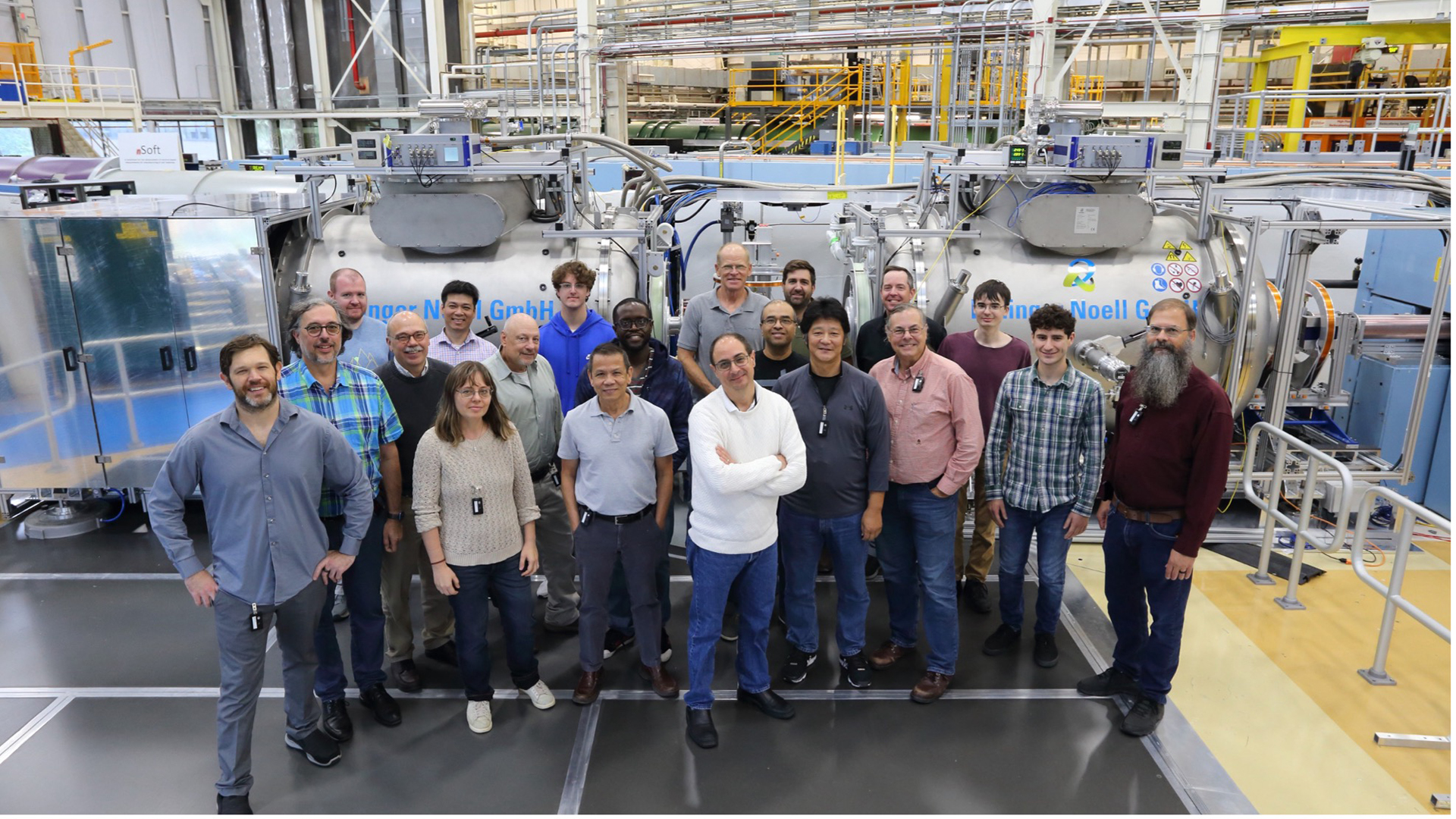
An international collaboration has brought a new capability to measure collective motions in nanoscales for soft, biological, and quantum materials in the US.
The newly commissioned neutron spin echo (ν-NSE) spectrometer at the NIST Center for Neutron Research (NCNR) represents a significant advancement in the study of slow dynamics in complex materials. Developed through a collaboration between the University of Delaware’s Center for Neutron Science (CNS), NIST, and the University of Maryland, and funded by the National Science Foundation’s Mid-scale Research Infrastructure program (award # 1935956), this instrument greatly enhances the capabilities of the US research community in soft matter, biological sciences, engineering, and magnetic materials.
Technical innovations
The spectrometer incorporates optimally designed superconducting precession coils (OSCPCs), which increase the maximum Fourier time by a factor of 2.5. This enhancement allows for the use of shorter neutron wavelengths with higher intensities, improving data acquisition rates by approximately an order of magnitude. The instrument is expected to routinely achieve Fourier times of 300 ns, with the potential to reach 700 ns for strongly scattering samples, thereby extending the accessible time scale for dynamic studies. (NIST)
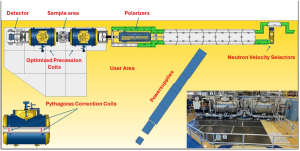
Additional critical components include a neutron velocity selector (NVS) and a polariser designed for long-wavelength operation, an updated position-sensitive detector (PSD) with improved count rate and sensitivity, and advanced Pythagoras correction coils. These components collectively enhance the instrument’s performance, particularly for long-wavelength neutron applications, where the instrument resolution gets better with the wavelength’s third power. (NIST)

Scientific impact
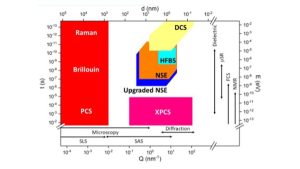
The NSE spectrometer enables high-resolution measurements of slow dynamics in a variety of systems, including polymers, surfactant membranes, confined liquids, and magnetic materials. In particular, it covers Å to micro length scales and pico to micro time scales that are not accessible by any other method (Fig. 1). By directly measuring the real part of the intermediate scattering function I(Q,t), the instrument provides unique insights into dynamics ranging from atomic to molecular scales, as well as quasiparticle kinetics over time scales ranging from picoseconds to hundreds of nanoseconds.
NSE provides information about material dynamics in a form similar to that of the more common method of dynamic light scattering (DLS), which can also measure the intermediate scattering function, but on much longer length and time scales due to the much longer wavelength of light (~ micron) as compared to neutrons (Angstroms). An example relevant for biotechnology is provided in Fig. 2, where a reference monoclonal antibody (NIST mAB) is probed in solution and the results compared with simulations. This unique and powerful capability is crucial for understanding the dynamic behaviour of materials at the nanoscale and provides information in a form that can be directly compared to theory, simulation, or physically interpreted in a manner familiar to scientists working across a broad range of research areas.

concentrations:10 (blue circle), 25 (green squares), 50 (orange diamonds) and 100 mg/mL (red triangles). (c) The intermediate scattering function up to correlation time, τ = 10 ns, as a function of Q ranging from 0.05-0.3 Å-. The symbols correspond to the ISF of free motion of a NISTmAb, the solid black lines are fits using I(Q,t)/I(Q,0) = exp(-Q² Deff τ), and the dashed lines are the fixed center of mass motions of NISTmAb. Courtesy of J. Nayem & Y. Liu (in preparation)
Collaborative efforts and future prospects
The successful development and commissioning of the NSE spectrometer underscore the importance of collaborative efforts in advancing scientific infrastructure. The NSE spectrometer adapted the technical innovations from the sister instrument J-NSE-Phoenix at the Heinz Maier-Leibnitz Zentrum (MLZ) operated by Juelich Centre for Neutron Science (JCNS). The partnership between academic institutions, NIST, and international laboratories has resulted in a state-of-the-art instrument that will serve the research community for years to come. As the spectrometer becomes fully operational, it is poised to facilitate groundbreaking studies in soft matter physics, biology, and materials science, contributing to advancements in areas such as functional polymers, drug development, membrane technology, and energy storage.
This instrument is anticipated to be accessible for users in 2026 under the auspices of the Center for High Resolution Neutron Scattering (CHRNS) at NIST. For more detailed information about the instrument and its capabilities, as well as the operation schedule, please refer to the official NIST page: (NIST).
Please note, this article will also appear in the 23rd edition of our quarterly publication.