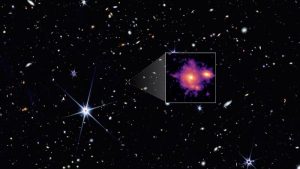
An international team led by the University of Geneva (UNIGE) has discovered the most distant spiral galaxy candidate known to date.
The Milky Way-like spiral galaxy, which formed just one billion years after the Big Bang, shows a remarkably mature structure, with a central old bulge, a large star-forming disk, and well-defined spiral arms.
The discovery was made using data from the James Webb Space Telescope (JWST) and offers important insights into how galaxies can form and evolve so rapidly in the early Universe.
The history of spiral galaxies
Large spiral galaxies like the Milky Way are expected to take several billion years to form.
During the first billion years of cosmic history, galaxies were thought to be small, chaotic, and irregular in shape.
However, the JWST is beginning to reveal a very different picture. Its deep infrared imaging is uncovering surprisingly massive and well-structured galaxies at much earlier times than previously expected, prompting astronomers to reassess how and when galaxies take shape in the early Universe.
A Milky Way twin?
Among these new findings is Zhúlóng, the most distant spiral galaxy candidate identified to date, seen at a redshift of 5.2 – just one billion years after the Big Bang.
Despite this early epoch, the distant galaxy exhibits a surprisingly mature structure: a central old bulge, a large star-forming disk, and spiral arms – features typically seen in nearby galaxies.
Dr Mengyuan Xiao, postdoctoral researcher at the Department of Astronomy of the Faculty of Science of UNIGE and lead author of the study, explained: “What makes Zhúlóng stand out is just how much it resembles the Milky Way – both in shape, size, and stellar mass.
“Its disk spans over 60,000 light-years, comparable to our own galaxy, and contains more than 100 billion solar masses in stars.”
These features make it one of the most compelling Milky Way analogues ever found at such an early time, raising new questions about how massive, well-ordered spiral galaxies could form so soon after the Big Bang.
The importance of JWST’s unique ‘pure parallel’ mode
Zhúlóng was discovered in deep imaging from JWST’s PANORAMIC survey (GO-2514), a wide-area extragalactic program led by Christina Williams (NOIRLab) and Pascal Oesch (UNIGE).
PANORAMIC exploits JWST’s unique “pure parallel” mode – an efficient strategy to collect high-quality images while JWST’s main instrument is taking data on another target.
“This allows JWST to map large areas of the sky, which is essential for discovering massive galaxies, as they are incredibly rare,” explained Christina Williams.
“The discovery highlights the potential of pure parallel programmes for uncovering rare, distant objects that stress-test galaxy formation models.”
Rewriting the history of spiral galaxies
Spiral galaxies were previously thought to take billions of years to develop. Moreover, massive galaxies were not expected to exist until much later in the Universe, because they typically form after smaller galaxies merge together over time.
“This discovery shows how JWST is fundamentally changing our view of the early Universe,” said Professor Pascal Oesch.
Future JWST and Atacama Large Millimeter Array (ALMA) observations will help confirm its properties and reveal more about its formation history. As new wide-area JWST surveys continue, astronomers expect to find more such galaxies, offering fresh insights into the complex processes shaping galaxies in the early Universe.