The GGP provides high-quality, open-source data to monitor and understand the dynamics of family formation and other life-course trajectories within societies at the individual level.
Populations change because of changes in three societal domains: fertility, mortality, and migration. In other words, because new children are born, people pass away, or people move across countries. In order to observe, understand, and predict population change, such population dynamics need to be monitored. Governments, businesses, and non-profit organisations may use insight into how populations change and adapt to new circumstances to inform policy, understand upcoming demand, and support vulnerable groups. Availability of reliable, representative information – data – to study population dynamics is therefore of utmost importance. To ensure quality and comparability of data across different countries, international data collection efforts are best organised in a Research Infrastructure (RI). Within the European Union (EU), RIs that operate on a non-economic basis can apply for inclusion on the European Strategic Forum for Research Infrastructures (ESFRI) roadmap, which can be understood as a seal of approval for the RIs’ scientific and societal relevance.
Flagship research infrastructure in demography
The Generations and Gender Programme (GGP) is the only European-led comparative research infrastructure focused on demographic trends and social dynamics within families.
The GGP was founded in 2000 and is run by a consortium of international knowledge institutions. The GGP is headquartered at the Netherlands Interdisciplinary Demographic Institute (NIDI) in The Hague, the Netherlands. In 2021, the GGP was included in the European Roadmap for research infrastructures (ESFRI). GGP is expected to become a European Research Infrastructure Consortium (ERIC) in 2027. The programme’s main tool for collecting data is the Generations and Gender Survey (GGS). With the GGS, new information is collected on the lives of (young) adults, meaning people aged 18-79, within a country or territory. With its longitudinal design, including both retrospective and prospective information, the GGS tracks the experiences and changes that individuals go through in their personal lives. These representative data are enriched with descriptive indicators for the national context. The GGS currently consists of two rounds of data collection.
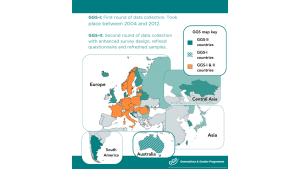
The first round (GGS-I) started in 2004 as a three-wave panel study with three-year time intervals. In this first round, information was collected from over 200,000 individuals from 19 countries. The second round (GGS-II) started in 2020. Data collection is currently ongoing. GGS round two is characterised by a revised questionnaire, enhanced survey design, and refreshed samples. The infographic above provides an overview of all countries and territories that have conducted the GGS at least once. Many European countries are part of both rounds of data collection, making GGS an excellent data source for country comparative research within the European context. In recent years, the GGP has also spread out its wings to other continents, with data collection efforts taking place in South America (Uruguay and Buenos Aires) as well as Asia (South Korea, Taiwan, and Hong Kong).
Comparing people’s life-course events and trajectories
Influential factors such as upbringing, education, choice of partner(s), general health, and personal beliefs contribute to shaping people’s life course. Whereas the life course of some people shows a high degree of stability, the lives of most people are characterised by consecutive phases marked by major events and role changes. Important topics that can be studied using data from the GGP are partner choice, family formation, the division of labour within households, intergenerational relationships, and the socioeconomic conditions of young adults, families, and other household types. In addition, the GGP provides information for the purposes of the United Nations Sustainable Development Goals (SDGs). Indicators of gender autonomy and the use of contraception are measured repeatedly within the programme. The GGP database contains reliable information on more than 300,000 individuals. Worldwide, the GGP has more than 6,000 users who together produce a rich source of up-to-date knowledge. In light of this reach, the GGP holds a key position among the group of survey data research infrastructures that jointly capture the entirety of people’s life courses, the three others being GUIDE, SHARE, and ESS.
Evidence-based policy making and informed societal debate
The GGP has a sustained impact in the policy domain. GGP data have informed strategic planning, policy reports, and parliamentary debates in numerous countries, including, for example, Austria, Croatia, Czechia, Estonia, France, Germany, Hungary, Italy, Lithuania, Moldova, the Netherlands, Norway, Poland, Sweden, and the United Kingdom. International organisations such as UNFPA, OECD, WHO, and the European Commission have cited GGP products in their analyses.
A recent scan identified over 500 policy documents referencing GGP or GGS, confirming the infrastructure’s broad policy footprint and institutional recognition. To inform its users and interested parties, the GGP regularly organises webinars and policy briefings. To stay updated on development within the programme as well as new data releases, sign up for the GGP’s free monthly newsletter, follow our LinkedIn page, or visit our website.
Please note, this article will also appear in the 24th edition of our quarterly publication.