PFASER’s electro-oxidation process, including patented boron-doped diamond electrodes, coupled with a proprietary perchlorate removal process, is set to deliver groundbreaking on-site treatment of PFAS with zero‑sludge.
The intrinsic chemistry of per‑ and polyfluoroalkyl substances (PFAS) makes them highly resistant to conventional treatment. As a result, these toxic molecules are ubiquitous as they are found just about everywhere on Earth, including in water, in soils, and in living creatures. In response, governments across the world are advancing new PFAS regulation and guidelines, tightening thresholds, restricting non-essential uses, and demanding greater accountability for long-term impacts.
For a majority of municipalities, utilities, airports, manufacturers, and landfill operators, to name but a few, this evolving landscape poses a twofold challenge:
- Short timetable: Designing and deploying proven, easy-to-operate yet cost-effective treatment systems before penalties or liability accrue.
- End‑of‑life accountability: Demonstrating that PFAS are permanently destroyed on site with low energy consumption, rather than being captured and exported to external sites and eventually treated at very high temperature or pressure using either incineration, supercritical water oxidation (SCWO), plasma or hydrothermal alkaline treatments (HALT).
PFASER, an advanced electro-oxidation (EO) system developed by WSP, addresses these challenges with groundbreaking efficacy, operational efficiency, and flexibility. This article explores current treatment technologies, including their key strengths and limitations, and compares them to the key features of PFASER, providing a detailed technical and strategic perspective for utilities, technology partners, policymakers, and investors.
Why current treatments fall short
PFAS separation technologies
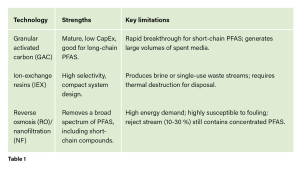
PFAS present a significant challenge for water treatment professionals, due to their persistence and resistance to conventional remediation methods. Most full‑scale PFAS solutions today rely on ‘separation’ rather than ‘destruction’. Granular activated carbon (GAC), ion‑exchange (IEX) resins, reverse osmosis (RO), and nanofiltration (NF) are effective in removing PFAS from water, but they do not degrade the molecules. As a result, these processes generate secondary waste streams, which require further handling – often through incineration, landfilling, or regeneration. These down-stream processes are associated with high operational costs and considerable carbon emissions.
Table 1 summarises key PFAS separation technologies, which remove PFAS from water but do not destroy the molecules.
As Valérie Léveillé, PhD, Senior Water Treatment Engineer at WSP in Canada, noted during a March 2025 webinar: “We need to shift from transferring PFAS to another waste stream toward destroying them at the molecular level, on site, within a compact and automated footprint.”
PFAS destruction technologies
Considering recent advancements, technologies aimed at the destruction of PFAS are increasingly regarded as preferable. Techniques such as EO represent a significant evolution in treatment philosophy, focusing on the permanent removal of PFAS on site rather than merely shifting contamination to another medium. Nonetheless, while the potential for total destruction is the ultimate goal, these technologies present notable challenges – including the risk of secondary toxic byproduct formation and substantial energy requirements – which may serve as limiting factors under certain operational or site-specific conditions.
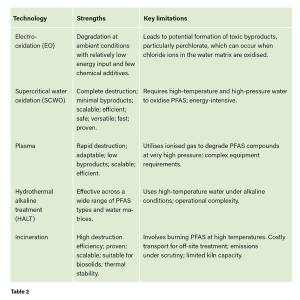
Destructive technologies, which break down the PFAS molecules at a chemical level, offer a more permanent solution. However, most of these methods rely on high-temperature processes, increasing their energy requirements and carbon footprint, particularly when conducted off site. The EO technology is the only one able to degrade PFAS at ambient conditions. The only key limitation is the formation of toxic byproducts, particularly perchlorate, which can occur when chloride ions in the water matrix are oxidised.
Table 2 compares treatment methods designed to destroy PFAS molecules, with their key limitations.
The future of PFAS treatment lies in advancing on-site, automated solutions that prioritise molecular destruction and minimise environmental impacts.
PFASER: Innovation at the intersection of need and technology
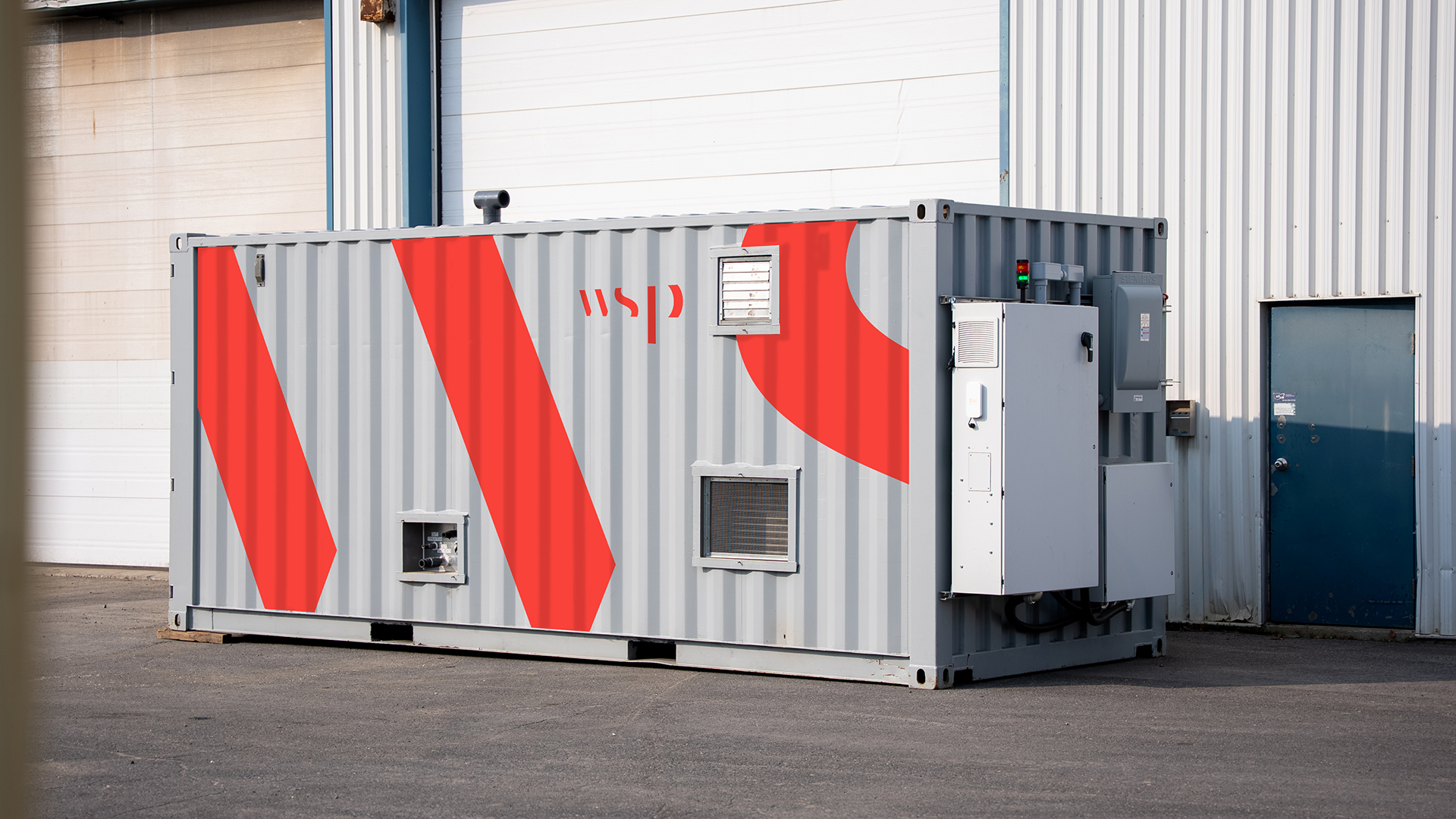
PFASER is a patent-pending system developed by WSP that leverages EO in combination with a per-chlorate removal system to deliver high-efficiency PFAS destruction on site, in a modular, containerised format, without producing toxic byproducts.
The following points encapsulate PFASER’s core features and technical innovations:
Electro‑oxidation with pro aqua’s BDD electrodes
PFASER exclusively incorporates pro aqua’s patented boron‑doped‑diamond (BDD) electrode reactors to effectively eliminate over 95% of total PFAS in contaminated water streams within minutes. BDD generates highly oxidative hydroxyl radicals and direct electron transfer pathways that cleave the ultra‑stable C–F bond, without chemical additives and without producing any sludge. Unlike mixed‑metal‑oxide anodes, BDD shows negligible wear and great stability: commercial cells have operated for over six years with no performance loss.
Perchlorate control
PFASER’s proprietary two‑step process – acidic hydrogen‑peroxide scavenging followed by targeted GAC polishing – is designed to target perchlorate, achieving a verified destruction rate of 99.999 %, or below 50 µg L-¹, while keeping GAC change‑out intervals >40 days under pilot loading. This is particularly important in chloride‑bearing waters.
Zero‑sludge, and self-cleaning
Unlike conventional methods such as GAC and ‘IEX, which concentrate PFAS in spent media requiring costly management or incineration, PFASER produces no sludge. This eliminates the need for off-site haulage and secondary waste processing, directly reducing operational costs and environmental liability. Additionally, the self‑cleaning, reverse‑polarity feature prevents mineral scaling.
Minimal chemical inputs
PFASER’s advanced EO process is engineered to use very low quantities of supplementary chemicals, streamlining treatment logistics and minimising the risk of hazardous byproduct formation and chemical run-off into the environment. This also facilitates easier regulatory compliance and safety management at the treatment site.
Low-energy, ambient operation
The system operates at ambient temperature and pressure, relying on standard electrical power. There is no need for high-temperature reactors, pressure vessels, or complex thermal management, sharply reducing capital expense and enhancing operational safety.
Rapid, modular deployment, and automation
A standard 20‑foot containerised PFASER skid treats up to 10m³ day-¹; multiple skids run in parallel for industrial throughputs. This plug-and-play format enables rapid mobilisation across a range of industries and geographies, in addition to supporting field trials, emergency response, and permanent installations alike. The remote SCADA enables 24/7 unattended operation, essential for remote remediation wells or airport de‑icing pads.
Speaking at the WSP webinar, Dr Léveillé said: “In 30–60 minutes of residence time, we achieve up to 95% total PFAS mass destruction, including stubborn C8 species like PFOA and PFOS. Without hauling a single tonne of spent media off site.”
Pilot results and early applications
Bench‑scale and real‑world trials confirm that PFASER’s laboratory performance translates to the field. Two representative cases (Table 3) show how the same boron‑doped‑diamond EO core, tuned only for flow rate and hydrogen‑peroxide dose, delivers consistent removal across very different water matrices. (Per‑ and polyfluoroalkyl substances are reported as Σ‑PFAS unless otherwise noted.)
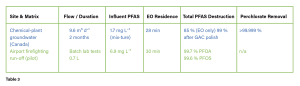
In practice, PFASER cuts 70-99% of total PFAS in 28–60 minutes (≤ 25 mA cm-²) without generating sludge or spent media – a small GAC polish then lasts for months, because the heavy lifting is done upstream by EO. Trials on chloride‑rich groundwater and aqueous film-forming foam (AFFF)‑laden airport run‑off confirm that a single, standardised EO core can handle widely different feeds. Deployments range from a 20ft mobile skid roaming a chemical‑plant plume to a compact ‘PFAS pit‑stop’ on an airport drain. These pilot efforts have paved the way for full‑scale builds now in progress (4m³ d-¹ airport groundwater and 30m³ d-¹ micro‑electronics wastewater), with commissioning underway and early indicators already showing promise.
Rapid on-site PFAS detection: Partnering with FREDSense
Real‑time process control is critical to minimise energy per kilogramme of PFAS destroyed. Through a collaboration with Calgary‑based FREDSense, WSP integrated FRED‑PFAS™ biosensor kits into the pilot workflow and routine investigation. The handheld device delivers total‑PFAS readings down to 1 µg L-¹ in under four hours, versus 7–14 days for standard LC‑MS/MS lab analysis.
Dr Léveillé said: “By pairing FRED‑PFASTM screening with PFASER data, we reduced pilot study time by 80%. Dynamic feedback let us dial residence time from 60 to 28 minutes without sacrificing removal targets.”
Looking ahead: Scaling PFAS destruction globally
As regulations tighten and client demand accelerates, PFASER is already scaling to larger systems and broader applications.
- Airport AFFF impacted groundwater: A comprehensive 4m³ d-¹ treatment system has being designed for a Canadian airport with the objective of intercepting groundwater impacted by AFFF operations. Perchlorate mitigation was not included as it is not explicitly regulated at airports in connection with PFAS remediation.
- Micro‑electronics wastewater: A 30m³ d-¹ variant is in detailed design for a semiconductor facility, tailored to destroy high Chemical Oxygen Demand process water (30,000 ppm or more).
- Cost breakthrough: Mass production of pro aqua’s BDD electrodes could significantly reduce unit costs within a few years, making EO accessible to virtually any client.
- Regulatory readiness: With zero secondary waste, PFASER aligns with US PFAS Disposal Guidance and anticipated EU Best Available Techniques for zero-pollution standards.
Conclusion and call to action
PFASER stands as a benchmark in advanced water treatment, as it demonstrates that destruction at the source is no longer aspirational, it is a practical, scalable option that:
- Eliminates up to 95% total PFAS and 99.999% perchlorate in minutes.
- Generates zero sludge, zero off‑site haulage, and minimal chemical inputs.
- Uses low-energy power and no high temperature or high pressure for PFAS destruction.
- Fits into standard containers for rapid deployment across industries.
To accelerate a PFAS‑free future, WSP invites:
- Utilities and site owners to pilot PFASER on challenging waters.
- Technology partners to integrate EO with upstream separation or downstream polishing.
- Investors and policymakers to support implementation of PFASER and manufacturing of field units.
“PFAS destruction is a team sport. By uniting detection, advanced oxidation, and smart engineering, we can turn regulatory pressure into an opportunity for cleaner, safer water worldwide,” added Dr Léveillé.
The technology is here. The results are in. The next step is collaboration, and urgency.
Please note, this article will also appear in the 23rd edition of our quarterly publication.