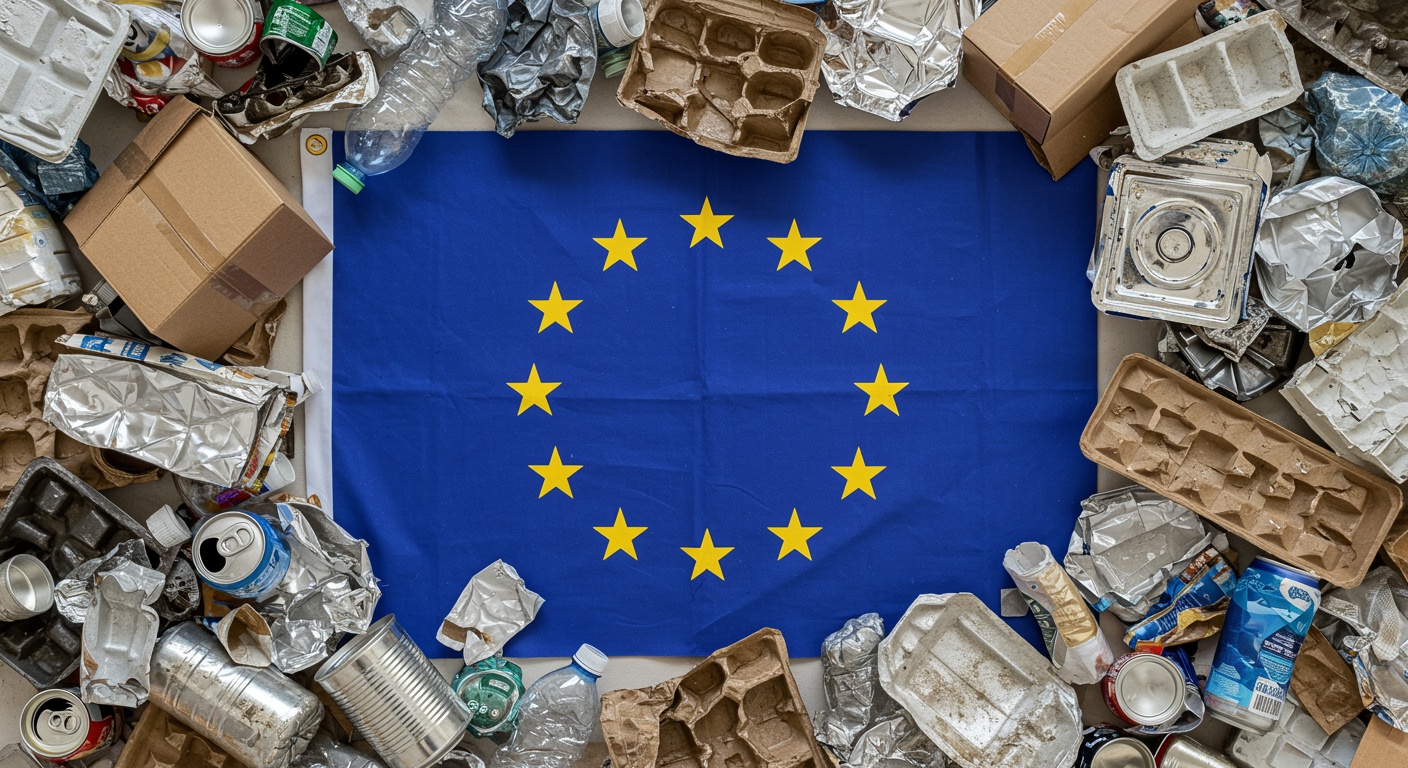
The European Union faces significant challenges in meeting its packaging waste reduction targets by 2030.
A rising demand for convenience, coupled with inadequate recycling infrastructure, complicates packaging waste management efforts across the bloc.

Many packaging materials remain difficult to recycle, resulting in large volumes ending up in landfills or being incinerated.
While some EU countries are making strides through innovative policies and practices, understanding the broader challenges is essential to assessing the EU’s path toward a circular economy and more effective regulation.
Why Europe is producing more plastic waste than ever
The increase in plastic waste across Europe stems from several interconnected factors. In 2022, the EU generated an average of 186.5 kg of packaging waste per person, with 36 kg attributed to plastic alone.
The growing preference for convenience-driven products, especially those relying on single-use plastics, has significantly contributed to this rise.
Although recycling technologies have advanced, they have not kept pace with the rapid growth in waste generation.
Inadequate recycling infrastructure and fragmented waste management systems have only worsened the problem. As a result, landfills continue to overflow and environmental pollution persists.
In response, the EU has introduced regulations aimed at ensuring 100% recyclable packaging by 2030. However, aligning standards across all member states remains a critical obstacle to realising these ambitious goals.
How online shopping and takeaway culture are driving packaging waste
The boom in e-commerce and takeaway services has played a major role in escalating packaging waste.
Excessive use of materials, such as multi-layered packaging and oversized boxes, has become common practice in online retail.
To combat this, new EU regulations have introduced a 50% maximum empty space threshold for grouped and e-commerce packaging. These efforts aim to reduce unnecessary material use without compromising product safety during transit.
Further, to address the growing volume of waste from takeaway culture, the EU has committed to cutting packaging waste by 10% by 2035 and 15% by 2040.
As part of this strategy, a ban on certain single-use plastic packaging commonly used in takeaway services will take effect on January 1, 2030. This represents a pivotal step toward curbing waste and promoting more sustainable consumption.
Why most packaging still ends up in landfills or incinerators
Despite improvements in recycling technology, a significant share of packaging waste continues to be landfilled or incinerated.
Key reasons include:
| Factor | Impact on packaging waste |
| Complex material composition | Reduces recyclability |
| Inadequate recycling facilities | Leads to increased landfill and incineration |
| Consumer behaviour | Results in mismanaged waste |
| Lack of public awareness | Lower recycling rates |
| Regulatory gaps | Weakens enforcement of recycling policies |
Although the EU has set a target for 100% recyclable packaging by 2030, current practices remain misaligned with this vision. More cohesive strategies and enforcement mechanisms are needed to overcome persistent barriers.
Which countries are leading the way in packaging waste reduction?
Several European countries are emerging as front-runners in the transition toward sustainable packaging. Their policies and innovations serve as potential blueprints for the rest of the EU.
- Germany: Achieved a recycling rate of approximately 67% in 2021, far exceeding the EU average.
- Netherlands: Introduced a deposit return system for plastic bottles and cans, resulting in over 90% recycling rates for these items.
- Sweden: Enforced strict regulations on single-use plastics, targeting 100% recyclable or reusable packaging by 2025.
- France: Banned several types of single-use plastics and promoted reusable alternatives, achieving a 15% reduction in plastic packaging waste since 2018.
These examples demonstrate that ambitious regulation combined with public engagement can lead to meaningful reductions in packaging waste, supporting broader EU sustainability objectives.
How packaging waste threatens Europe’s shift to a circular economy
Reducing packaging waste is central to the EU’s circular economy goals. Yet, current trends suggest that achieving a 5% reduction in packaging waste by 2030 may be difficult.
In 2022, average per-person waste remained high, with plastic packaging playing a substantial role. The Packaging and Packaging Waste Regulation (PPWR) mandates that all packaging be recyclable by 2030, but this goal is undermined by low recycling rates and limited uptake of reusable systems.
Resistance is also likely from industries that depend on single-use plastics. Furthermore, reaching the target of 10% market share for reusable packaging by 2030 presents logistical and cultural challenges.
Unless decisive and coordinated action is taken, packaging waste could stall the EU’s transition to a circular economy, undermining progress toward climate neutrality and resource efficiency.
How PPWR aims to solve the crisis
The PPWR is a cornerstone of the EU’s strategy to tackle its growing packaging waste crisis. It introduces a comprehensive framework focused on sustainability and circularity, including:
- Binding reduction targets: Aims to reduce packaging waste by 5% by 2030, rising to 15% by 2040, based on 2018 levels.
- Mandatory recyclability: Requires that all packaging placed on the EU market be fully recyclable by 2030.
- Recycled content requirements: Mandates a minimum of 30% recycled content in plastic packaging by 2030, with incremental increases by 2040.
- Ban on certain single-use plastics: Prohibits the use of specified single-use plastic packaging starting January 1, 2030.
If implemented effectively, these measures could significantly reduce packaging waste and advance Europe’s broader sustainability and circular economy ambitions.