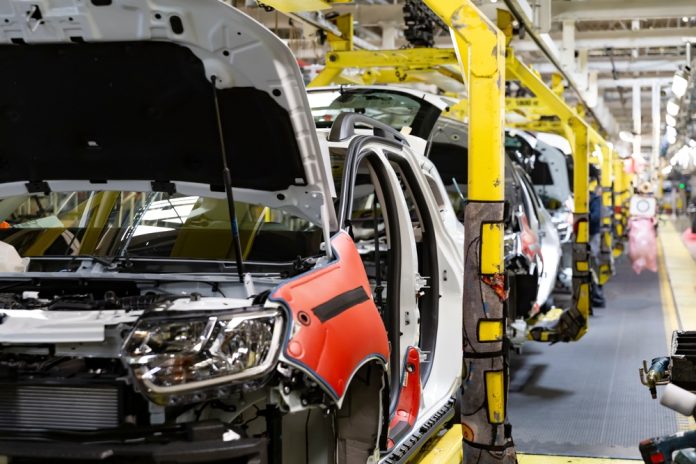
The UK automotive industry has revealed an ambitious 10-point plan designed to re-establish the nation as one of the world’s top 15 vehicle manufacturing hubs by 2030.
The plan, developed in response to the government’s recently launched Industrial Strategy, outlines how targeted reforms and investment could generate an additional £50bn for the UK economy over the next decade.
This renewed commitment comes alongside the publication of a new report by the Society of Motor Manufacturers and Traders (SMMT) titled ‘The Competitive Edge: Driving Long-Term UK Automotive Growth’.
The document highlights the sector’s potential and ongoing challenges, and is supported by insights from the first-ever UK Automotive Business Leaders Barometer.
Mike Hawes, SMMT Chief Executive, commented: “The government’s long-term Industrial Strategy, including the Drive35 £2.5bn auto capital and R&D fund, recognises automotive as a pillar of advanced manufacturing, integral to the world leading innovation that creates the high value jobs, wealth and economic growth that are vital to our country’s future.
“Now we must make the most of that position and put in place the right conditions for growth.”
Strong foundations, but rising costs
According to the SMMT’s report, the UK automotive sector is standing on a platform of innovation and investment readiness.
Over half of the surveyed businesses have either secured or are planning new investments. However, this optimism is tempered by financial pressures: 73.5% of CEOs reported rising operational costs, and 46.9% experienced falling profits in the past year.
High electricity costs are a central issue. British automotive manufacturers pay more than double the European average for energy, burdened by taxes six times higher than those in competing nations. In 2024 alone, this added over £200m to the sector’s energy bills.
Rapid reforms promised in the Industrial Strategy – particularly around industrial energy costs – could slash these electricity bills by up to 20%. However, current proposals to ease standing charges only apply to battery production.
The SMMT is urging the government to extend these benefits to automotive manufacturing as a whole, especially as EV production becomes the industry standard.
EV transition in danger without urgent market intervention
The UK’s transition to electric vehicles (EVs) is another focal point. Manufacturers have spent £6.5bn on EV incentives over the past 18 months to stimulate demand that still lags far behind government mandates.
More than half (52%) of automotive leaders believe the UK is significantly off track to meet the 2030 ban on new internal combustion engine vehicles.
Adding to the strain, new taxation rules, such as the Vehicle Excise Duty (VED) Expensive Car Supplement, have effectively penalised electric vehicles, with an estimated £360m hit to EV buyers starting from April 2025.
To correct course, the industry is calling for bold consumer-focused measures: revising the ECS, reducing VAT on new EVs and public charging, and reinstating meaningful incentives to encourage mass adoption. Without such intervention, the EV market risks stagnation.
Global trade reset brings renewed hope
Despite domestic hurdles, recent diplomatic wins offer a glimmer of hope for the UK automotive industry.
A new economic agreement with the United States eliminates tariffs that threatened industry profitability, while trade negotiations with India and a refreshed relationship with the EU create a stronger global platform for UK automotive exports.
When combined with domestic reforms to energy pricing, capital allowances, workforce skills, and regulatory efficiency, these trade developments could revive the UK’s competitive edge – unlocking new investment, creating jobs, and supporting the country’s net-zero ambitions.
The 10-point plan to accelerate automotive growth
To transform this potential into reality, the SMMT has outlined ten strategic recommendations as part of its growth blueprint:
- Launch a robust consumer incentive scheme for electric and low-emission vehicles.
- Publish a clear decarbonisation roadmap for heavy-duty transport, in collaboration with industry.
- Guarantee universal access to EV charging by mandating infrastructure rollouts nationwide.
- Position the UK as a top investment destination, led by a proactive Office for Investment.
- Cut industrial energy costs to align with global competitors.
- Boost supply chain funding to mitigate investment risks and enhance competitiveness.
- Free up apprenticeship levy funds for broader workforce training initiatives.
- Rebuild EU-UK trade relations to protect and expand shared automotive interests.
- Capitalise on the UK-US Economic Prosperity Deal to maximise export opportunities.
- Negotiate automotive-focused trade deals with both new and existing global partners.
A sector at the crossroads
The UK automotive industry stands at a critical juncture. With the right support and policy alignment, it has the capacity to deliver enormous economic and environmental benefits – reclaiming global status, creating thousands of jobs, and driving the UK’s green transition.
But urgent action is needed to address cost imbalances, restore consumer confidence, and unlock the full potential of one of Britain’s most innovative industries.