Alpha Vet Tech’s WirelessZoo technology is transforming animal health monitoring to provide welfare-focused, data-rich veterinary care.
Veterinary monitoring has long presented a paradox. While accurate vital signs are essential for diagnosis, treatment, and recovery, the methods used to capture them are often invasive, episodic, or stressful to both patient and clinician. Manual thermometers, chest straps, and wired ECGs remain standard in many practices — despite the rise of real-time, connected health monitoring in human medicine.
WirelessZoo, a wearable monitoring platform developed by Alpha Vet Tech, offers an emerging alternative. Designed in collaboration with veterinarians, nurses, and researchers, the system captures and transmits real-time vital signs data continuously — with minimal disruption to the animal’s natural behaviour.
Clinical trials and early field use have demonstrated WirelessZoo’s ability to reduce handling, improve baseline accuracy, and provide continuous physiological data across a range of settings – including post-operative recovery, anaesthesia, and mobile veterinary transport. These benefits are particularly evident in high-acuity or high-stress environments, where early changes in vital signs often precede observable clinical deterioration.
Rethinking how we monitor
In practice, physiological monitoring often involves a trade-off between accuracy, invasiveness, and workflow practicality. While rectal thermometers, auscultation, and manual SpO₂ checks remain routine, they offer only point-in-time data and require varying degrees of patient handling — which can be problematic in post-op care, high-stress cases, or with fractious animals.
Even continuous monitoring setups — such as wired ECGs or tethered pulse oximetry — can introduce artefact, restrict patient mobility, or limit their use to anaesthetised or heavily sedated patients. This not only affects data quality, but consumes technician time and can compromise patient welfare.
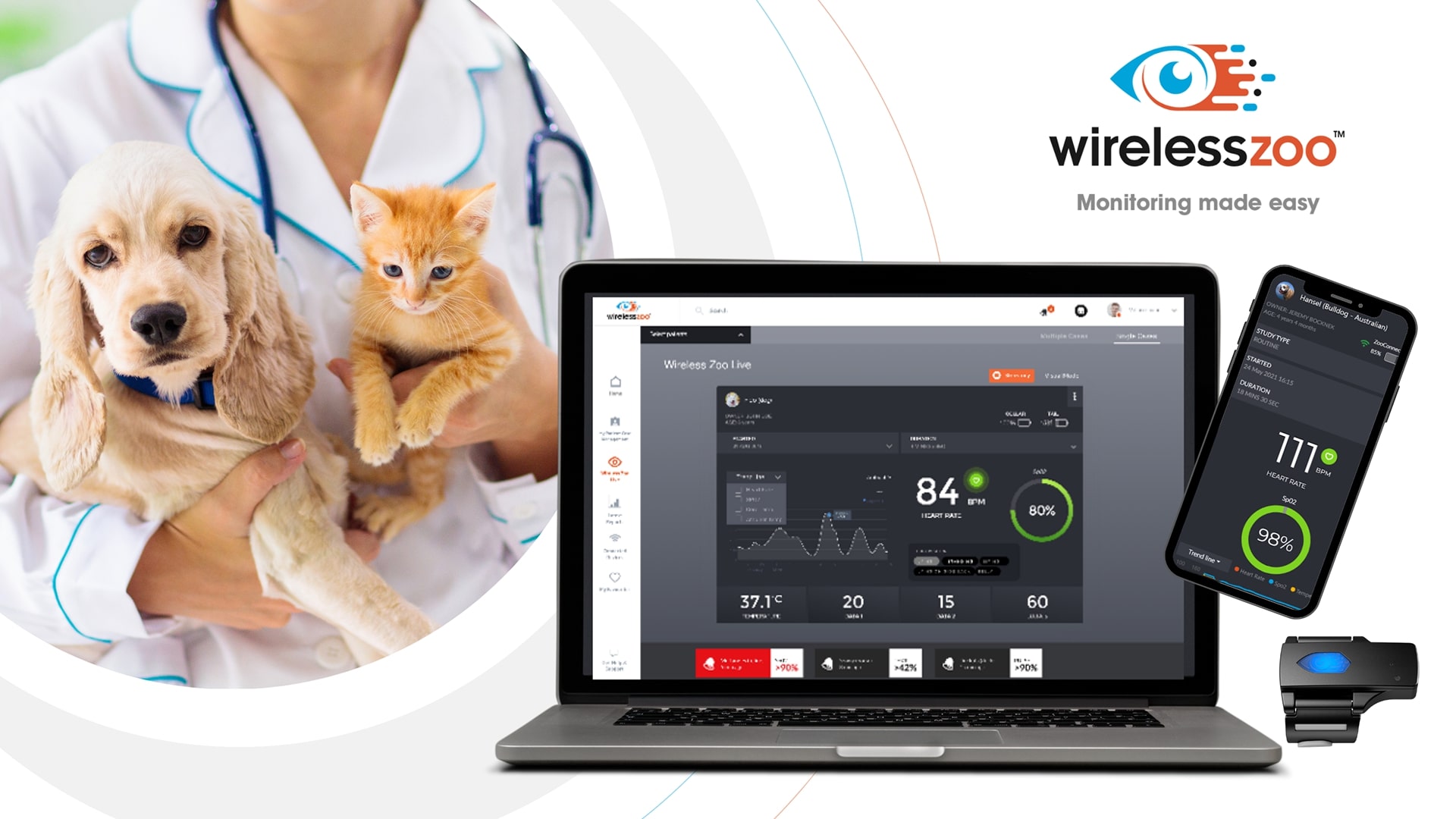
WirelessZoo addresses these limitations by providing continuous, live-streamed vitals through a wearable device designed to minimise restraint and integrate into existing workflows. The device monitors:
- Heart rate (HR)
- Blood oxygen saturation (SpO₂)
- Body temperature
It is most commonly clipped to the tail, chosen for its low motion artefact and ease of access — though in species where the tail is not viable, other anatomical sites can be used. While shaving is not always necessary, it may be recommended in certain cases to optimise sensor contact and signal integrity.
What sets WirelessZoo apart is its ability to capture clinically relevant data without interfering with the patient’s natural behaviour — enabling more accurate baseline readings, earlier detection of deterioration, and reduced reliance on manual spot-checking or sedation.
Designed for workflow — in practice, in transit, in the field
WirelessZoo has been trialled across general practices, specialist hospitals, and academic institutions in Australia, Switzerland, the UK, and the US. In these settings, veterinary teams reported improved efficiency, more reliable monitoring pre- and post-surgery recovery and transport, and reduced stress for patients and staff.
The system has been applied successfully to a wide range of companion animals. While trials have not yet been conducted on equine or livestock patients, the platform’s portability, adaptability, and wireless design offer strong potential for future use in large animal settings — particularly in environments where traditional monitoring infrastructure is impractical.
WirelessZoo supports the entire surgical workflow — pre-operatively, it provides baseline vitals to help assess anaesthetic risk and inform induction planning; intra-operatively, it delivers continuous monitoring without tethering or repositioning, reducing interference and allowing easier access to the patient.
Applications to date include:
- Post-operative monitoring in recovery suites or overnight hospitalisation.
- Anaesthetic cases, particularly those requiring longer procedures or close intraoperative tracking.
- Pre-op assessments, offering non-invasive baseline vitals for ASA grading and decision-making.
- Patient transport, both emergency and routine, where wireless monitoring can offer real-time updates in transit.
- General practice and day procedure clinics, where remote or low-contact monitoring reduces stress in anxious, reactive, or brachycephalic patients.
- At-home and outpatient monitoring, particularly for cardiac, oncology, or palliative care cases, where continuous data can inform treatment response and allow earlier intervention without the need for hospitalisation.
Purpose-built anaesthesia charting
In response to clinician feedback, WirelessZoo now includes a built-in digital anaesthesia chart — developed to streamline the collection of vital sign data, anaesthetic protocols, drug administration, and technician observations in one central platform.
This feature allows:
- Automated capture of WirelessZoo’s real-time data.
- Manual input of additional observations and administered medications.
- Timestamped, consolidated records for each case.
- Digital storage and export for audit, training, or clinical review.
The chart not only simplifies workflow during surgery but enhances continuity of care and post-operative handover by ensuring that no critical detail is lost between shift changes or across teams.
Clinical decision support through AI
WirelessZoo’s cloud-based platform is not simply a passive repository for data. It incorporates a growing suite of AI-enabled tools designed to support evidence-based veterinary care.
Veterinary professionals can use the system to:
- Receive real-time alerts when vital parameters deviate from expected thresholds.
- Track patient trends over time to support early intervention or discharge planning.
- Query an AI knowledge base with clinical questions around treatment protocols, drug interactions, or risk-adjusted management options.
- Access peer-reviewed references and citations linked to query results, supporting informed clinical judgment.
By combining machine learning with clinical context, the platform allows for more proactive care — not only detecting deterioration, but helping the clinical team anticipate, plan, and act earlier.
Joe Impellizeri, Chief Medical Officer at Apha Vet Tech, said: “Access to immediate data like this is a gamechanger in the advancement of patient care.”
Improving compliance, recordkeeping, and research standards
WirelessZoo also adds value beyond direct patient care. With timestamped, objective data automatically recorded, the platform supports:
- Ethical oversight in research environments.
- Welfare documentation in transport or shelter contexts.
- Transparent, shareable records for case review or referral.
- Audit support for anaesthesia protocols and post-op monitoring.
As expectations around recordkeeping and welfare transparency increase, especially in academic or regulated environments, these features provide an added layer of confidence and accountability.
A global shift toward connected veterinary care
WirelessZoo is now in use — or in preparation for rollout — across North America, Europe, Australia, and Asia. Early adopters include veterinarians across general and specialist practice, as well as those working in animal transport, pharmaceutical R&D, and academic research.
But WirelessZoo is more than a device. It’s part of a larger movement toward a globally connected approach to animal health — one that brings together real-time data, clinical expertise, and welfare-led innovation. Through ongoing collaboration with veterinary professionals, research bodies, industry partners, and regulators, we are working to shape new standards in physiological monitoring and elevate patient outcomes across every setting.
The future of veterinary monitoring has arrived
As connected devices and AI-driven insights reshape human healthcare, veterinary medicine is now undergoing its own transformation. WirelessZoo brings that evolution into practice — in a form that is species-adaptable, workflow-friendly, and clinically meaningful.
This is more than just a shift in tools. It’s a shift in mindset — from episodic monitoring to continuous insight, from reactive interventions to proactive decisions, from restraint-based workflows to patient-centric care.
The future of veterinary monitoring is wireless. It’s intelligent. It’s compassionate. And with WirelessZoo, it’s already here.
Please note, this article will also appear in our Animal Health Special Focus publication.