The presence of ice on the Moon would be an important resource at a future lunar base, as it could be used to support humans or be broken down to hydrogen and oxygen, key components of rocket fuel.
Therefore, scientists and space explorers have long been on the hunt to determine where and how much ice is present on the Moon.
Now, researchers from the University of Hawai‘i at Mānoa are using two innovative approaches to advance the search for ice on the Moon.
ShadowCam hunts for surface ice on the Moon
Water ice on the Moon was previously detected in the permanently shaded regions of its north and south poles by Shuai Li, assistant researcher at the Hawai‘i Institute of Geophysics and Planetology (HIGP) in the UH Mānoa School of Ocean and Earth Science and Technology (SOEST).
A new study led by Jordan Ando, a planetary sciences graduate student in Li’s laboratory, examined images from a specialised camera, the “ShadowCam,” that was on board the Korea Aerospace Research Institute’s Korea Lunar Pathfinder Orbiter.
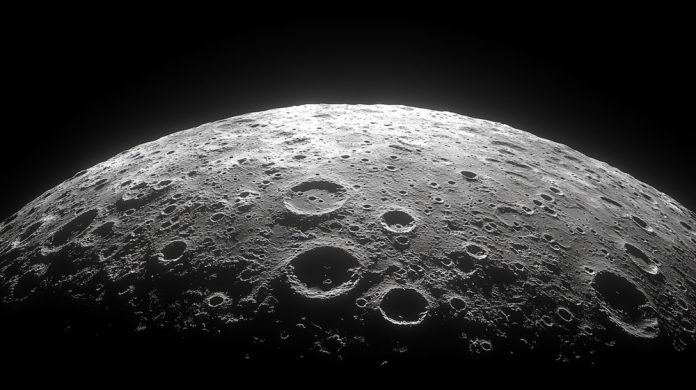
Craters in the Moon’s polar regions receive no direct sunlight, but sunlight that bounces off one side of a crater can indirectly illuminate another side. The ShadowCam, designed specifically to look only at the dark, permanently shaded areas on the Moon, is extremely sensitive to the indirect light reflected off the lunar surface.
Ando said: “Ice is generally brighter, that is, it reflects more light, than rocks. We analysed high-quality images from this sensitive camera to look really closely into these permanently shaded areas and investigate whether water ice in these regions leads to widespread brightening of the surface.”
While the ice in the shaded regions did not significantly brighten the surface, the team’s analysis of the ShadowCam images helps to refine the estimate of the amount of lunar ice that could be on the surface.
Li’s previous method suggested that the lunar surface contains 5%-30% water ice. The analysis of Shadow Cam images narrows the range, indicating that water ice makes up less than 20% of the lunar surface.
Cosmic rays help the search for buried ice
In addition to these investigations of lunar ice at the surface, another group of UH Mānoa researchers with HIGP and the Department of Physics and Astronomy recently published a study in Geophysical Research Letters that outlines an innovative approach to detect buried ice on the Moon’s poles.
“With our recent study, we showed that a new technique for detecting buried water ice on the Moon is possible using naturally-occurring cosmic rays,” explained Emily Costello, study lead author and postdoctoral researcher at HIGP.
“These ultra-high-energy cosmic rays strike the lunar surface and penetrate to the layers below. The rays emit radar waves that bounce off buried ice and rock layers, which we can use to infer what’s below the surface.”
The team used an advanced computer simulation that tests how radar waves travel through the lunar soil and how they encode information about possible buried layers of ice on the Moon.
“This method for searching for water ice on the Moon is brand new and really exciting,” said Christian Tai Udovicic, a co-author on the study who presented the findings at the recent Lunar and Planetary Science Conference in Houston, Texas.
“Since it relies on high-energy physics that only a few scientists in the world are experts in, even planetary scientists who are studying ways to find lunar water ice are often surprised when they hear about this technique.”
A hub for space exploration
A team of HIGP and Physics Department researchers are working to assemble a radar instrument specifically tuned to listen for these signals on the Moon and hope to test the full system by early 2026.
They will look for opportunities to send it to the Moon to hopefully detect large deposits of buried water ice on the Moon for the first time.
Costello concluded: “More and more, Hawai‘i is becoming a hub for space exploration, and specifically the exploration of the Moon.
“These projects, led by UH Mānoa scientists, represent up-and-coming opportunities for students and professionals in Hawai‘i to lead and participate in the budding space industry.”